About Naemorhedus goral (Hardwicke, 1825)
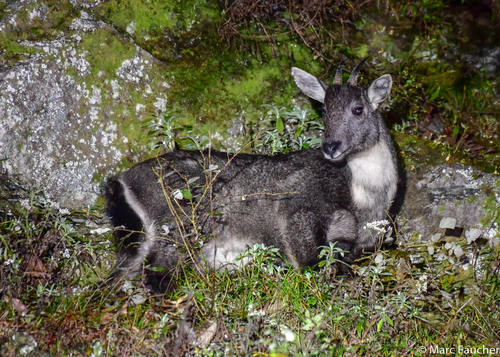
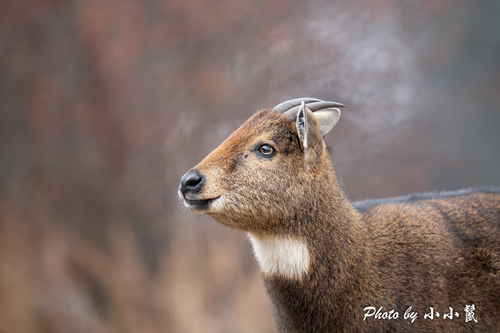
Characteristics: The Himalayan goral (scientific name Naemorhedus goral) measures 95 to 130 cm (37 to 51 in) in length and weighs 35–42 kg (77–93 lb). It has a gray or gray-brown coat, with tan legs, lighter throat patches, and a single dark stripe running along its spine. Males have short manes on their necks. Both males and females have backward-curving horns that can grow up to 18 cm (7.1 in) long. Aside from specific unique skull shape features, gorals are mainly distinguished from their close relatives serows by the absence of preorbital glands below the eyes, and the absence of matching depressions in their skulls.
Distribution and habitat: The Himalayan goral is found across the Himalayas, ranging from Pakistan, Nepal, Bhutan, southern Tibet, and the Indian states of Sikkim and Arunachal Pradesh, and may extend as far as western Myanmar. It most commonly lives at elevations between 900 and 2,750 m (2,950 and 9,020 ft) above sea level, but has been recorded at 1,000 to 4,000 m (3,300 to 13,100 ft) in Pakistan. As of 2004, approximately 370 to 1017 Himalayan goral lived in Pakistan, split across seven isolated populations. The species is most likely absent from Punjab Province, Pakistan.
Behaviour and ecology: Group home ranges for Himalayan goral typically span around 40 hectares (0.40 km²). During mating season, males occupy marked territories of 22–25 hectares (0.22–0.25 km²). Himalayan goral often form small groups of four to twelve individuals, though they also may travel in pairs, or live solitarily – this is especially common for older males. The species is crepuscular, meaning it is most active during early morning and late evening. After feeding in the morning, it typically drinks and then rests on a rock ledge for the rest of the day. It feeds on leaves and other soft plant parts, with grasses making up the bulk of its diet. The Himalayan goral is very agile and can run quickly. Its coloration provides excellent camouflage, making it extremely hard to spot, and this is compounded by its habit of lying still for most of the day. Despite this, it is hunted by a range of predators, most notably the Himalayan wolf. Himalayan goral can live 14 or 15 years. Females give birth after a 170–218 day gestation period, usually to a single offspring. Young are weaned at 7 or 8 months of age, and reach sexual maturity around 3 years old.