About Naematelia encephala (Pers.) Fr.
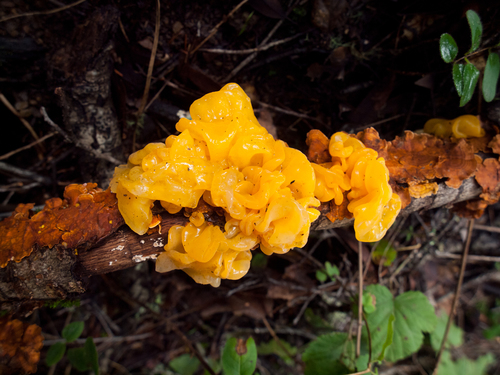
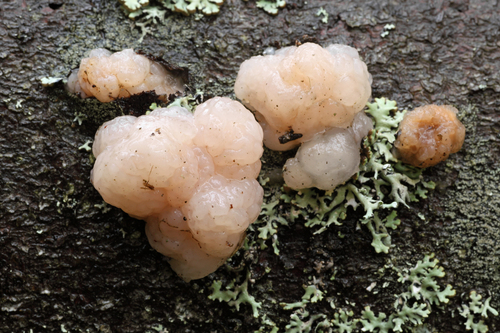
The fruit bodies of Naematelia encephala are gelatinous and colored dull pale pink to yellowish pink. They grow up to 3 cm (1 in) across, have a brain-like shape that is compact and densely folded, and reveal a hard, whitish core when cut. Microscopically, its clamped hyphae sit within a dense gelatinous matrix. Haustorial cells grow from these hyphae and produce filaments that attach to and penetrate the unclamped hyphae of the host, which are abundant in the central core. The basidia are tremelloid, meaning they are spherical to ellipsoid with oblique to vertical septa; they measure 13–20 by 12–17 μm and are usually unstalked. The basidiospores are mostly subglobose, smooth, and measure 6–11 by 5.5–9 μm, and they germinate via either a hyphal tube or yeast cells. Naematelia encephala is a parasite of Stereum sanguinolentum, growing on and often completely enveloping the host's basidiocarps. Because it follows its host, its fruit bodies are typically found on dead, attached or recently fallen branches of conifers. This species has a north temperate distribution; it is known throughout North America and Northern Eurasia, and has also been recorded from Australia.