About Naematelia aurantia (Schwein.) Burt
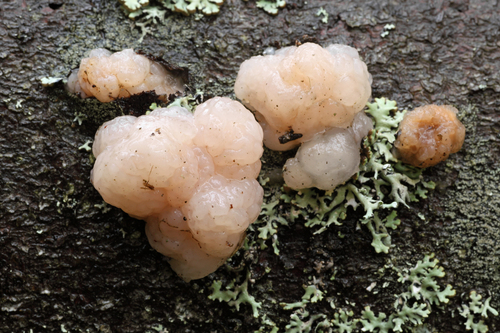
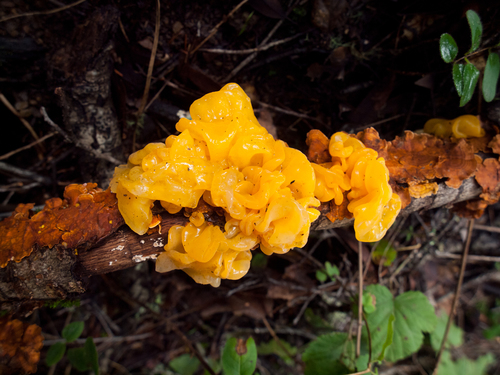
Fruit bodies of Naematelia aurantia are gelatinous, bright yellow, and can grow up to 15 cm (6 in) across. Their shape ranges from lobed to frondose, similar to seaweed. When viewed microscopically, the species' hyphae have clamp connections and are embedded within a dense gelatinous matrix. Haustorial cells grow from these hyphae, producing filaments that attach to and penetrate the unclamped hyphae of the species' host. The basidia are tremelloid, meaning they are spherical to ellipsoid with oblique to vertical septa, and measure 13–14 by 9–13 μm; they are sometimes stalked. The basidiospores are subglobose to ellipsoid, smooth, and measure 5.5–9.5 by 4.5–7.5 μm. They germinate either via a hyphal tube or by producing yeast cells. Naematelia aurantia is a parasite of the fungus Stereum hirsutum, and grows on and often completely covers the host's basidiocarps. Because it follows its host, its fruit bodies are typically found growing on dead, still attached or recently fallen branches of broadleaf trees. This species has a mainly north temperate distribution, and is known to occur across North and South America, Europe, and northern Asia.