About Nacerdes melanura (Linnaeus, 1758)
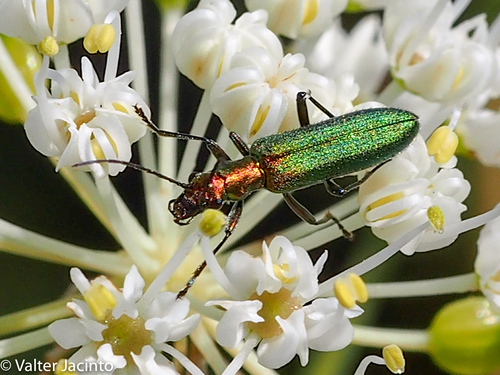
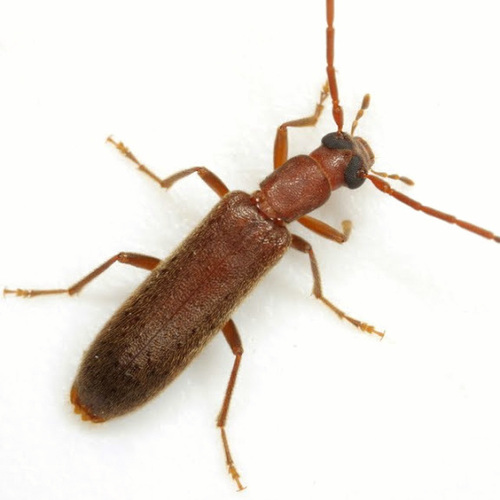
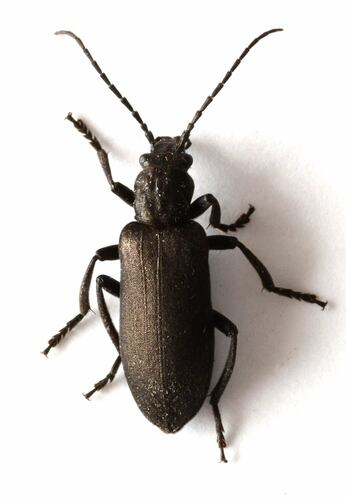
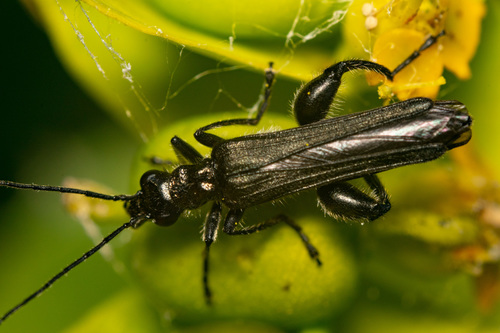
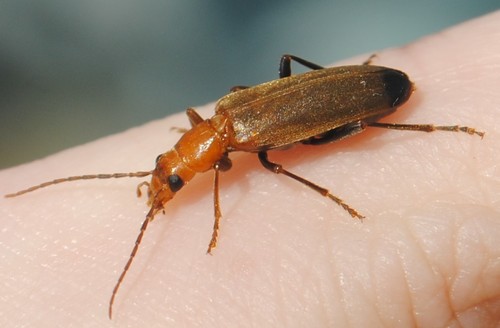
For the beetle Nacerdes melanura, commonly called the wharf borer, females lay eggs in damp, fungus-attacked decaying timber. Eggs are creamy white, slightly curved, and have tapered ends. Larvae are also creamy white, with brown mandibles, and bore into timber to feed on the wood. Adult wharf borers are 10 to 12 mm long, with yellowish to reddish-orange coloring, a long slender body, and antennae that are half the body length. Large numbers of adult beetles often emerge from under building floors, leading occupants to mistake them for cockroaches. They can be distinguished from cockroaches by a black band across the end of both elytra, and three raised longitudinal lines on each wing case — a trait shared by all beetles in the family Oedemeridae. There are seven species of this family in the UK. Wharf borers resemble soldier beetles (found on flowers) in size and form, and both groups are harmless to humans. The wharf borer is a cosmopolitan species. It lives anywhere with moist, decaying wood, such as wharf timbers regularly submerged by tidal rivers, with the River Thames as one example. A 2003 survey by Pitman et al. found the wharf borer to be widespread in temperate countries, with recorded samples from Australia, New Zealand, Japan, France, Denmark, and Canada. Pitman et al. (2003) additionally noted that wharf borers are widespread in England and Wales, with a small number of records from Scotland, and no adults or larvae have been found in Ireland. There is ongoing uncertainty in scientific literature about the species’ origin. Some sources hypothesize it is native to the Great Lakes region of North America, where it has been reported to cause extensive damage to dock timber. Other researchers argue it was introduced to the New World from Europe via the lumber trade or driftwood. Adult wharf borers may occur in a range of different habitats, but larvae are almost always restricted to damp, rotten wood. Buried pieces of wood can also harbor these insects. Populations of wharf borers reportedly increased in London after the Second World War, when large amounts of timber became buried underground following bomb blasts. The species has been found under the floors of gas stations and apartments, and also within telegraph poles. Like all beetles, the wharf borer undergoes complete metamorphosis. In the UK, development from egg to adult takes approximately 12 months, and adults typically emerge between June and late August. Eggs are laid on wood surfaces exposed to variable temperature conditions. Reported egg longevity is 5 to 11 days. After hatching, first instar larvae burrow roughly 1 cm beneath the wood surface, where soft-rot wood degradation is already present. The larval stage can last anywhere from 2 months up to 2 years. During this stage, larvae digest cellulose and hemicellulose, and produce the enzyme cellulase that allows them to feed on rotting wood, a trait similar to many other wood-boring beetles. Tunnels created by larval burrowing can reach 30 cm in length. Larvae must reach a specific head capsule size before pupation, and this size takes about 8.5 months to attain. Pupae are cream-white, and the pupal stage lasts 6 to 17 days, with duration influenced by temperature and relative humidity. At the start of pupation, the abdomen reduces in size, and the head loses its prognathous form. Eye pigmentation begins after 3 days of pupation, followed by mandible pigmentation at 6 days and elytra pigmentation at 9 days. Pupae are able to move their abdomen side to side. Adults are short-lived, non-feeding, free-living, and capable of flight, and can locate suitable wood using olfactory cues. They emerge from the pupal stage between May and September, though they are most commonly observed in June. Under laboratory conditions, adults live for 2 to 10 days, during which they mate and lay eggs. Females do not show preference for a specific substrate when choosing an oviposition site. Wharf borers are known to infest both hardwood and softwood.