About Myzus persicae (Sulzer, 1776)
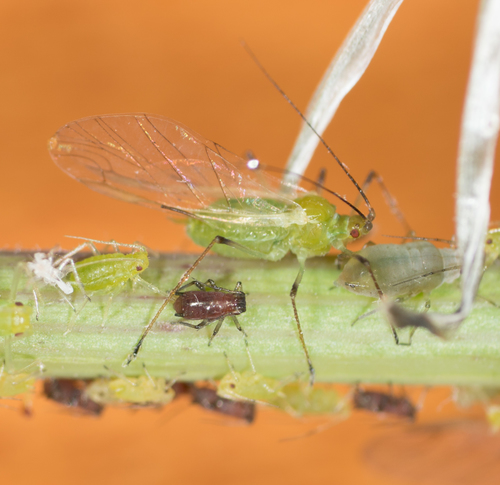
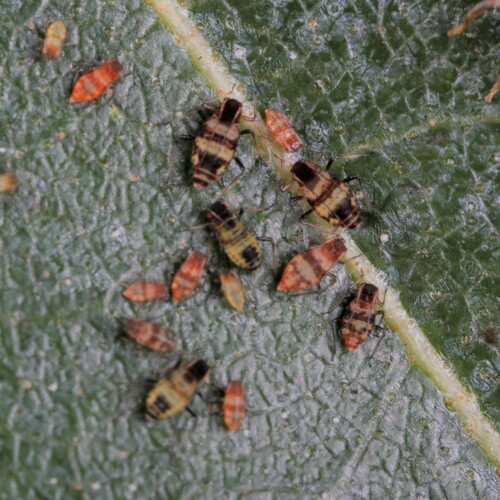
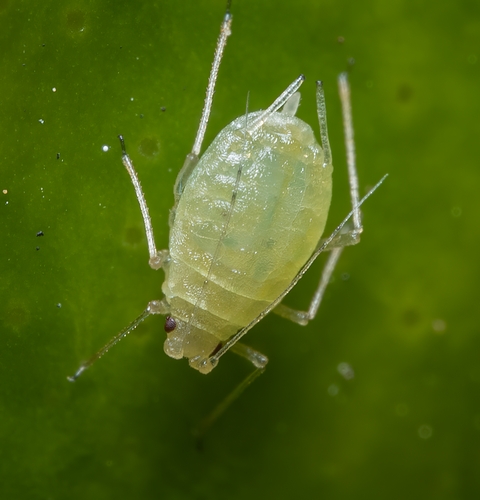
Morphology: The eggs of Myzus persicae measure about 0.6 millimetres (0.024 in) long and 0.3 millimetres (0.012 in) wide, and have an elliptical shape. Eggs are initially yellow or green, but turn black as they develop. Nymphs start out green, but quickly become yellowish and look similar to viviparous adults. Nymphs that will develop into winged females may be pinkish. Adult winged aphids have a black head and thorax, and a yellowish green abdomen with a large dark dorsal patch. They are approximately 1.8 to 2.1 millimetres (0.071 to 0.083 in) long. Wingless adult aphids are yellowish or greenish, and may have medial and lateral green strips. Their cornicles match their body colour, are moderately long, and are unevenly swollen along their length. All appendages are pale. Adult green peach aphids can be yellowish-green, red, or brown in colour, a morphological variation driven primarily by host plants, nutrition, and temperature. Key distinguishing traits for this species include convergent inner faces of the antennal tubercles when viewed from above, and slightly clavate dark-tipped siphunculi that are approximately as long as the terminal process of the antenna.
Distribution: The green peach aphid is found worldwide, but is likely originally from Asia, just like its primary host plant, Prunus persica. This species does not favour areas with extreme temperature or humidity. These aphids can be carried great distances by wind and storms, but existing studies suggest long-distance migration is uncommon for M. persicae. This means the spread of diverse genotypes across distant geographic regions is likely the result of human activity. These insects are pests of field crops, and also commonly invade greenhouses. When young plants infested by these aphids in greenhouses are transported to other locations, the aphids become widely distributed. This explains their broad distribution, their ability to survive well in areas with inclement weather, and their ease of transport on plant material. This species has been introduced into 16 countries or islands. It occurs in terrestrial habitats, and its native range is likely temperate Asia. In the European Nature Information System (EUNIS), its habitat is classified as lines of trees, small anthropogenic woodlands, recently felled woodland, early-stage woodland and coppice.
Habitat: During overwintering, this species uses tree hosts from the genus Prunus, particularly peach, peach hybrids, apricot, and plum trees, as host plants. In summer, aphids leave woody tree hosts to feed on herbaceous hosts, including vegetable crops from the families Solanaceae, Chenopodiaceae, Compositae, Brassicaceae, and Cucurbitaceae. Crops vary in their susceptibility to green peach aphid, and large aphid populations most often occur on actively growing plants or the youngest plant tissue. After aphids establish colonies, some redistribution may happen as the infestation progresses, before overcrowding masks their host preferences.
Life cycle: The life cycle of the green peach aphid changes with temperature. A full generation takes approximately 10 to 12 days, and over 20 generations per year have been recorded in mild climates. Aphids overwinter on Prunus plants. Once plants break dormancy, the eggs hatch, and nymphs feed on the flowers, young foliage, and stems of the plant. After several generations, winged individuals deposit nymphs on summer hosts. In cold climates, adults return to Prunus plants in autumn, where mating occurs and eggs are laid. All generations except the autumn generation that produces eggs are parthenogenetic (non-sexual). Females give birth to their first offspring 6–17 days after birth, with an average age of 10.8 days at first birth. The reproductive period varies, but averages 14.8 days. The average lifespan is approximately 23 days when no predators are present. The most severe damage to plants occurs in early summer, during the aphid breeding peak. This is because winged dispersants from Prunus spp. that host the overwintering egg stage deposit nymphs on summer hosts such as tobacco, potatoes, and cruciferous vegetables, and the aphids remain harmful for multiple generations after this migration.
Reproduction: The green peach aphid normally reproduces through cyclical parthenogenesis, with several generations of apomictic parthenogenesis followed by a single sexual generation. Mating occurs on the primary host, where eggs are laid and enter diapause over winter. When spring arrives, parthenogenetic females hatch from the eggs, and their descendants disperse to secondary host plants where they produce many parthenogenetic (asexual) generations. This species can use secondary host plants from 40 different families, many of which are economically important crops. Sexual morphs of this species form in autumn as day lengths shorten and temperatures drop. Some genotypes have lost the ability to reproduce sexually, and instead reproduce through parthenogenesis on secondary hosts year-round. These genotypes are called obligate parthenogens.
Food habits: Some groups of aphids feed predominantly in the parenchymal tissue of plants, while most aphid species feed on phloem sap. The green peach aphid ingests sugary fluids through a membrane. When it feeds on a plant for a long period, Myzus persicae can take up chloroplast DNA, even though the chloroplasts themselves remain uninjured. Exudation from M. persicae stylets occurs to help the aphid ingest phloem sap from plants, with assistance from pressure within the plant. On artificial diets, this species can also ingest food from a source with negligible pressure, and can even produce honeydew on certain artificial diets.