About Myzomela sanguinolenta (Latham, 1801)
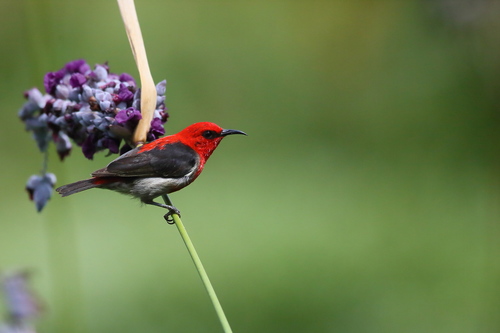
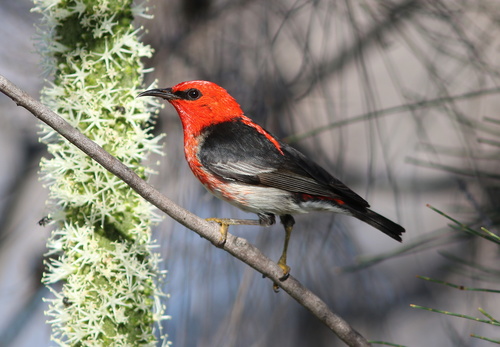
The scarlet myzomela (Myzomela sanguinolenta) is the smallest honeyeater native to Australia. It has a distinctive compact body, short tail, a relatively long down-curved black bill, and dark brown irises. This species measures between 9 and 11 cm (3.5 and 4.3 in) long, with an average wingspan of 18 cm (7.1 in) and an average weight of 8 g (0.28 oz). It has relatively long wings for its size: when the wings are folded, the longest primary feathers reach more than half the length of the tail. The scarlet myzomela exhibits sexual dimorphism, with males having much brighter colouration than females. Adult males have bright scarlet red heads, napes, and upper breasts, with a narrow black stripe running from the beak to the eye and a thin black eye-ring. Their red plumage extends as a central stripe down the back and rump. On the breast, the red becomes increasingly mottled with grey toward the grey-white belly and flanks. The sides of the breast are brown-black. The mantle and scapulars are black, the upperwing is dull black, and secondary covert feathers have white edges. The upper side of the tail is black, and the underside is dark grey. The underwing is white with a dark grey trailing edge and tip. Females have brown heads and necks, darker on the crown and lighter and greyer on the sides, with a pale grey-brown throat and chin. They sometimes have pinkish or reddish patches on the forehead, throat, and cheeks. Their upperparts are brown, and they sometimes have scarlet patches on the uppertail coverts. Their tail is blackish-brown, with yellow fringes on all rectrices except the central pair, and their wings are blackish-brown. Females have a yellowish or brownish base to their otherwise black bill. Moulting occurs over the Australian spring and summer. Young birds leave the nest with juvenile plumage; they resemble females but have more reddish-brown upperparts, and light brown rumps and uppertail coverts. After moulting out of juvenile plumage, immature males develop patches of red feathers growing through their original brown juvenile plumage. Immature females are very difficult to distinguish from juveniles or adult females. Both sexes gain full adult plumage after two moults. It is not known if plumage changes with additional moults after the scarlet myzomela reaches adulthood. The scarlet myzomela is more commonly heard than seen, and it has a wider variety of call notes than most other honeyeaters. Males are more vocal than females. The main call is a tuneful tinkling call, made up of sets of six notes that rise or fall in tone; it has been compared to the sound of cork rubbed on glass. Females chirp while hopping around, when meeting and interacting with males, and can also produce a squeaking call. Both sexes make a short chiew-chiew contact call. In eastern Cape York Peninsula, northern Queensland, where their ranges overlap, males may be confused with the similar-looking red-headed myzomela. However, the red colouration of the red-headed myzomela is restricted to the head and sharply demarcated, and this species lives in mangroves rather than woodlands. The dusky myzomela resembles the female scarlet myzomela, but it is larger with a longer bill and tail, has much darker brown plumage, and lacks the pink tinge on the face and throat. The scarlet myzomela is distributed along Australia's east coast, from Cooktown in Far North Queensland south to Mitchell River National Park in Gippsland, Victoria. It is rarer south of the Hacking River in New South Wales. Its range extends inland to Charters Towers, Carnarvon Gorge, and Inglewood in Queensland, and to the Warrumbungles in New South Wales. It is a rare vagrant to Melbourne. The movements of this species are not well understood, but it appears to be migratory in the southern part of its range and more sedentary in the north. Populations move north along part of the Australian east coast for winter. Nomadic population movements also occur, generally following the flowering of the scarlet myzomela's preferred food plants. Population numbers have been recorded fluctuating in some areas, with local movements linked to the flowering of preferred food plants. Local irruptions have been recorded in Sydney in 1902 during a drought, 1981 and 1991 in northwestern Sydney, and 1994 centered on the Lane Cove River valley; in Nowra in 1980; across southern Victoria in 1985; and in the Eurobodalla district in 1991 and 1993. An 18-year field study in Mangerton found that scarlet myzomelas arrived in the area in early spring (August) and left by November, and were completely absent in three separate years. The maximum recorded age from banding is just over 10 years, for a bird caught south of Mount Cotton in Queensland. The scarlet myzomela inhabits dry sclerophyll forest and woodland, generally dominated by eucalypts with little understory. They are found alone, in pairs, or in small groups, and sometimes join other honeyeaters in the canopy of flowering trees.