About Myzomela rubratra (R.Lesson, 1827)
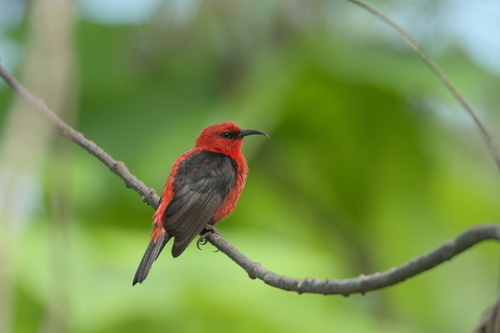
The Micronesian myzomela, with the scientific name Myzomela rubratra (R.Lesson, 1827), is a bird species belonging to the honeyeater family Meliphagidae. This species forms a superspecies with multiple related, similar-looking myzomelas that live on islands and mainland areas across the Pacific and Australasia. It is currently divided into seven insular subspecies. Its distribution covers the Northern Mariana Islands, including Rota, Tinian and Saipan, and the Caroline Islands, including Yap, Chuuk, Pohnpei, Kosrae, and Palau. The Marianas subspecies Myzomela rubrata saffordi has been extirpated from Guam since 1986. Across its entire distribution, the Micronesian myzomela uses a variety of both natural and human-created habitats, ranging from sea level to the highest peaks in the region. However, because Micronesia has very few mountains, this species is primarily found in lowland areas. Habitats it occupies include forests, mangroves, scrubland, secondary scrub, savanna, as well as agricultural lands, plantations and urban areas. The Micronesian myzomela feeds mainly on nectar, but it also eats insects and other small invertebrates. One study estimated that the ratio of nectar to insects in its diet is 60:40. The species can be found alone or in pairs; occasionally, small groups will gather at plentiful nectar sources. They are territorial and act aggressively to defend their territories from other members of their own species, as well as from other species such as bridled white-eyes. This species is an important pollinator within its native range; after it was extirpated from Guam, the island lost this pollinator, leading to negative adverse effects on the local ecosystem.