About Myzomela obscura Gould, 1843
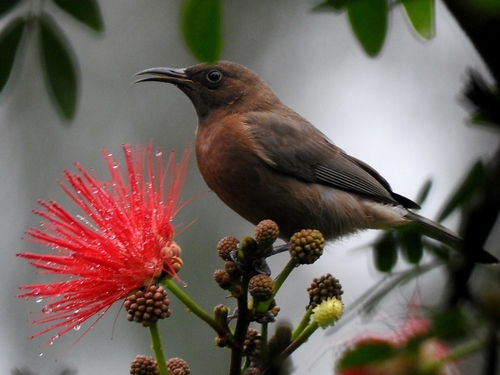
The dusky myzomela, also called the dusky honeyeater, has the scientific name Myzomela obscura. It is a small brown bird, and is a common resident of the Aru Islands, southern New Guinea, and northern and eastern Australia. Within Australia, there are two separated populations: one in the Top End, and another extending from Cape York Peninsula along the east coast as far south as the border of New South Wales. This species is rare in areas south of Rockhampton. The Moluccan myzomela (M. simplex), red-tinged myzomela (M. rubrotincta), and Biak myzomela (M. rubrobrunnea) were formerly considered the same species as the dusky myzomela. In 2021, the International Ornithological Congress split these three groups into their own distinct species. Dusky myzomelas measure around 12 to 15 cm (5 to 6 inches) in length. While they are dull in colour, they are active and fast-moving. They often hover to capture insects or take nectar from flowers in the upper forest storey. They live in a wide range of habitat types, including monsoonal forests, scrubs, woodlands, swamps, and almost any area located near water. Dusky myzomelas are typically sedentary in habitats they find sufficiently attractive, and are nomadic or migratory in less attractive districts, particularly in the southern part of their range. Breeding occurs during the dry season, which typically runs from March to September. The dusky myzomela usually builds a small, neat cup-shaped nest from fine bark, spiderwebs, and leaves. The nest is placed on a well-hidden branch located high over water. Its eggs are white with fine reddish spots.