About Myzomela erythrocephala Gould, 1840
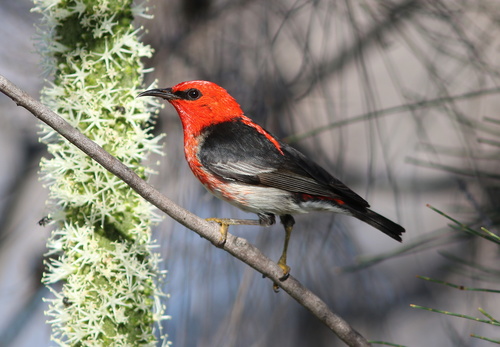
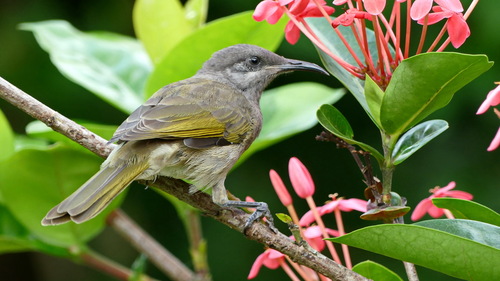
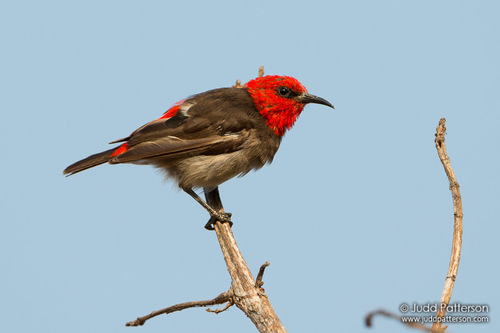
The red-headed myzomela (Myzomela erythrocephala Gould, 1840) is a distinctively marked small honeyeater with a compact body, short tail, and a relatively long down-curved bill. On average, this species measures 12 centimetres (4.7 in) long, with a wingspan of 17–19 cm (6.7–7.5 in) and a weight of 8 grams (0.28 oz). It displays sexual dimorphism: males are slightly larger and far more brightly colored than females. The adult male of the nominate subspecies has glossy, light-reflecting dark red plumage on its head, neck, and rump. The rest of its upper body is blackish-brown, while its upper breast and underbody are light brownish-grey. The red head plumage is sharply separated from the brown body plumage, creating the appearance of a red hood. The bill is black or blackish-brown, and the gape is either black or yellowish. A distinct black loral stripe extends to form a narrow eye ring, and the iris is dark brown. The adult female has grey-brown head and neck plumage, with a pink-red tint on the forehead and chin. The rest of the female's upper body is grey-brown, with darker shades on the wings and lighter shades on the breast and underparts, and the gape is yellow. One study has linked female bill color to breeding status: females with horn-coloured (grey) bills also have well-developed brood patches. Juveniles resemble females, but have a clear pale yellow edge on the lower mandible. They have no red plumage when young, and begin growing red feathers on their face around one month after hatching. Males retain their juvenile plumage for up to three months, and take a similar length of time to develop full adult coloration. The subspecies M. e. infuscata is similar in appearance to the nominate subspecies, but has red plumage extending from the rump onto the back, a darker grey belly, and is slightly larger overall. The red-headed myzomela produces a range of contact calls and songs, which are mostly metallic or scratchy in quality. Its song is an abrupt tchwip-tchwip-tchwip-tchwip; it also has a slightly softer swip-swip-swip-swip contact call, and a scolding charrk-charrk. The red-headed myzomela closely resembles the scarlet myzomela, though their ranges only overlap a small amount in eastern Cape York Peninsula; unlike the red-headed myzomela, the scarlet myzomela lives in woodlands rather than mangroves. The female red-headed myzomela resembles the dusky myzomela, but the dusky myzomela is larger and darker brown, and lacks red markings around the bill. The Sumba myzomela is similar to the red-headed myzomela, but is slightly smaller, has darker upper body parts, and has a broad black pectoral band. The nominate subspecies of the red-headed myzomela is found across the tropical coastlines of Western Australia, the Northern Territory, and Queensland. In Western Australia, it inhabits coastal areas of the Kimberley and various offshore islands; it is distributed similarly in the Northern Territory, including Melville Island and the Sir Edward Pellew Group of Islands. It is widespread around the coast of the Gulf of Carpentaria and across Cape York Peninsula. M. e. infuscata occurs at scattered sites in West Papua, south Papua New Guinea (from Mimika Regency in the west to the Fly River in the east), and the Aru Islands. Some birds from Cape York have features that are intermediate between the two subspecies. Although the red-headed myzomela has a wide distribution, it is not abundant across its range. The largest recorded population density was 5.5 birds per hectare (2.2 per acre) at Palmerston in the Northern Territory. The peak abundance of this species in mangroves around Darwin Harbour during the mid-dry and early wet season coincided with both the production of young and the flowering of the yellow mangrove (Ceriops australis). The movements of this species are poorly understood; it has variously been described as resident, nomadic, or migratory. Population numbers fluctuate in some areas, and local movements may be linked to the flowering of preferred mangrove and Melaleuca food trees, with some indication that the birds can travel longer distances. One banded bird was recaptured nearly five years after marking, 27 kilometres (17 mi) from its original banding site. The species' presence on many offshore islands suggests the red-headed myzomela can successfully cross water over long distances. The maximum recorded age from banding is 7 years and 1.5 months. The red-headed myzomela mostly lives in mangroves of monsoonal coastal areas, especially thickets of spotted mangrove (Rhizophora stylosa), smallflower bruguiera (Bruguiera parviflora), and grey mangrove (Avicennia marina) that border islands or grow in river deltas. It is also often found in paperbark thickets that fringe mangroves, such as stands of cajeput (Melaleuca leucadendra). It is considered a mangrove specialist; this adaptation likely developed as northern Australia became more arid, and bird populations became dependent on mangroves after other forest types disappeared. Mangroves provide the species with nectar, insects, shelter, and nesting sites, and supply most of the species' needs for most of the year. In Australia, mangrove vegetation forms a narrow, discontinuous strip along thousands of kilometres of coastline, which supports birds specialized to this habitat. Eighty Mile Beach in Western Australia has no mangroves and no fringing Melaleuca forests, making it unsuitable for colonization by this nectar-feeding bird, and it marks the southern limit of the red-headed myzomela in Western Australia. The red-headed myzomela is occasionally found in swampy woodlands, casuarina woodlands, open forest (particularly those with Pandanus and paperbarks), and on coconut farms.