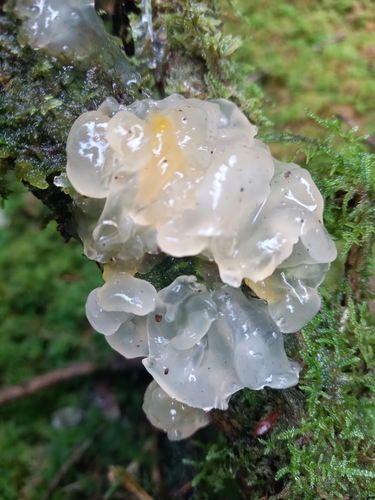
About Myxarium nucleatum Wallr.
Myxarium nucleatum produces scattered, pustular, gelatinous fruit bodies that measure 2 to 20 millimetres (1⁄8 to 3⁄4 inch) in diameter. These fruit bodies often grow together to form larger compound structures, which may be irregularly brain-like (cerebriform) and reach up to 6 centimetres (2+1⁄4 inches) across. Fruit bodies range from colourless (hyaline) to whitish, and occasionally show yellowish tints. Naked-eye visible opaque, white, spherical mineral inclusions made of calcium oxalate are present in the fruit bodies. The spore-bearing hymenium surface is smooth. As fruit bodies age, they may turn brownish and eventually dry into a thin, varnish-like film, and this species produces a white spore print.
Myxarium nucleatum typically produces fruit bodies in autumn and winter. In its current broad classification, the species is distributed across Europe, North America, Central America, South America, and New Zealand. It is often found growing in association with old pyrenomycetes, and is presumed to be a wood-rotting species that typically grows on dead attached or fallen branches. It was first documented growing on hawthorn, but is also known to occur on many other broadleaf trees and shrubs, including beech, ash, sycamore, and ivy.
In Europe, the fruit bodies of Myxarium nucleatum can act as a host for the parasitic fungus Zygogloea gemellipara. This parasite has auricularioid basidia, which are more or less cylindrical basidia with lateral septa. It forms thin thread-like hyphae within the hymenium of its host, and the parasite's hyphae attach to the host's hyphae via twisting, tendril-like haustorial cells.

