About Mytilus galloprovincialis Lamarck, 1819
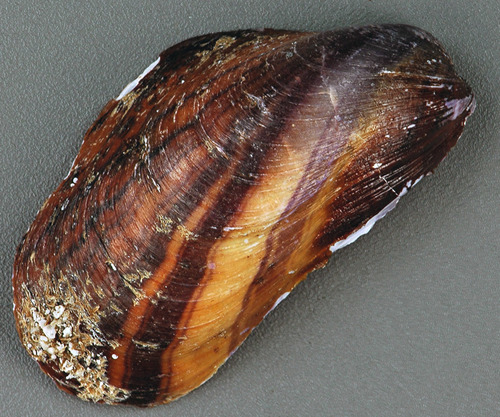
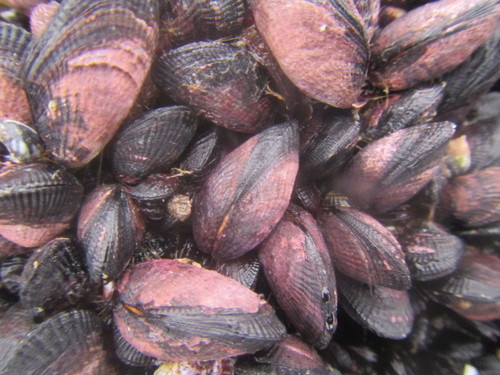
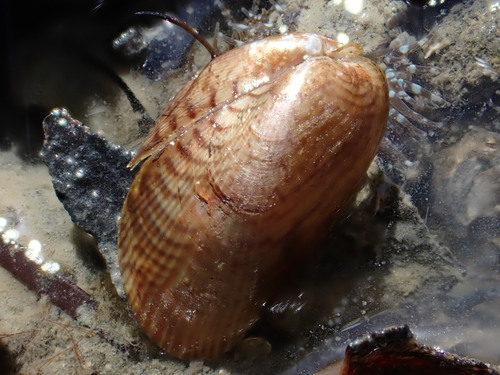
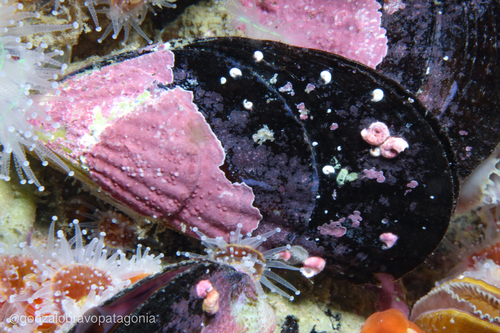
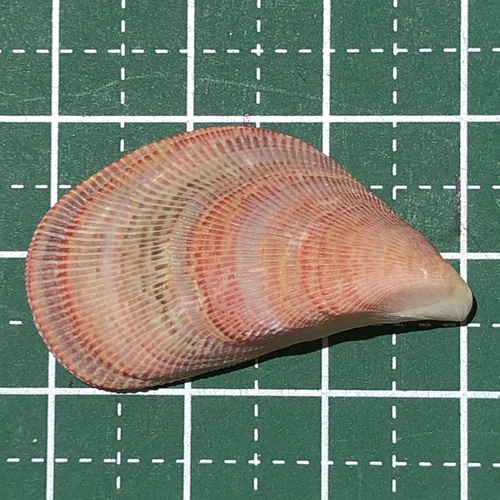
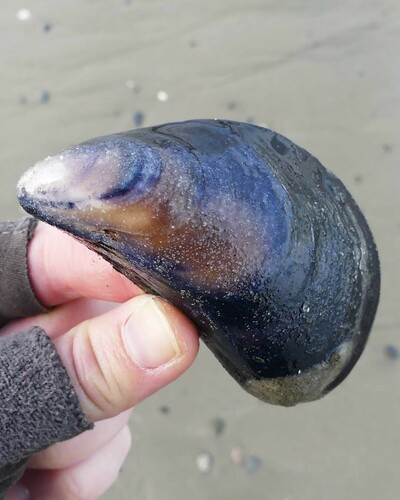
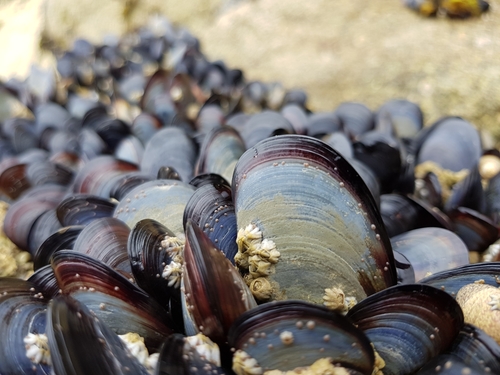
Mytilus galloprovincialis, the Mediterranean mussel, grows to a maximum length of 140 mm. It has a smooth shell, with a slightly broader base than the related black mussel Choromytilus meridionalis, a species it is often confused with in South Africa. Its shell is typically blue-violet or black, but can also shade to light brown. In Europe, this species is native to the Mediterranean Sea and Black Sea, and occurs along Atlantic coasts from Portugal north through France, the British Isles, and into Norway. It has recently been recorded in the European Arctic, including northern Norway and Svalbard. In the northern Pacific, it was introduced to the California coast from Europe via human activity in the early 20th century, and it is also found in the Puget Sound region of Washington state, where it is used for aquaculture. It exists as an invasive species on the Asian coast, across Japan including the Ryukyu Islands, in North Korea, and around Vladivostok in Russia. Native genetic lineages of Mytilus galloprovincialis occur in parts of the Southern Hemisphere, with additional populations introduced from the Northern Hemisphere through recent human activity; these distinct lineages can be told apart by their genetic characteristics. No original native populations of this mussel existed in southern Africa, but it was introduced from Europe in 1984, and is now the dominant mussel species in the low intertidal zone along South Africa’s West Coast. Its distribution in the region extends from the Namibian border to Port Alfred, spanning from the intertidal zone to just below the low tide boundary. This species is also found in New Zealand, Australia, and South America. The Mediterranean mussel is a filter feeder. In South Africa, it is rare in subtidal zones, which provides another way to distinguish it from the black mussel Choromytilus meridionalis. Mussel species are generally used as bioindicators for the entire ecosystem they inhabit. The immune system of bivalve molluscs is commonly selected as a target parameter to assess the health of both the species and their surrounding environment. In the Adriatic Sea, Mytilus galloprovincialis and the clam Chamelea gallina show similar annual variations in cytotoxic activity. Exertions from the hemolymph of Mytilus galloprovincialis are considered a useful biomarker for immune activity, and thus for overall mussel health. The immune systems of both Chamelea gallina and Mytilus galloprovincialis are affected by changing environmental parameters, including water acidification, rising temperatures, and changes in seawater salinity. These parameters reflect the typical conditions associated with global climate change, so bivalve molluscs are considered predictors of climate change’s future impact on the health of both wild and farmed aquatic organisms. Multiple combined stressors, including hyposalinity and heat shock, can significantly alter the metabolic rate, antioxidant enzyme activity, and feeding rate of Mytilus galloprovincialis. This suggests these mussels may face energy limitation when exposed to combined environmental stress.