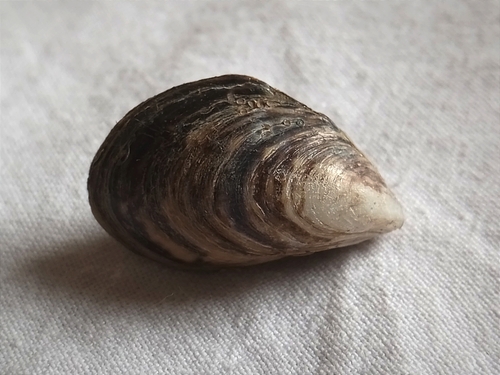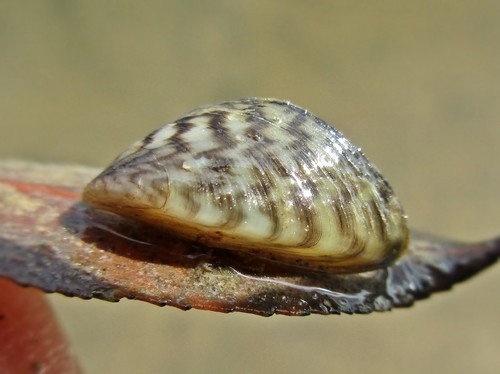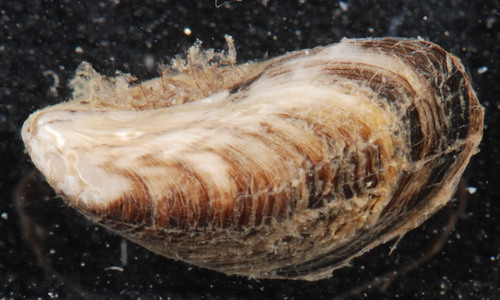
About Mytilopsis leucophaeata (Conrad, 1831)
Mytilopsis leucophaeata is visually very similar to the zebra mussel, and shares similar shell striping. It can be distinguished from the zebra mussel by an apophysis (a small projection) on the inner surface of its shell, located near the umbo. Adult shell length ranges between less than 1 cm and 2 cm, with an average length of 1 cm. This species is native to the Gulf of Mexico. It first spread from its native range via ship ballast water, or by attaching to moved oysters, reaching the Hudson River in the 1930s. From the Hudson River, it spread further to other eastern US estuaries including Chesapeake Bay, and to the Pernambuco coast of northeastern Brazil. It also spread via ballast water to brackish waters across Europe, including the Baltic Sea, North Sea, Atlantic Ocean, Mediterranean Sea, Black Sea, and Caspian Sea. Like the zebra mussel, Mytilopsis leucophaeata is a significant biofouling pest in many countries, particularly in the regions where it has been introduced in Europe. This species lives exclusively in brackish water, at salinities ranging from 0.5 psu to approximately 12 psu, though it most commonly occurs at upper salinity limits between 5 and 6 psu. It attaches itself to hard substrates, including oyster and true mussel shells, oyster and mussel farming cages, rocks, boats, pilings, and ropes.