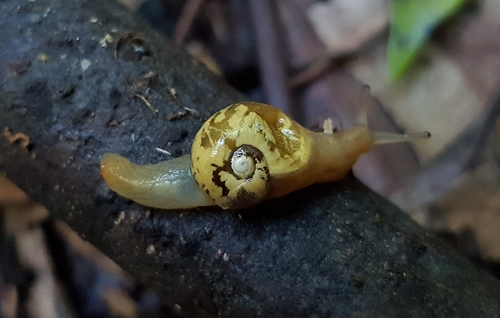
About Mysticarion porrectus (Iredale, 1941)
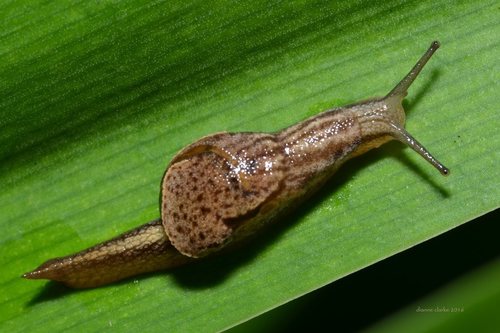
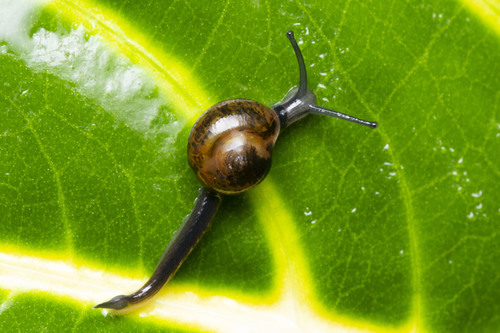
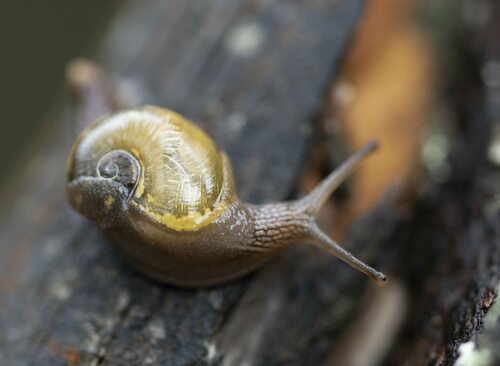
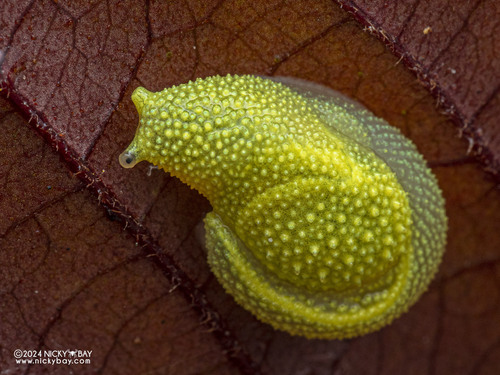
Mysticarion porrectus is a species of semi-slug gastropod mollusc in the family Helicarionidae. The shell of this snail species is very thin and transparent, allowing its brightly coloured internal organs to be visible through the shell. The snail has a gland at the end of its tail, which is thought to release pheromones during courtship. The shell of this Mysticarion species is too small for the snail's soft body parts to fully retract into it. As a semi-slug, evolution has reduced the size and thickness of its shell, which now only provides some protection for the snail's visceral organs. This process of shell reduction has evolved independently across many different gastropod families. In some families including Athoracophoridae, Cystopeltidae and Limacidae, the shell has either disappeared entirely or reduced so much that it only exists as a small internal plate; these animals are called slugs, which are snails that have lost their external shell over evolutionary time. One hypothesis for shell reduction in some families is limited calcium carbonate availability in local rocks or soil, as this mineral is required for snails to build their shells. Within the Helicarionidae family, shell forms span nearly the full range of reduction: from species with large, fully developed shells that the entire body can withdraw into, to species with very reduced ear-shaped or plate-like shells that are partially or almost fully internal, and sit on the snail's back like a saddle. The Helicarionidae family is considered a Gondwanan group, because it is mainly limited to regions of the Southern Hemisphere and Southeast Asia, including Oceania and South Africa. In Australia, most helicarionids live along the eastern coast and mountain ranges, especially in the Border Ranges and Wet Tropics bioregions. A small number of species are found in South Australia, one species lives in the high-rainfall area of south-western Western Australia, and two species occur in the Kimberley region. Mysticarion porrectus is believed to be a herbivore that scrapes biofilms such as algae and sooty mould from the surface of living leaves. The snail frequently rests on the leaves of shrubs and saplings, as well as on the trunks of larger trees. It typically rests on its side, with the tip of its tail curved backwards. The tail region can act as a suction cup, and because the snail rests on leaves, it can be accidentally carried by other animals, cars, or humans that brush against the foliage it rests on. Most arboreal snails produce very sticky mucus, and this hitchhiking ability may explain why some smaller arboreal snail species have very large distributions, as the snails can easily travel on the feet or legs of birds or bats.