About Myrrhis odorata (L.) Scop.
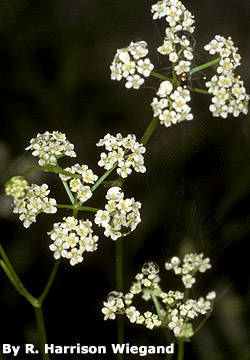
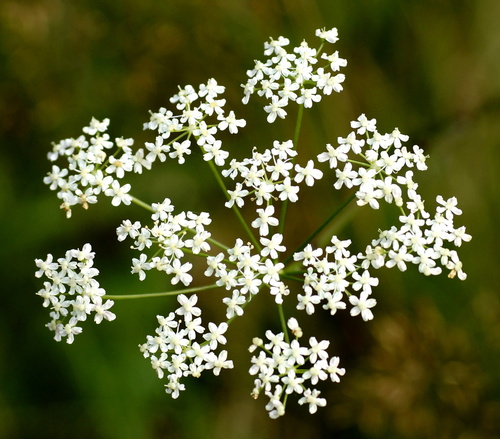
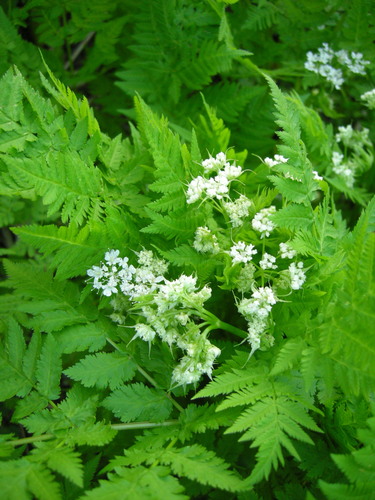
Myrrhis odorata (L.) Scop. is a tall herbaceous perennial plant that reaches 2 metres (6+1⁄2 ft) in height and 1 m (3+1⁄2 ft) in width. Its leaves are fern-like, 2–4-pinnate, finely divided and feathery, growing up to 50 centimetres (20 in) long, with whitish patches near the rachis. The entire plant is covered in soft hairs, and releases a strong aniseed scent when crushed. The small creamy-white flowers are around 2–4 mm across, borne in large umbels, and flowering occurs from May to June. The fruits are slender and dark brown, measuring 15–25 mm long and 3–4 mm broad.
This species is native to mountain regions of southern and central Europe, ranging from the Pyrenees to the Caucasus. It has been introduced and become naturalized in other locations, growing in cultivated areas, woodland margins, roadside verges, river banks and grassland. In the British Isles, it is most abundant in northern England and eastern Scotland.
In fertile soils, Myrrhis odorata grows easily from seed, and can also be propagated by division in spring or autumn. Its leaves are sometimes used as an herb, eaten raw or cooked, with a strong or sweet anise-like taste. The roots and seeds are also edible: roots are cooked like parsnips, and seeds are chewed raw. It has a long history of use as a medicinal herb. Similar to its relatives anise, fennel, and caraway, it can be used to flavour akvavit. Its essential oils are mostly composed of anethole.