About Myrmotherula axillaris (Vieillot, 1817)
The white-flanked antwren (Myrmotherula axillaris) is 9 to 10.5 cm (3.5 to 4.1 in) long and weighs 5 to 10.6 g (0.18 to 0.37 oz), with weight variation between its subspecies. It is a smallish bird with a short tail.
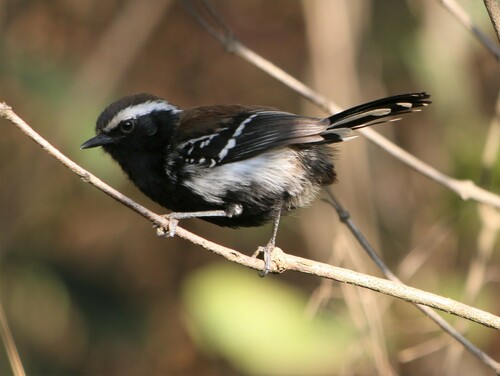
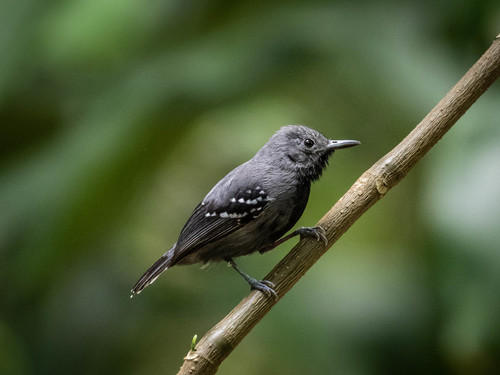
Adult males of the nominate subspecies M. a. axillaris have a dark gray head, neck, back, and rump, with a hidden white patch between the shoulders. Their tail is blackish with white-tipped feathers. Their wings are blackish with white tips on the coverts and gray edges on the flight feathers. Their throat, breast, and belly center are black, their flanks are the eponymous white, and their crissum is gray with black and white feather tips.
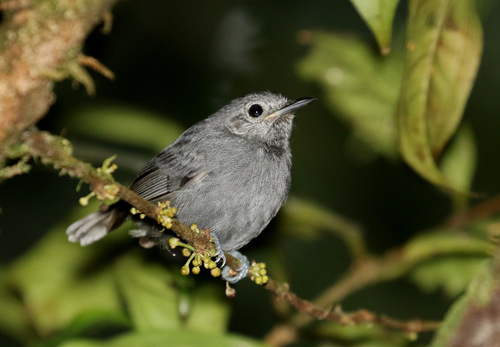
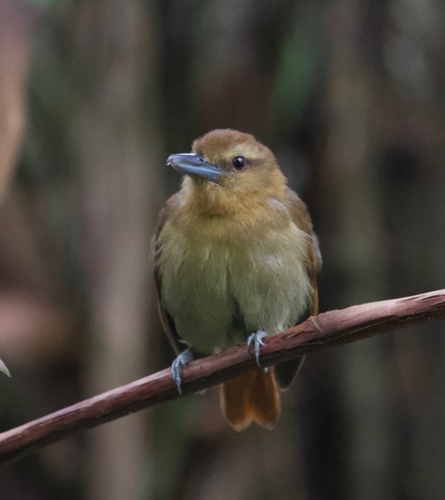
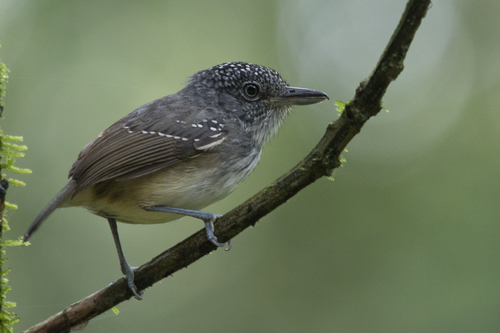
Adult females of the nominate subspecies have a mottled pale olive-brown face. Their upperparts are olive-brown, turning reddish yellow-brown on the rump. Their tail feathers are dark brown with light cinnamon-rufous edges. Their wings are dark brown with cinnamon edges on the coverts and light cinnamon-rufous edges on the flight feathers. Their throat and flanks are white, their breast and belly are rich buff, their sides are olive-brown, and their crissum is reddish brown.
Juvenile males resemble adult females, but have mixed yellow-brown and gray upperparts and wings, and mixed white and gray underparts.
The four additional subspecies differ from the nominate subspecies and from each other as follows: M. a. albigula: males are blacker than the nominate (with variation between individuals) and have wide white edges on the scapulars; females have grayer upperparts than the nominate, pale buff tips on wing coverts, paler underparts, and a buff crissum. M. a. melaena: males resemble M. a. albigula males; females resemble nominate females but are paler. M. a. heterozyga: males are slightly paler than the nominate with less extensive black underparts; females are paler and less rufescent than the nominate and have buff tips on the flight feathers. M. a. fresnayana resembles M. a. heterozyga.
The white-flanked antwren ranges from Honduras to central South America. The subspecies are distributed as follows: M. a. albigula occurs on the Caribbean slope of Central America from Honduras south through Nicaragua, Costa Rica, and Panama into northern Colombia, and on the Pacific slope from Panamá and Darién provinces of Panama south through western Colombia into Ecuador as far as Azuay Province; there is also a single record from Chiapas, Mexico. M. a. melaena occurs in Colombia's isolated Sierra Nevada de Santa Marta, and from Colombia east of the Andes and western Venezuela south through eastern Ecuador into northeastern Peru, and east in Brazil north of the Amazon to the Rio Negro. M. a. heterozyga occurs from east-central Peru's departments of Ucayali and Madre de Dios east into Brazil south of the Amazon to the Rio Madeira. M. a. axillaris occurs in Trinidad, and from eastern Venezuela south through western Brazil into northern Bolivia, and east through the Guianas and across much of northern Amazonian Brazil. M. a. fresnayana occurs in far southeastern Peru's Department of Puno and in northwestern and central Bolivia.
The white-flanked antwren inhabits the understorey and mid-storey of evergreen forest, including terra firme, várzea, igapó, and transitional forest types. It also occurs in secondary woodland. Some populations specialize in particular microhabitats within these forest types: for example, in part of its Brazilian range M. a. axillaris favors stands of Guadua bamboo, while in other parts it apparently shuns bamboo stands. Overall, the species occurs from sea level to about 1,100 m (3,600 ft), and locally up to 1,400 m (4,600 ft). It reaches only 450 m (1,500 ft) in Honduras, 900 m (3,000 ft) in Costa Rica, 1,000 m (3,300 ft) in Colombia, 900 m (3,000 ft) in Ecuador, and is found mostly below 1,100 m (3,600 ft) in Brazil.