About Myrmorchilus strigilatus (Wied-Neuwied, 1831)
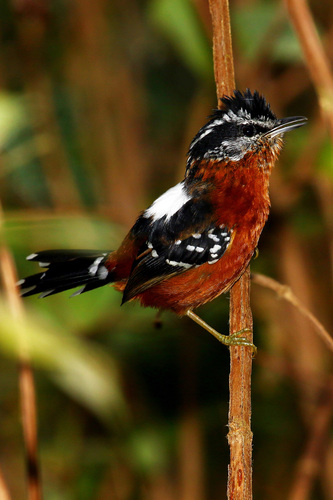
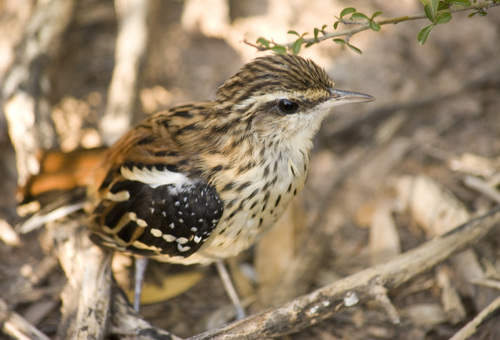
The stripe-backed antbird, with the scientific name Myrmorchilus strigilatus (Wied-Neuwied, 1831), measures 15 to 16 cm (5.9 to 6.3 in) in length and weighs 23 to 26 g (0.81 to 0.92 oz). For the nominate subspecies, adult males have a buffy face marked by a white supercilium and a dark line running through the eye. Their crown, neck, and back are rufous with black streaks, while their rump and uppertail coverts are plain rufous. Their central tail feathers are rufous, and the outer tail feathers are black with white outer edges and tips. Their wings are black, with rufous coloring on the edges of the flight feathers; their wing coverts are black with white tips. Their throat and breast are black. The rest of their underparts are white, with black spots on the sides and flanks, and a buff tinge on the crissum. Adult females of the nominate subspecies have a buff throat, breast, and belly, with darker streaks on the sides and breast. Males of the subspecies M. s. suspicax have a buff supercilium, flanks, and crissum. Females of M. s. suspicax have a brownish supercilium, and deeper buff flanks and crissum than the nominate subspecies. The stripe-backed antbird has a disjunct distribution. The nominate subspecies occurs in northeastern Brazil, in an area roughly bounded by eastern Piauí, Rio Grande do Norte, and northern Minas Gerais. Subspecies M. s. suspicax is found in western Mato Grosso and Mato Grosso do Sul states of Brazil, southeastern Bolivia, western Paraguay, and northern Argentina as far south as Santa Fe Province. The nominate subspecies primarily lives in caatinga woodlands and scrublands. Subspecies M. s. suspicax primarily inhabits the woodlands and scrublands of the Gran Chaco. In both of these ecozones, the species favors areas with dense ground cover. Its elevation range extends up to approximately 1,100 m (3,600 ft).