About Myrmoborus myotherinus (Spix, 1825)
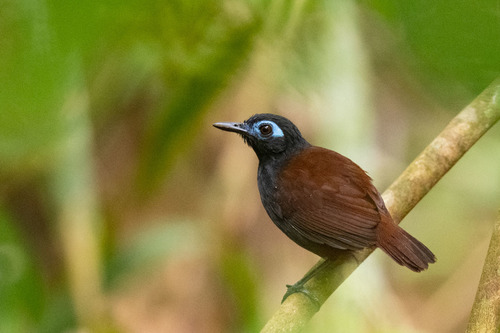
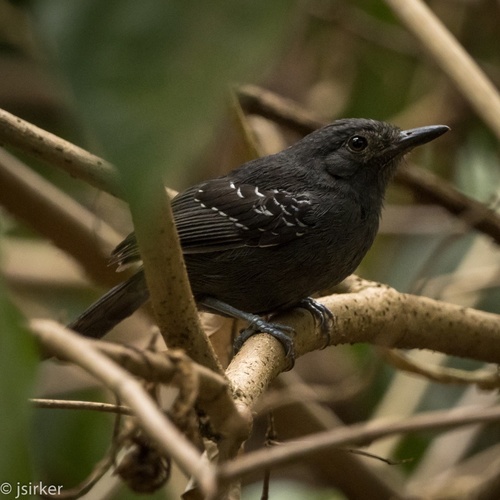
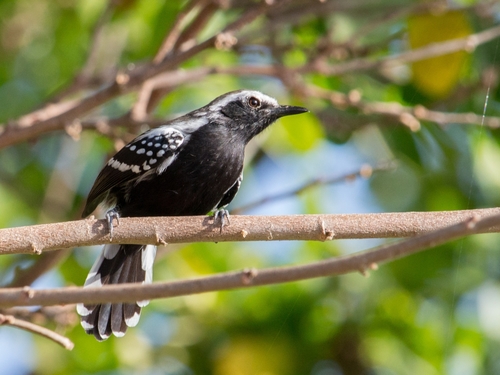
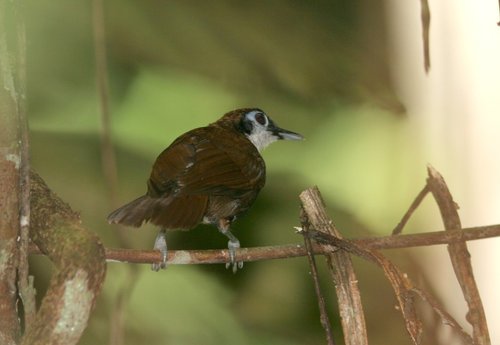
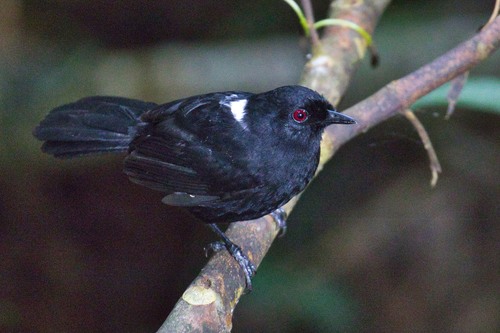
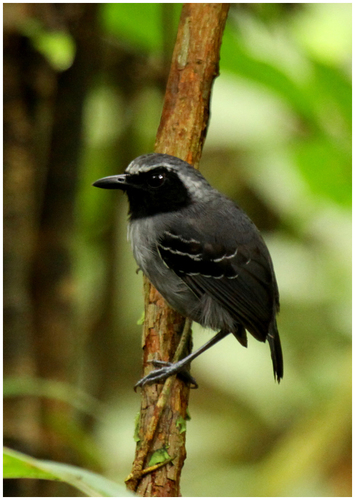
The black-faced antbird (scientific name Myrmoborus myotherinus (Spix, 1825)) is 12 to 13.5 cm (4.7 to 5.3 in) long and weighs 16 to 22 g (0.56 to 0.78 oz). Adult males of the nominate subspecies M. m. myotherinus have a dark bluish gray crown, nape, and upperparts, with a small white patch between their scapulars. Their wings and tail are slightly darker gray, with white tips on the wing coverts. Their face is mostly black with a pale supercilium. Their throat is black, and the rest of their underparts are pale gray, with slightly darker sides, flanks, and crissum. Adult females have a dark grayish olive-brown crown, nape, and upperparts. Their wings and tail are also mostly dark grayish olive-brown; their wing coverts are black with pale yellowish brown tips. Their face is blackish, and their throat is white with small black spots at its lower edge. Their underparts are light buff, with an olive tinge on the sides, flanks, and crissum. Subadult males have variable amounts of brown mixed into their gray upperparts, have brownish edges on their flight feathers, and paler underparts than adult birds. Both sexes have a deep red iris. The other subspecies of the black-faced antbird differ from the nominate subspecies and from each other as follows: M. m. elegans: males are slightly paler than the nominate; females have dark olive-gray upperparts, darker yellow-buff tips on the wing coverts than the nominate, and reddish underparts with brown sides and flanks. M. m. incanus: males are similar to the nominate; females have white tips on wing coverts and white underparts with pale ochraceous to tawny-olive flanks and crissum. M. m. ardesiacus: males have slate-gray upper- and underparts; females have olive-brown upperparts that usually have a buff tinge on wing covert tips, and entire deep ochraceous underparts mixed with white. M. m. proximus: males are darker overall than the nominate; females are mostly reddish yellow-brown with few spots on the throat. M. m. ochrolaemus: males are paler than the nominate with whitish underparts; females have slaty olive upperparts, a rufous-buff supercilium and wing covert spots, and deep yellow-ochre throat and underparts with no spots on the throat. M. m. sororius: males are similar to the nominate; females have pale buff to light ochraceous brown throat and darker underparts than the nominate with a redder band across the breast and few throat spots. The black-faced antbird occurs across most of the Amazon Basin, with each subspecies occupying a distinct range. M. m. elegans is found in southern Venezuela, extreme northwestern Brazil, and from southeastern Colombia south through eastern Ecuador into central Peru, north of the Amazon and west of the Ucayali River. M. m. myotherinus is found in eastern Peru east of the Ucayali, Amazonas and Acre states in western Brazil, and northwestern Bolivia. M. m. incanus is found in Brazil north of the upper Amazon (Solimões) between the Japurá and Içá rivers. M. m. ardesiacus is found in Brazil between the Japura and Negro rivers. M. m. proximus is found in Brazil south of the Amazon between the Purus and Madeira rivers. M. m. ochrolaemus is found in Brazil south of the Amazon from the Madeira and Roosevelt rivers east to the Atlantic at Marajó Island, and south into Mato Grosso state. M. m. sororius is found in Rondônia and southeastern Amazonas states in south-central Brazil. The black-faced antbird primarily inhabits the understorey of terra firme evergreen forest. It also occurs in nearby mature secondary woodland, transitional forest, and occasionally in seasonally flooded areas. It favors dense regrowing vegetation in gaps, such as those created by fallen trees. In terms of elevation, it reaches 900 m (3,000 ft) in Brazil and Venezuela, 800 m (2,600 ft) in Colombia, and 1,250 m (4,100 ft) in Peru. In Ecuador it mostly occurs below 700 m (2,300 ft), but is found locally as high as 1,300 m (4,300 ft).