About Myrmoborus leucophrys (Tschudi, 1844)
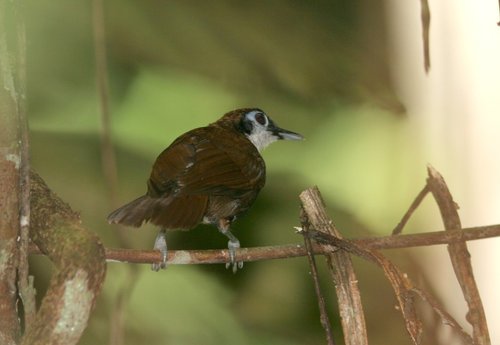
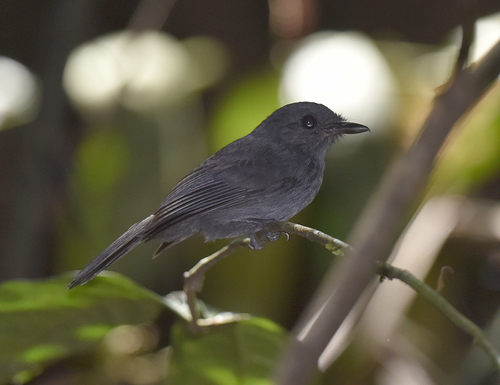
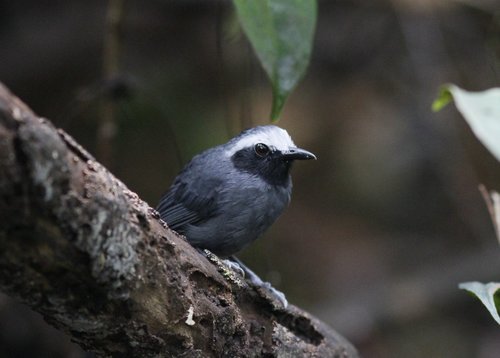
The white-browed antbird (Myrmoborus leucophrys, originally described by Tschudi in 1844) is 12 to 13.5 cm (4.7 to 5.3 in) long and weighs 18 to 22 g (0.63 to 0.78 oz). Four subspecies are recognized, each with distinct plumage traits. For the nominate subspecies M. l. leucophrys, adult males have a namesake white forehead and supercilium. The rest of their body is mostly dark bluish gray, darkest on the wings and tail and lightest on the crissum. The area of their face below the white markings, chin, and throat are black. Adult females of the nominate subspecies have a cinnamon to yellow-buff forehead and supercilium. Their crown is olive-brown with a reddish tinge, and the rest of their face is black. They have olive-brown upperparts, and dark yellowish brown wings and tail with pinkish to pale buff-brown tips on the wing coverts. Their throat and underparts are mostly white, with some blackish gray on the sides and light olive-gray flanks. Males of subspecies M. l. angustirostris are similar to nominate males but paler. Females of this subspecies have a paler supercilium than nominate females, and almost white (paler) tips on the wing coverts. Males of M. l. erythrophrys have a wider white forehead band and supercilium, and a less well-defined black throat than the nominate subspecies. Females of this subspecies have a darker and redder supercilium that contrasts very little with the crown. Males of M. l. koenigorum have an entirely white crown, and the black plumage of their throat extends onto the breast. Females of this subspecies are similar to female M. l. erythrophrys. The white-browed antbird has a disjunct distribution across the Amazon basin and Guianan Shield: it occurs in both the northern Amazon Basin/Guianan Shield and the southern Amazon Basin, but is absent from a large area of Amazonia between these two regions. The ranges of its subspecies are as follows: M. l. erythrophrys is found on the east slope of the Andes from northwestern Venezuela south into Colombia to the Putumayo River; M. l. leucophrys ranges from the Putumayo in extreme southern Colombia south along the east slope of the Andes of eastern Ecuador and eastern Peru into northeastern Bolivia, and east across much of southern Amazonian Brazil south of the Amazon River; M. l. angustirostris ranges from southern Venezuela east across the Guianas and northern Brazil north of the Amazon River to the Atlantic coast in Amapá state; M. l. koenigorum is restricted to the upper valley of the Huallaga River in Peru's Department of Huánuco. The species uses different habitats in different parts of its range. In the Amazon Basin, it typically occurs near water, occupying both várzea and transitional forests, where it favors dense shrub cover, Heliconia thickets, and sometimes bamboo. Subspecies M. l. angustirostris often occurs in similar habitat, but is also found equally often on the edges and in overgrown clearings of terra firme forest. A small portion of the M. l. angustirostris population in southern Venezuela also lives in shrubby, stunted woodlands on white-sand soils that border savanna. Along the Andean slopes, the other three subspecies use a similar mix of habitats to that of most M. l. angustirostris. The species occurs up to different maximum elevations depending on location: 400 m (1,300 ft) in Colombia, 1,100 m (3,600 ft) in Ecuador, 1,400 m (4,600 ft) in Peru, 1,000 m (3,300 ft) in Venezuela, and possibly up to 800 m (2,600 ft) in Brazil.