About Myrmica rubra (Linnaeus, 1758)
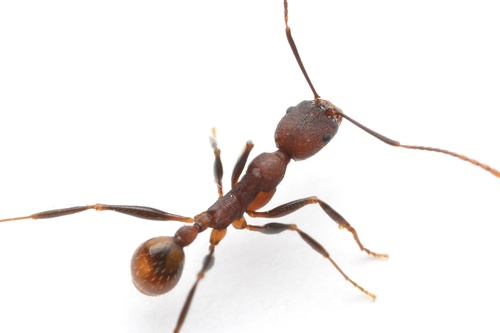
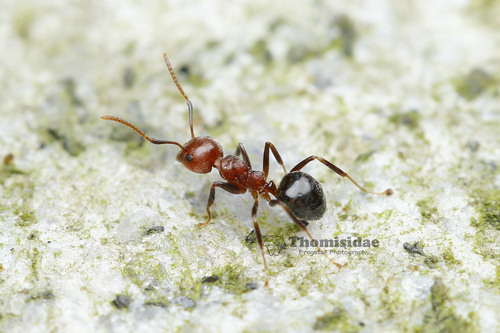
Identification: Worker Myrmica rubra are yellowish brown, with a body length between 3.5 and 5.5 mm. They have smooth, shiny frontal triangles and subspinal areas, and long, slender antennal scapes. Queen Myrmica rubra are similar in appearance to workers, but have a larger thorax that stores wing muscles, and typically measure between 5.5 and 7.0 mm in length. While this is not yet fully confirmed, it is thought that a second reproductive morph called microrubra exists; this morph was previously considered a social parasite of M. rubra, and its queens are smaller in size, more comparable to worker M. rubra. Male M. rubra have a darker body colour than queens and workers. They have long projecting hairs on their tibiae and tarsi, which is the most reliable feature to distinguish them from Myrmica ruginodis. Distribution and habitat: Myrmica rubra is one of the most common and widespread Myrmica species in the Palaearctic. Its native range extends from Portugal to East Siberia (reaching as far east as Transbaikalia), and from northern Greece to the northern forest-tundra zone. The species has also been introduced to North America, where it is found in the northwestern and northeastern United States and western Canada, and is considered an invasive species. It is very common across Europe and the United Kingdom, where it typically lives in meadows and gardens. Myrmica rubra feeds on honeydew excreted by aphids, many types of insects, other invertebrates, and pollen; pollen consumption is a rarely documented behaviour among temperate zone ants. They will attack any creature that disturbs their nest, but are less aggressive than the red imported fire ant.