About Myrmecophilus pergandei Bruner, 1884
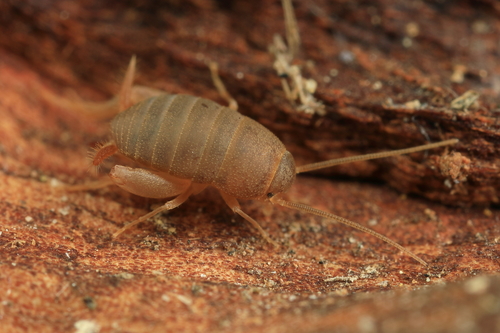
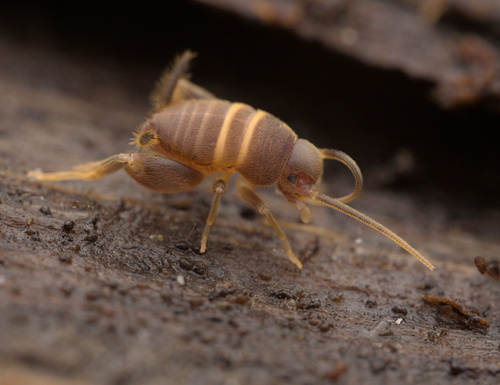
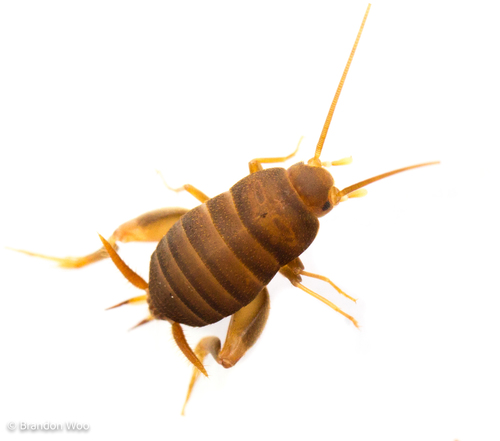
When viewed from above, Myrmecophilus pergandei Bruner, 1884 has an overall oval shape, narrowest at the head. The head is flattened and deeply sunken into the front margin of the pronotum. The basal joint of the antenna is very large and globular, with a few short bristle-like hairs surrounding the insertion point of the second antenna joint. The remaining antenna joints gradually decrease in size toward the antenna apex. Antennae are as long as the insect’s body; their base is pale yellowish, while the rest of the antenna is rufous. Eyes are small and black, formed from a cluster of ocelli-like cells. They are located directly behind the base of the antenna, and are partially concealed by the front margin of the pronotum in dried specimens. Anterior legs are small, slightly compressed, and lack spines or other armoring. Posterior femora are greatly enlarged, compressed, and ovately thickened. Posterior tibiae are stout, slightly compressed, shorter than the posterior femora, and bear four movable spines on their inner edge and two on their outer edge; the tibial apex has four long spurs, and the tarsi are unmodified. Cerci are stout, tapering to a point, slightly thickest at their midpoint, quite hairy, and as long as the abdomen. They are slightly thicker in males than in females. The ovipositor is slender and larger than is typical for the genus, with valves of equal length. The pronotum is large and wide, narrow at the front and broad at the back, with straight edges. The mesonotum and metanotum are the same size as each other, and much larger than the first abdominal segment. The body is primarily ochraceous and piceous; the front margin of the pronotum, the hind margins of the thoracic and abdominal segments, and the apex of the ovipositor are dark brown. A distinctive characteristic of this species is a pair of light-colored elliptical markings on the disc of the pronotum. Adult individuals of this species measure 3.85 mm in length. This species has been recorded in the United States, across the states of Colorado, Georgia, Illinois, Louisiana, Maryland, Massachusetts, Mississippi, Nebraska, New Hampshire, New Jersey, New York, Oklahoma, Pennsylvania, and Virginia.