About Myrmecophaga tridactyla Linnaeus, 1758
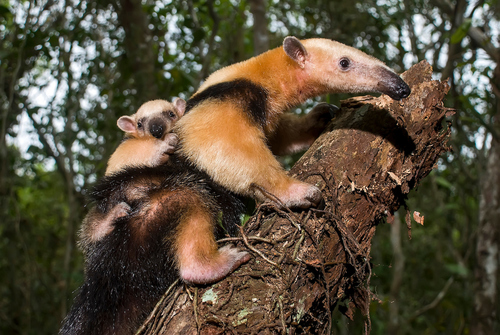
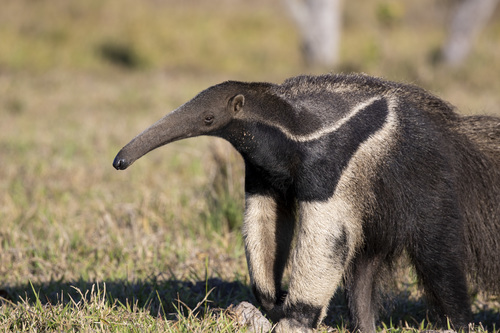
The giant anteater (Myrmecophaga tridactyla Linnaeus, 1758) can be identified by its large size, long narrow muzzle, and long bushy tail. Its total body length ranges from 182 to 217 cm (72 to 85 in). Males weigh 33 to 50 kg (73 to 110 lb), while females weigh 27 to 47 kg (60 to 104 lb), making this species the largest living member of its suborder. Its head, which measures 30 cm (12 in) long, is especially elongated even compared to other anteaters. A cylindrical snout makes up most of the head, and its eyes, ears, and mouth are all relatively small. Giant anteaters have poor eyesight but a powerful sense of smell that is 40 times stronger than a human's. While males are larger and more robust than females, telling the sexes apart from a distance can be difficult. The male's genitals are located inside its body, and its urogenital opening is smaller and positioned farther from the anus than the female's. The female has two mammary glands located between her front legs. Even for an anteater, the neck is particularly thick when compared to the back of the head, with a small hump protruding behind the neck. The giant anteater's coat is mostly grayish brown or black with mottled white markings. It has white front legs with black rings around the wrists and hands, dark hind legs, and a brown tail. A thick black mark with white outlines and sharp tips runs from the throat to the shoulders. The coat hairs are long, especially on the tail, which makes the tail look larger than it actually is. An erect mane runs along the animal's back. This bold patterning was originally thought to act as disruptive camouflage, but a 2009 study suggests it is actually warning coloration. Giant anteaters have broad ribs and five toes on each foot. Three toes on the front feet have claws, with particularly large claws on the third digits. It walks on its front knuckles, similar to gorillas and chimpanzees, which keeps it from scraping its claws against the ground. The middle digits, which support most of the animal's weight, have long metacarpophalangeal joints and bent interphalangeal joints. Unlike the front feet, all five toes of the hind feet have short claws, and giant anteaters walk plantigrade on their hind feet. As a "hook-and-pull" digger, the giant anteater has a large supraspinous fossa that gives the teres major more leverage, increasing the pulling power of the front limbs, while the triceps muscle helps control the thickened middle digit. As a mammal, the giant anteater has an unusually low body temperature of around 33 °C (91 °F), which is a few degrees lower than the typical mammalian temperature of 36 to 38 °C (97 to 100 °F). Xenarthrans as a group generally have lower metabolic rates than most other mammals, a trend thought to correlate with their dietary specializations and low mobility. The giant anteater is native to Central and South America, with its known modern range stretching from Honduras to Bolivia and northern Argentina. Fossil remains of the species have been found as far north as northwestern Sonora, Mexico. It is largely absent from the Andes, and has been completely wiped out in Uruguay, Belize, El Salvador, and Guatemala, as well as in parts of Costa Rica, Brazil, Argentina, and Paraguay. The species can live in both tropical rainforests and arid shrublands, as long as enough prey is available to support it. The International Union for Conservation of Nature lists this species as vulnerable, due to the number of regional extirpations of the species. It is listed under Appendix II by CITES, which tightly restricts international trade in giant anteater specimens. By 2014, the total global population had declined by more than 30 percent over the last three generations. In 1994, around 340 giant anteaters died from wildfires at Emas National Park in Brazil. The animal is particularly vulnerable to fires because its coat can easily catch fire, and it is too slow to escape. Human-caused threats to the giant anteater include vehicle collisions, dog attacks, and habitat destruction. One study of anteater mortality along roads found that anteaters are likely to be struck on linear roads near native plants. A 2018 study in Brazil found five key results: (1) roads are more harmful to anteaters from habitat fragmentation rather than vehicle accidents, (2) 18–20% of satisfactory anteater habitat did not meet minimum patch size requirements, (3) 0.1–1% of the species' range had dangerously high road density, (4) 32–36% of the anteater's distribution makes up critical areas for its survival, and (5) more conservation opportunities exist in the northern part of Brazil. A 2020 study in the Brazilian Cerrado found that road mortality can reduce local population growth by 50 percent. Giant anteaters are commonly hunted in Bolivia, both for trophies and as food. In the Chaco region, the animal's thick, leathery hide is used to make horse-riding equipment. In Venezuela, giant anteaters are killed for their claws. They are also killed because they are perceived as dangerous, particularly during threat displays. The species' biggest ecological strengths are its wide range and adaptability. The Amazon, Pantanal, and Cerrado contain multiple protected areas where giant anteaters can find refuge. In Argentina, some local governments list it as a national heritage species, granting it official protection. Despite its well-known status, the giant anteater has not been well studied in the wild, and research has been limited to certain areas. The species may use multiple different habitats; a 2007 study of giant anteaters in the Brazilian Pantanal found that the animals move and forage in open areas and rest in forests, which provide shade when temperatures rise and retain heat when temperatures drop. On average, anteaters travel around 3,700 m (12,100 ft) per day. Giant anteaters can be either diurnal or nocturnal. A 2006 study in the Pantanal found that they are mostly nocturnal in warm weather, but become more active during daylight hours as temperatures drop. Diurnal giant anteaters have been observed at Serra da Canastra. Nocturnality in anteaters may be a response to human disturbances. Giant anteaters prefer dense brush for sleeping, but they may use tall grass when temperatures are cooler. When resting, they carve a shallow cavity into the ground. They sleep curled up with their bushy tail draped over their body, both to stay warm and to camouflage themselves from predators. One anteater was recorded sleeping flat on its side with the tail unfolded on a 17 °C (63 °F) morning, which may have allowed its body to absorb sunlight for warmth. Giant anteaters sometimes enter water to bathe, and will even swim across wide rivers. They are also capable of climbing, and have been recorded climbing both termite mounds and trees while foraging. One individual was observed trying to climb a tree by rearing up and grabbing onto a branch above it. Giant anteaters mate year-round. A male follows an estrous female, who then partially raises her tail. Courting pairs have been recorded sharing the same insect nest while feeding. For mating, the female lies sideways and the male hunches over her. A mating pair may stay together for up to three days and mate multiple times during that period. Giant anteaters have a 170–190 day gestation period, which ends with the birth of a single pup while the female stands upright. There is some evidence that this species can experience delayed implantation. Pups are born weighing 1–2 kg (2.2–4.4 lb), and their eyes remain closed for the first six days after birth. The mother carries her dependent young on her back. The pup can camouflage against its mother by aligning its own black and white band with the mother's. The mother grooms and nurses her young, which communicate with her using sharp whistles. After three months, grooming becomes less frequent, and the young begin to eat more solid food. Both grooming and nursing stop at 10 months of age, which is when the young leave their mother. Giant anteaters reach sexual maturity at 2.5–4 years of age.