About Myrmecobius fasciatus Waterhouse, 1836
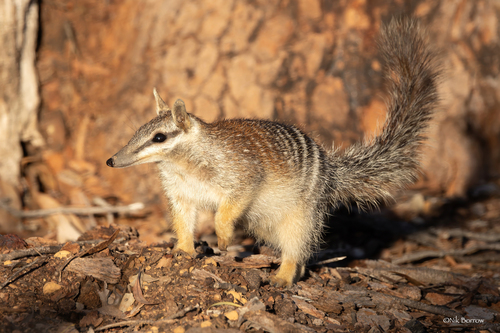
The numbat (Myrmecobius fasciatus Waterhouse, 1836) is a small marsupial with distinctive stripes, measuring 35 to 45 centimetres (14 to 18 in) in total length including the tail, and weighing between 280 and 700 g (9.9 and 24.7 oz). It has a finely pointed muzzle, and a prominent bushy tail that is roughly the same length as its body. It has five toes on its fore feet, and four toes on its hind feet. Its fur colour varies widely, ranging from soft grey to reddish-brown. Individuals often have a brick red patch on the upper back, and always have a distinct black stripe running from the tip of the muzzle through the eye to the base of the small, round-tipped ear. Between four and eleven white stripes cross the animal's hindquarters, and these stripes gradually become fainter toward the midback. The underside is cream or light grey, and the tail is covered in long grey hair flecked with white. Numbats also have a sternal scent gland that may be used for marking territories. Unlike most other small marsupials, the numbat is diurnal, a trait largely tied to the constraints of its specialised diet; numbats do not have the typical physical traits that other large termite-eating animals such as anteaters, aardvarks, and pangolins have, which are powerful forelimbs with heavy claws. Like other myrmecophages (mammals that eat termites or ants), the numbat has a degenerate jaw with up to 50 tiny nonfunctional teeth. Although it is capable of chewing, it rarely does so because of the soft texture of its diet. Uniquely among terrestrial mammals, the numbat has an extra cheek tooth located between the premolars and molars; it remains unclear whether this is an extra supernumerary molar or a retained deciduous tooth that stays into adulthood. Because of this variation, not all individuals share the same dental formula, but the general unique pattern is 4.1.3.1.4 / 3.1.4.1.4. Similar to other myrmecophages, the numbat has a long narrow tongue coated in sticky saliva, which is produced by large submandibular glands. A further dietary adaptation is the presence of numerous ridges along the soft palate, which apparently help scrape termites off the tongue so they can be swallowed. The numbat's digestive system is relatively simple and lacks many of the adaptations seen in other insectivorous animals, likely because termites have softer exoskeletons and are easier to digest than ants. Numbats can get a large amount of water from their diet, so their kidneys do not have the typical water-retaining specialisations found in other animals that live in arid environments. Although numbats primarily find termite mounds using scent, they have the highest visual acuity of any marsupial, and unusually for marsupials, they have a high proportion of cone cells in the retina. Both of these traits are likely adaptations to their diurnal lifestyle, and vision appears to be the primary sense they use to detect potential predators. Numbats were once widely distributed across southern Australia, ranging from Western Australia to north-western New South Wales. Since the arrival of Europeans, their range has shrunk significantly, and the species now only survives naturally in two small patches of land: Dryandra Woodland and Tone-Perup Nature Reserve, both in Western Australia. Today, wild numbats are naturally found only in eucalypt forest areas, though they were once more widespread across other types of semiarid woodland, spinifex grassland, and sand dune-dominated terrain. It is estimated that fewer than 1,000 numbats remain in the wild. After measures were put in place to exclude feral cats, the number of numbats trapped during annual population surveys in Dryandra Woodland rose to 35 by November 2020, up from 10 recorded in 2019 and 5 in 2018. This was the highest number of recorded numbats since 36 were recorded in the 1990s. The species has been successfully reintroduced into three fenced, feral predator-proof reserves that host more varied environments: Yookamurra Sanctuary in the mallee of South Australia, Scotia Sanctuary in semi-arid New South Wales, and Mount Gibson Sanctuary in Western Australia. Reintroduction efforts began at large fenced reserves in Mallee Cliffs National Park (New South Wales) in December 2020, and on South Australia's Eyre Peninsula in 2022. Two previous attempts to reintroduce numbats to fenced reserves in other areas failed: one in the South Australian arid zone near Roxby Downs, and the other at Newhaven Sanctuary in the Northern Territory, in the northernmost part of the species' former range. There are plans to reintroduce the species to a managed semi-fenced area on South Australia's southern Yorke Peninsula, as part of the Marna Banggara project, formerly known as the Great Southern Ark project. Numbats are insectivores that survive entirely on a diet of termites from the genera Heterotermes, Coptotermes, Amitermes, Microcerotermes, Termes, Paracapritermes, Nasutitermes, Tumulitermes, and Occasitermes. An adult numbat needs up to 20,000 termites per day. As the only marsupial that is fully active during the day, the numbat spends most of its time searching for termites. It digs termites out of loose earth with its front claws and captures them with its long sticky tongue. Because termites have a high water content, numbats get most of their required water directly from their food, which lets them survive in dry Australian habitats. Despite its alternative common name banded anteater, the numbat does not intentionally eat ants. Although ant remains have occasionally been found in numbat excreta, these ants belong to species that prey on termites, so they were likely eaten accidentally alongside the numbat's main food. Known native predators of numbats include various reptiles and raptors, specifically carpet pythons, sand goannas, wedge-tailed eagles, collared sparrowhawks, brown goshawks, and little eagles. Numbats are also preyed on by invasive red foxes and feral cats. Adult numbats are solitary and territorial. An individual male or female establishes a territory of up to 1.5 square km (370 acres) early in life, and defends it from other members of the same sex. The animal generally stays within this territory for the rest of its life; male and female territories overlap, and during the breeding season males will travel outside their normal home ranges to find mates. Although the numbat has relatively powerful claws for its size, it is not strong enough to access termites inside their hard concrete-like mounds, so it must wait until termites are active near the surface. It uses a well-developed sense of smell to locate shallow, unfortified underground galleries that termites build between their nest and feeding sites. These galleries are usually only a short distance below the soil surface, and are accessible to the numbat's digging claws. The numbat aligns its activity with termite activity, which depends on temperature: in winter, it feeds from midmorning to midafternoon; in summer, it wakes earlier, takes shelter during the hottest part of the day, and feeds again in the late afternoon. Numbats can enter a state of torpor, which may last up to fifteen hours per day during winter. At night, the numbat retreats to a nest, which can be located in a log or tree hollow, or in a burrow. Burrows are typically narrow shafts 1–2 m (3 ft 3 in – 6 ft 7 in) long that end in a spherical chamber lined with soft plant material: grass, leaves, flowers, and shredded bark. The numbat can block the opening of its nest with the thick hide of its rump to prevent predators from accessing the burrow. Numbats have relatively few vocalisations, but have been reported to hiss, growl, or make a repetitive 'tut' sound when disturbed. Numbats breed in February and March, which is late austral summer, and normally produces one litter per year. They can produce a second litter if the first is lost. Gestation lasts 15 days, and results in the birth of four young. Unusual for marsupials, female numbats have no pouch. The four teats are instead protected by a patch of crimped golden hair, and by swelling of the surrounding abdomen and thighs during lactation. Newborn young are 2 cm (0.79 in) long. They crawl immediately to the teats and remain attached until late July or early August, by which time they have grown to 7.5 cm (3.0 in). They reach 3 cm (1.2 in) long when they first grow fur, and adult patterning begins to appear once they reach 5.5 cm (2.2 in). After weaning, the young are left in a nest or carried on the mother's back, and become fully independent by November. Females reach sexual maturity by the following summer, but males do not reach maturity for an additional year.

