About Myrmeciza squamosa Pelzeln, 1868
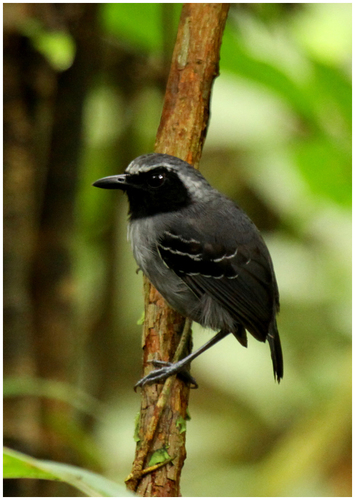
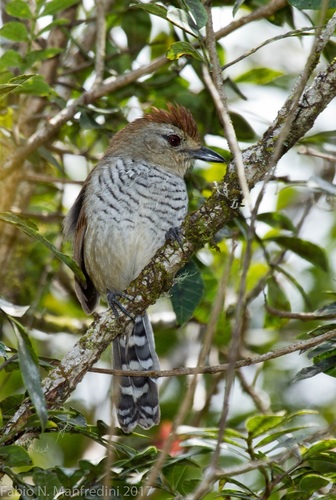
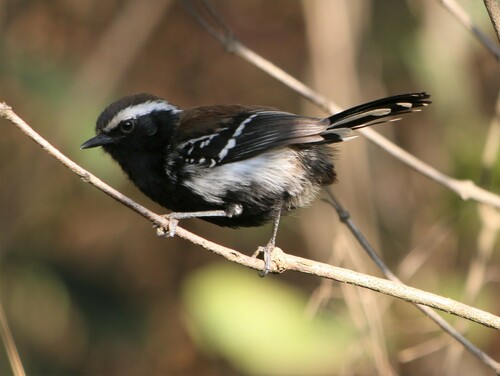
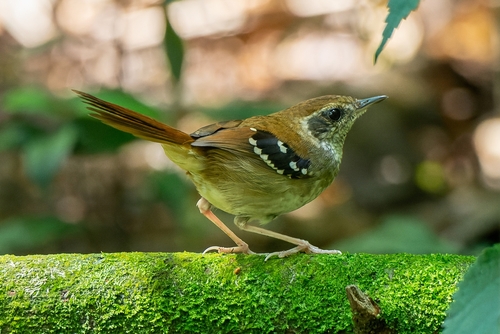
The squamate antbird (Myrmeciza squamosa Pelzeln, 1868) measures 14 to 15 cm (5.5 to 5.9 in) long and weighs 16.5 to 20 g (0.58 to 0.71 oz). Adult males have a dark yellowish brown crown and upperparts, with a white patch between their scapulars and scattered black markings across the back. Their face is mostly black, except for a long gray-tinged white supercilium. Their tail is dark yellowish brown with tawny feather edges, their flight feathers are brownish with rufous edges, and their wing coverts are black with wide white tips. Males have a black chin and throat, black breast and side feathers with wide white edges, a white belly, and ochre-brown flanks and crissum. Adult females are similar to males, but have paler upperparts, a white throat with faint gray bars, plain white underparts, and olive-brown flanks and sides. The squamate antbird is found in eastern Brazil, ranging from southern São Paulo state south to northern Rio Grande do Sul, with one additional record from Iguaçu National Park in western Paraná. This species mostly lives on the floor of evergreen forest and nearby mature secondary forest, and also occurs locally near the coast in restinga woodland growing on sandy soil. It prefers areas with many saplings and a dense herbaceous understorey, and it occurs at elevations from sea level to 1,000 m (3,300 ft).