About Myrmeciza longipes (Swainson, 1825)
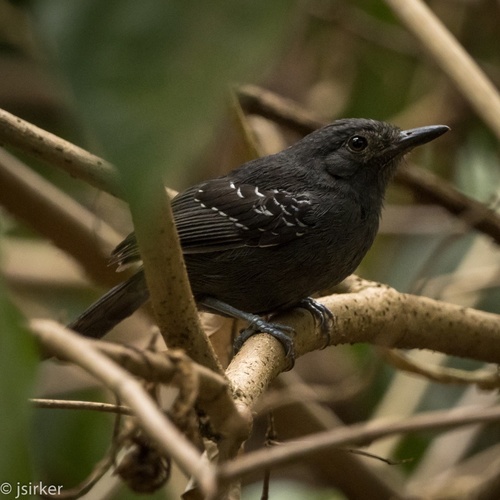
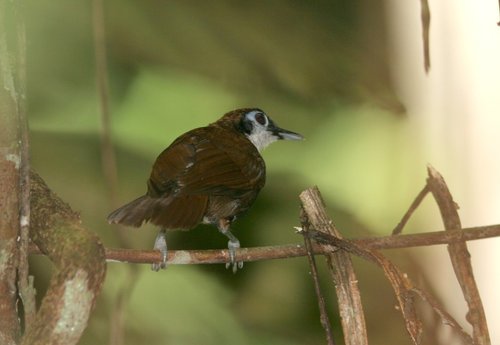
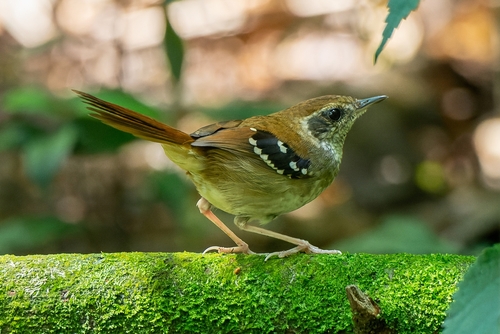
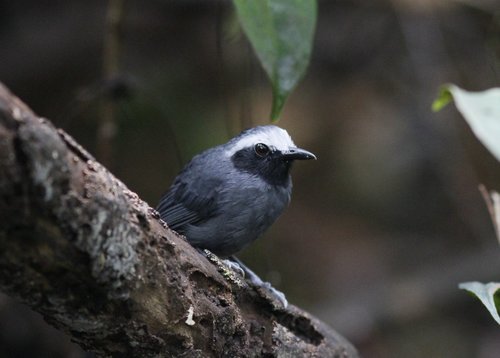
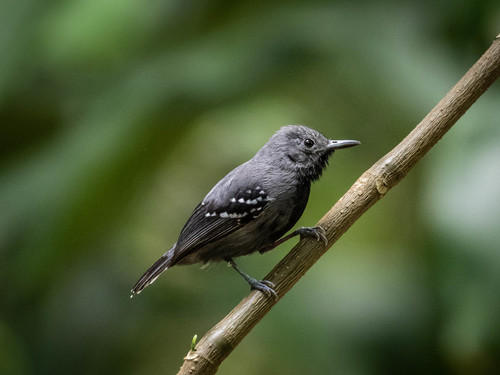
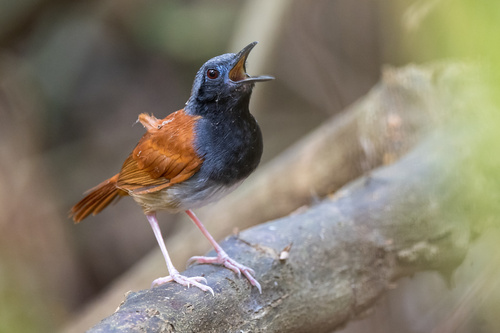
Myrecmiza longipes, the white-bellied antbird, is approximately 15 cm (5.9 in) long and weighs an average of around 28 g (0.99 oz). Nominate subspecies M. l. longipes adult males have cinnamon rufous coloring on their crown, upperparts, wings, and tail, with a hidden white patch between their scapulars. The lesser wing coverts have white or pale buff edges, and sometimes have cinnamon tips. The sides of the head, throat, and upper breast are black, bordered with slate gray; the lower breast and belly are white; the flanks are tawny or buffy; and the undertail coverts are tawny. Adult females have upperparts similar to males, with the addition of black bars near the end of their wing coverts. The sides of a female's head are dark brown, the chin is white, the throat and upper breast are ochraceous buff, the lower breast and belly are white, the flanks are ochraceous buff, and the undertail coverts are tawny ochraceous. Both sexes have pinkish gray legs and feet. Variations exist across the recognized subspecies. Males of M. l. panamensis have more black and less white on their underparts than the nominate subspecies. Males of M. l. boucardi have a gray crown, and females have richer ochraceous coloring on the throat and breast than the nominate. Males of M. l. griseipectus have black that only extends slightly onto the breast, and also have large black spots on their wing coverts; females of this subspecies have more white on the belly than the nominate. This species has a disjunct distribution across Central and South America and Trinidad, with each subspecies occupying a separate range. M. l. panamensis is found on the Caribbean slope of Panama from Colón Province eastward, the Pacific slope of Panama from Coclé Province eastward, and in northern Colombia from extreme northern Chocó Department east to La Guajira Department. M. l. longipes is found from the east slope of the Eastern Andes in northeastern Colombia, east through northern Venezuela to Sucre state, and on Trinidad. M. l. boucardi is found in the upper Magdalena River Valley in central Colombia. M. l. griseipectus occurs east of the Andes in Meta Department, central Colombia, in southern and eastern Venezuela, Guyana, Suriname, and in northeastern Brazil north of the Amazon from Roraima eastward. The white-bellied antbird primarily lives on the floor and in the understorey of moderately humid semi-deciduous forest. It also can be found in deciduous forest, small patches of more humid rainforest, gallery forest, and shrubby secondary forest. Its maximum elevation ranges are 500 m (1,600 ft) in Panama, 1,800 m (5,900 ft) in Colombia, 1,300 m (4,300 ft) in Venezuela, and 700 m (2,300 ft) in Brazil.