About Myrmeciza hemimelaena P.L.Sclater, 1857
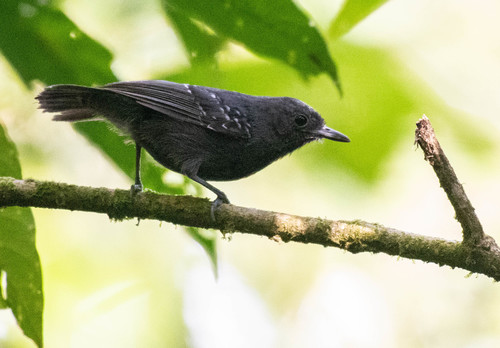
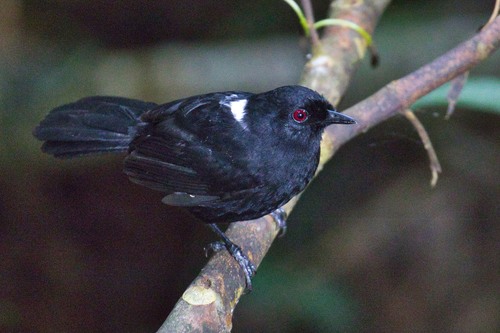
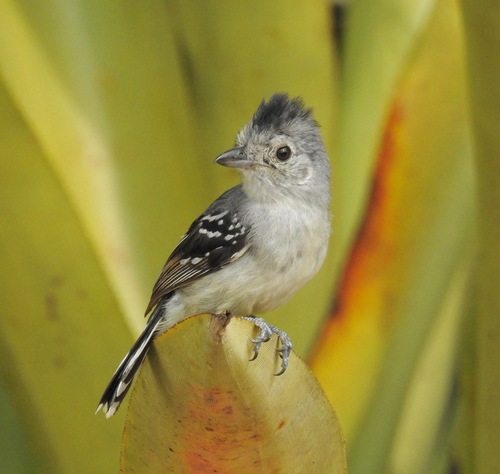
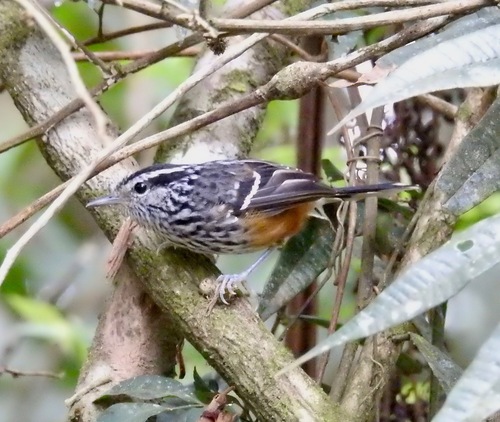
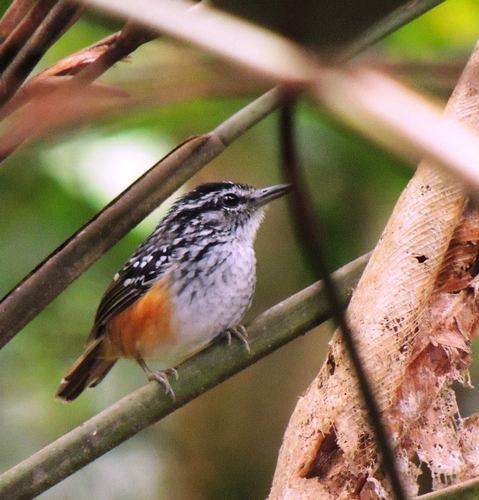
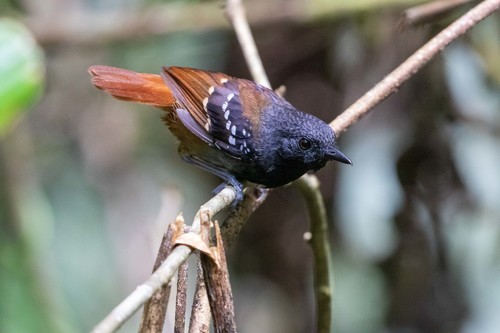
The southern chestnut-tailed antbird (Myrmeciza hemimelaena P.L.Sclater, 1857) measures 11 to 12 cm (4.3 to 4.7 in) in length and weighs 14.5 to 16.5 g (0.51 to 0.58 oz). Males of the nominate subspecies have a mostly gray head and upper mantle, with black-centered feathers. The remainder of their upperparts, tail, and flight feathers are dark yellowish red-brown. They have a white patch between the scapulars, with black spots near the feather tips. Their wing coverts are black with large white to buff-white tips. Their throat and upper breast are black, the center of their belly is white to gray, and the rest of their underparts are yellowish red-brown. They have a black bill. Females have a brown tinge on the crown, a reddish yellow-brown throat and breast, and a pale reddish yellow-brown to white belly. Their mandible is pale. Males of subspecies M. h. pallens have more white on their belly than the nominate subspecies, while females of this subspecies are overall paler than the nominate. The nominate subspecies of southern chestnut-tailed antbird is found south of the Amazon and Marañón rivers in eastern Peru, in southwestern Amazonian Brazil east to the Madeira River and south to Acre state, and in northwestern Bolivia west of the Mamoré and Grande rivers. Subspecies M. h. pallens is found east of the nominate subspecies’ range, in Brazil south of the Amazon from the Madeira River into Pará, south to Rondônia and northern Mato Grosso, and in eastern Santa Cruz Department in Bolivia. This species primarily inhabits the understorey and floor of terra firme forest and adjacent mature secondary forest. In Peru, it also occurs in seasonally flooded forest and the transitional forest between seasonally flooded forest and terra firme. In parts of Brazil, it is associated with bamboo and other herbaceous plants in tree-fall gaps, but it tends to avoid bamboo in Peru. In Brazil, it occurs from near sea level up to 900 m (3,000 ft), and in Colombia it reaches an elevation of 1,500 m (4,900 ft).