About Myrmeciza exsul P.L.Sclater, 1859
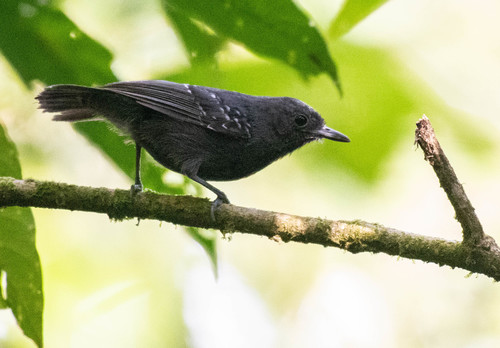
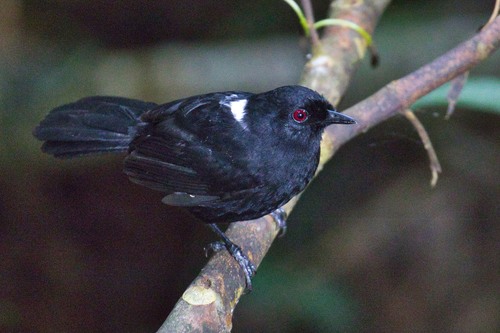
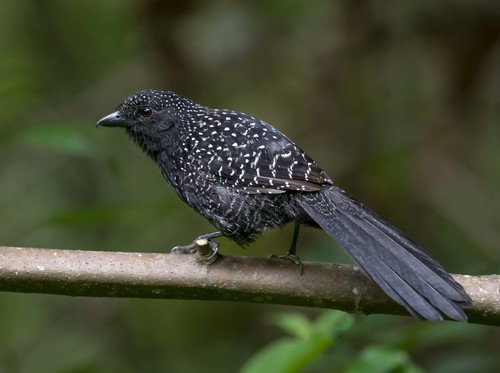
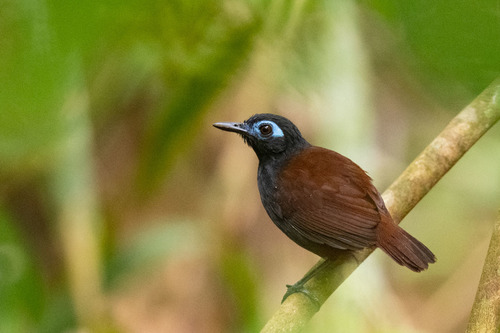
The chestnut-backed antbird (Myrmeciza exsul P.L.Sclater, 1859) measures 14 to 15 centimetres (5.5 to 5.9 in) in length and weighs approximately 29 grams (1.0 oz). All subspecies of both sexes have a pale blue patch of bare skin surrounding each eye. For the nominate subspecies P. e. exsul, adult males have a slate-black head and neck, deep chestnut upperparts, and deep chestnut wings and tail with some black and white markings on the wing coverts. Their throat, breast, and belly are blackish slate, while their flanks, vent area, and undertail coverts are brown. Adult females of the nominate subspecies have a duller black head and neck than males, but their upperparts match the male's. Their chin and throat are duller slate-blackish than males, and the rest of their underparts are brown. Both sexes of the nominate subspecies have a reddish brown iris, a black bill, and dark horn to blackish legs and feet.
Males of subspecies P. e. occidentalis are paler overall than the nominate, but are otherwise similar. Females of this subspecies have upperparts matching the nominate, with bright tawny-chestnut or rufous-chestnut throat and upper breast, tawny-russet lower breast and belly, and tawny-brown flanks, vent, and undertail coverts. Males of subspecies P. e. maculifer resemble nominate males, with the addition of white tips on their wing coverts. Females also resemble nominate females, except they have rufous-chestnut underparts. Males of P. e. cassini are similar to nominate males but paler, and have wide white tips on their wing coverts. Females of this subspecies have a buff breast, with the rest of their underparts being cinnamon-orange. Males of P. e. niglarus have slightly lighter upperparts than the nominate. Females have brighter underparts than the nominate, but darker underparts than those of occidentalis. Considerable intergradation occurs between all subspecies.
The subspecies of the chestnut-backed antbird have distinct ranges: P. e. exsul is found from eastern Honduras along the Caribbean slope through Nicaragua and Costa Rica into Panama, reaching near the Panama Canal. P. e. occidentalis occurs on the Pacific slope of western Costa Rica and western Panama, extending to Veraguas Province. P. e. cassini ranges from extreme southeastern Panama south of the Bay of San Miguel into northern Colombia, east to Cesar Department and south through the Magdalena Valley. P. e. niglarus is found in Panama east of the Canal in Colón Province, and on the Pacific slope from Panama Province south into northern Chocó Department in far northwestern Colombia. P. e. maculifer occurs on the Pacific slope from central Chocó in Colombia south into western Ecuador, as far as El Oro Province.
Most chestnut-backed antbird subspecies live in the understorey of the interior of humid to wet evergreen forest. They occur in both primary and secondary forest, though they prefer primary forest. They favor dense vegetation, vine tangles, and the undergrowth of older gaps formed by fallen trees. Subspecies P. e. occidentalis inhabits drier, more open semi-humid transitional forest than other subspecies, and occurs more often in younger secondary forest. In terms of elevation, the species is found up to 1,200 m (3,900 ft) in Honduras, Costa Rica, and Colombia, and up to about 1,000 m (3,300 ft) across most of the rest of Central America. In Ecuador, it mostly occurs below 900 m (3,000 ft), but locally reaches 1,500 m (4,900 ft) in Pichincha Province.