About Myrmecia nigrocincta Smith, 1858
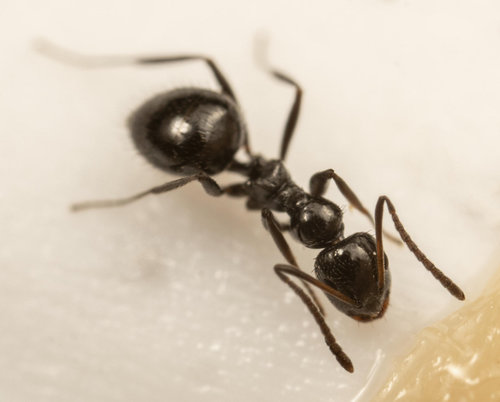
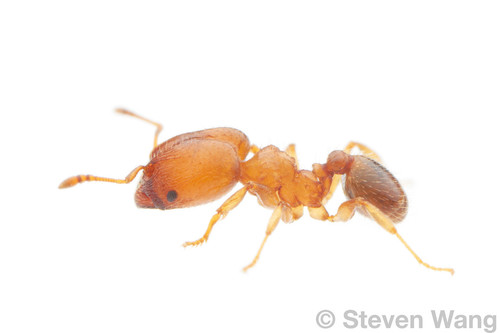
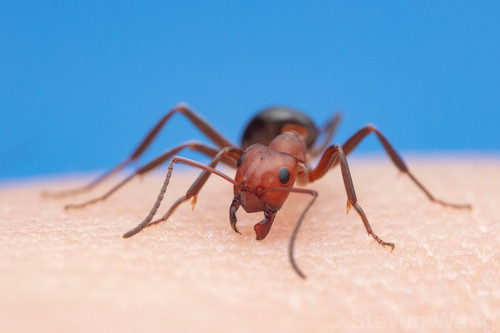
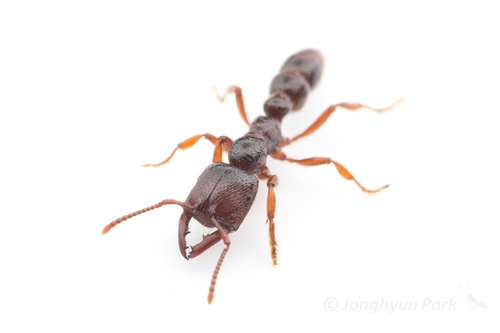
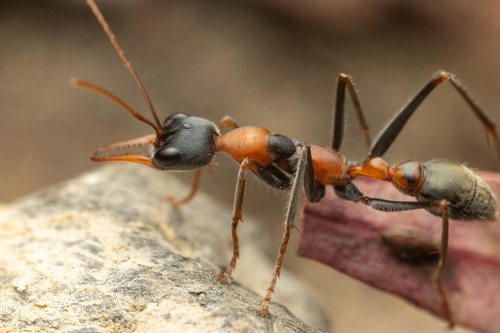
Myrmecia nigrocincta is a species of bulldog ant, like all other members of the genus Myrmecia, and it shares the genus trait of having elongated mandibles. This species is primarily coloured black and orange-red. Mandible colour varies by location, being either black or yellow. The gaster, head, legs and mesonotum are black, while the pronotum, propodeum, petiole and post-petiole are red. The front of its head bears linear ridges, and it has apical spurs on the tibia of both the middle and hind legs. Its legs are thin, and grow more slender further from the body. M. nigrocincta can be told apart from other Myrmecia species by its bi-coloured yellowish-red and black thorax and post-petiole, plus its yellowish-red node. Worker ants measure 13 to 15 millimetres (0.51 to 0.59 in) long, males are 16 to 17 millimetres (0.63 to 0.67 in) long, and queens (fertile females) are 17 to 19 millimetres (0.67 to 0.75 in) long. Queen M. nigrocincta have only rudimentary wing development, and their stubby, reduced wings leave them unable to fly. This species is abundant in eastern Australia, and prefers temperate bushlands. It is most commonly found in dry to semi-dry forests and sclerophyll woodlands, on coastal plains of eastern Australian states where suitable dry forest habitat is common. It also prefers tropical climates and warm temperatures. It can occur in other habitat types at elevations ranging from 80 to 1,220 metres (262 ft to 4,000 ft). Recorded locations for M. nigrocincta colonies in Queensland include Cairns, Atherton, Mackay, Mt. Tamborine, Brisbane, Blackall Range and Fletcher. In New South Wales, the species occurs in Lismore, Dorrigo, Armidale and Sydney, specifically the suburbs of Heathcote and Como. In Victoria, it is found in Trafalgar and Millgrove, and colonies have also been recorded in South Australia. M. nigrocincta is a skilled jumper, able to leap distances between 76 and 102 millimetres (3 to 4 in). It propels these jumps with a sudden extension of its middle and hind legs. It has good vision, and can be seen running among plants and leaves, occasionally jumping between branches. It mostly forages on plants, trees and other vegetation, but will sometimes forage on the ground. This ant species is diurnal and does not hibernate. It is omnivorous, feeding on other insects including caterpillars and spiders, as well as honey water. It has been observed preying on the larvae of imperial hairstreak butterflies, and will even jump while carrying these larvae. Predators of M. nigrocincta, and the genus Myrmecia overall, include spiders, birds, lizards, mammals, and other predatory invertebrates such as assassin bugs and redback spiders. M. nigrocincta ants have been recorded visiting flowers of Eucalyptus regnans and Senna acclinis, and are considered a possible pollination vector for E. regnans trees. Though Senna acclinis is self-compatible, M. nigrocincta is unable to properly release pollen from its flowers, which restricts the species' ability to successfully pollinate S. acclinis. M. nigrocincta lives in colonies that nest in sandy soil; their nests sometimes form a mound that resembles a molehill. Worker ants work to conceal their nests with twigs and leaves. Depending on the colony's habitat, they decorate nests with plant material and gravel, alongside other materials like dry leaves, rocks, vegetation, and twigs to camouflage the colony. Nests are positioned next to a clump of grass or bush, or at the base of a tree. M. nigrocincta colonies are monogyne, meaning each colony has only one queen. The queen is semi-claustral: when founding a new colony, the queen must forage to get enough food to raise her brood. Colonies contain between 400 and 1200 individuals, so they are classified as large colonies. Worker and scout ants use pheromones to communicate. They are quick to defend their nests, and may react aggressively even to a shadow passing over the nest. In 1922, Wheeler described the species' reaction to nest disturbance as: "they bound out of their small mound nest in a series of short hops like Lilliputian cavalry galloping to battle." The ants aggressively defend their colony, delivering multiple bites and willingly sacrificing themselves to protect the queen and the rest of the colony. M. nigrocincta is a gamergate species, which allows female workers to be fertile. Fertile workers can reproduce in both queenless colonies and queenright colonies (colonies that have a queen). This means a colony that loses its queen can still survive and grow without a queen. In laboratory M. nigrocincta colonies with no queen present, worker-laid eggs were reared into mature males, confirming that workers are highly fertile. The average life expectancy of an adult worker M. nigrocincta is 1.1 to 1.2 years, with a maximum life expectancy of 1.3 years (over 400 days). When collected, M. nigrocincta larvae are 4.7mm in length, and grow to 9.7mm when fully mature.