About Myristica fragrans Houtt.
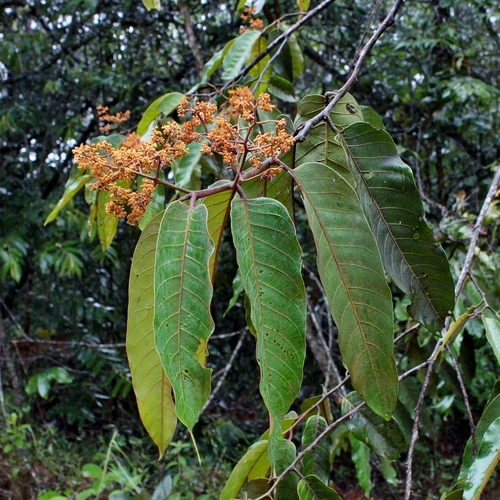
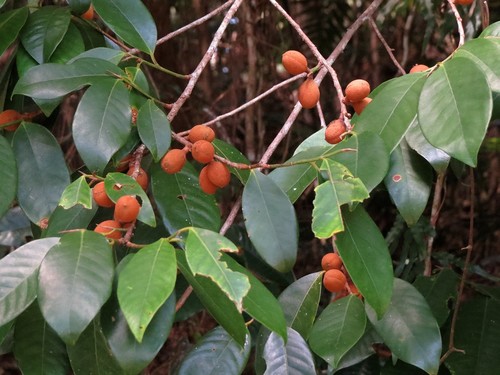
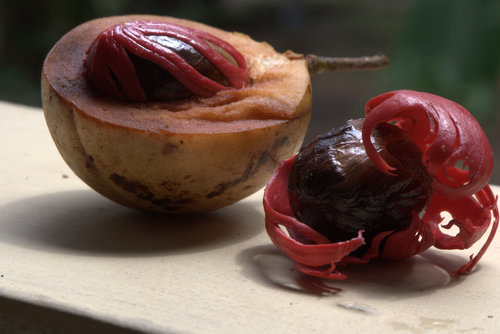
Myristica fragrans Houtt. is an evergreen tree that typically grows 5–15 meters (16–49 feet) tall. On the island of Tidore, it may occasionally reach 20 meters (66 feet) or even 30 meters (98 feet) in height. Its leaves are arranged alternately, are dark green in color, measure 5–15 cm (2.0–5.9 in) long by 2–7 cm (0.8–2.8 in) wide, and have petioles roughly 1 cm (0.4 in) long. This species is dioecious, meaning male (staminate) and female (carpellate) flowers grow on separate individual plants, though rare plants may produce both flower types. The flowers are bell-shaped, pale yellow, and have a somewhat waxy, fleshy texture. Staminate flowers grow in clusters of 1 to 10, and each flower is 5–7 mm (0.2–0.3 in) long. Carpellate flowers grow in smaller clusters of 1 to 3, and are slightly longer, reaching up to 10 mm (0.4 in) in length. Carpellate trees bear smooth yellow ovoid or pear-shaped fruits that are 6–9 cm (2.4–3.5 in) long, with a diameter of 3.5–5 cm (1.4–2.0 in). The fruit has a fleshy husk that splits into two halves along a lengthwise ridge when ripe. Inside the husk is a shiny purple-brown seed, measuring 2–3 cm (0.8–1.2 in) long by around 2 cm (0.8 in) across, covered by a red or crimson fleshy aril. The seed of this plant is the commercial source of nutmeg, while the aril is the source of mace. Myristica fragrans can be grown as an accent tree. Ground nutmeg and mace from the plant are used in cooking. The seeds are processed to make essential oils, while other plant parts including arils, bark, flowers, and leaves are used to add fragrance to soaps and perfumes.