About Myriostoma coliforme (Dicks.) Corda
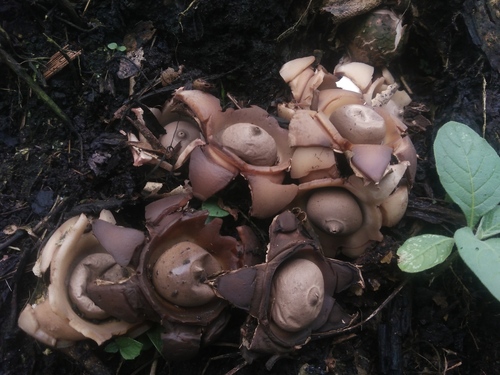
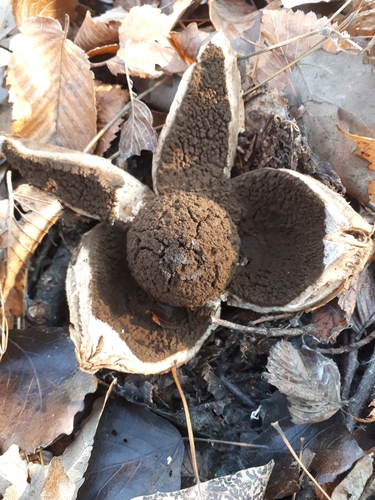
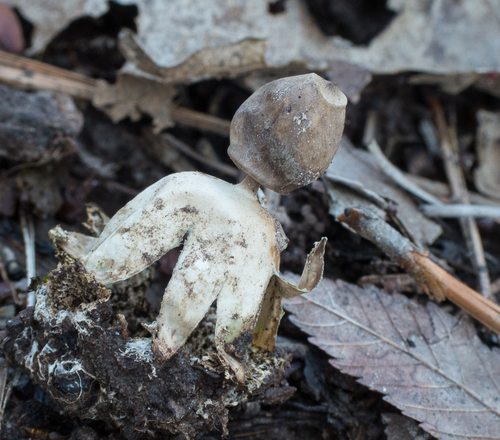
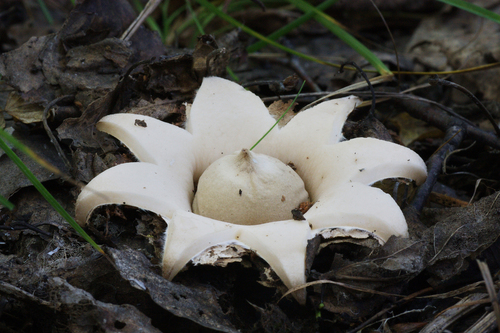
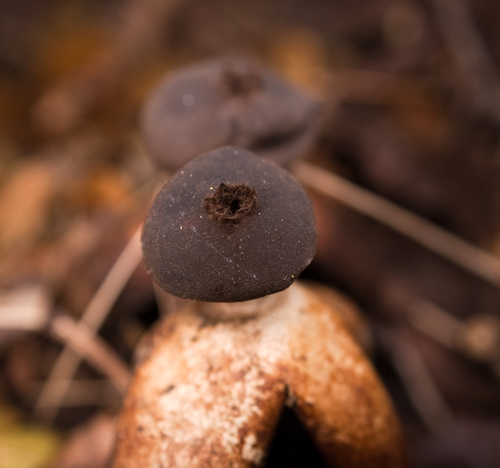
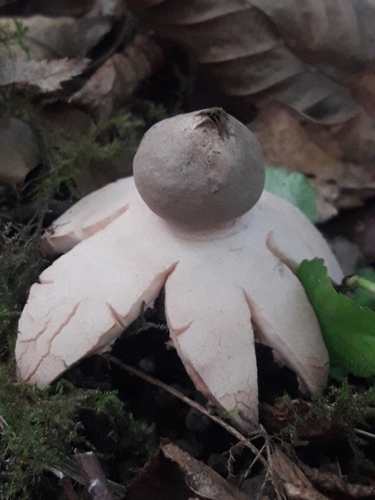
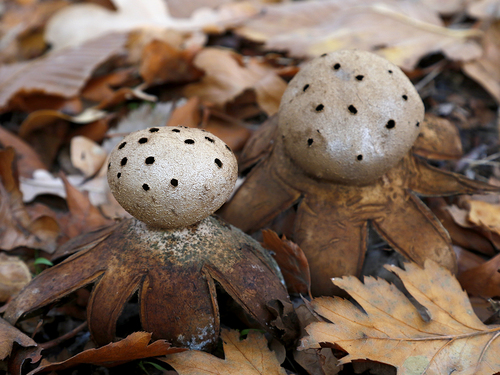
The fruit bodies of Myriostoma coliforme begin development underground or buried in leaf debris, connected to a mycelial strand at their base. As they mature, the exoperidium (the outer tissue layer of the protective peridium) splits into 7 to 14 backward-curving rays, which push the fruit body up above the growing substrate. Fully expanded fruit bodies measure 2–12 cm (0.8–4.7 in) across from ray tip to opposite ray tip. The rays are unequal in size, with tips that often roll inward, and they are made up of three distinct tissue layers. The inner pseudoparenchymatous layer, named for its resemblance to the tightly packed cells of plant parenchyma, is fleshy and thick when fresh. It starts pale beige, darkens to yellow or brown as it matures, and often cracks and peels away as it ages. The outer mycelial layer is frequently matted with fine leaf debris or dirt, and it usually cracks to expose a middle fibrous layer made of densely packed hyphae 1–2.5 μm wide. The base of the fruit body is concave to vaulted and often covered with clinging dirt. The roughly spherical spore sac, called the endoperidium, is 1–5 cm (0.4–2.0 in) in diameter, and is held up by a cluster of short, flattened sphere-shaped columns. It is grey-brown and covered in tiny, lightly interconnected warts that are less than 0.1 mm high. Several to many evenly spaced openings called ostioles are present, mostly on the upper half of the endoperidium; they are roughly circular with fimbriate (fringed) edges. The inedible fruit bodies have no distinct taste, though dried specimens develop an odour similar to curry powder or bouillon cubes. Like earthstars, this fungus uses the force of falling raindrops to help disperse its spores: spores are ejected in small bursts when objects such as raindrops hit the outer wall of the spore sac. The gleba (spore-bearing mass) is brown to greyish-brown, with a cotton-like texture. When compressed, this texture lets the endoperidium flex quickly to push a puff of air out through the ostioles, which releases a spore cloud to be carried away by wind. Columellae (sterile structures that start at the base of the gleba and extend through it) are usually not visible in the mature gleba, but are visible at the base of the spore sac. These columellae are not connected to the ostioles, and instead end within the gleba some distance away from the openings. Capillitia (sterile strands inside the gleba) are long, slender, free, tapering, and unbranched, measuring 3.3–4 μm thick with thickened walls. The spores are spherical, nonamyloid, and covered in irregularly shaped flaring protuberances up to 1.6 μm high. Including the ornamentation, spores measure 6.1–8.0 μm across. Myriostoma coliforme is a saprotrophic species, meaning it gets nutrients from decomposing organic matter. Its fruit bodies grow in groups on well-drained or sandy soil, often in partial shade under trees. It grows in deciduous forests, mixed forests, gardens, along hedges and grassy road banks, and grazed grasslands, and tends to grow on well-drained south-facing slopes. In Europe, its main habitat is riparian mixed forests dominated by Salix alba and Populus alba along large rivers. In Hawaii, it has been collected at elevations above 2,000 m (6,600 ft), where it appears to prefer mamane (Sophora chrysophylla) forest. The species is widespread in north temperate regions. It is rare in Europe, where it appears on the Regional Red Lists of 12 countries, and is one of 33 candidate species for listing in Appendix I of the Bern Convention (the Convention on the Conservation of European Wildlife and Natural Habitats). Although it was originally described from England, it was considered extinct in mainland Britain until it was rediscovered in Suffolk near Ipswich, one of its original localities, in 2006; it had last been recorded in the country in 1880. The fungus is considered extinct in Switzerland. Its most northerly known location is southern Sweden, and it is generally rare in northern Europe. It is similarly widespread but rarely encountered in North America, though there may be isolated localities like New Mexico where it is more abundant. Until 2017, M. coliforme was thought to be the only species in the genus Myriostoma, with a worldwide distribution. Since that time, molecular research using cladistic analysis of DNA sequences has found at least five additional Myriostoma species in Central and South America, South Africa, and Australia. As a result, the distribution of M. coliforme sensu stricto is uncertain, but it appears to be restricted to the Northern Hemisphere.