About Myriopteris tomentosa (Link) Fée
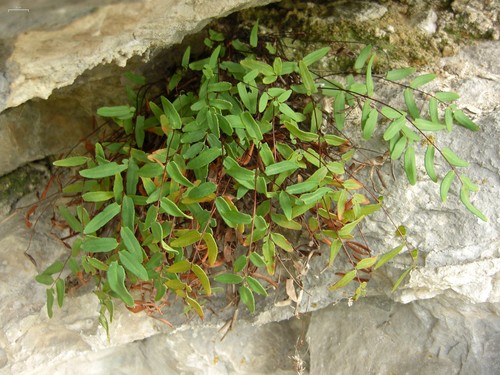
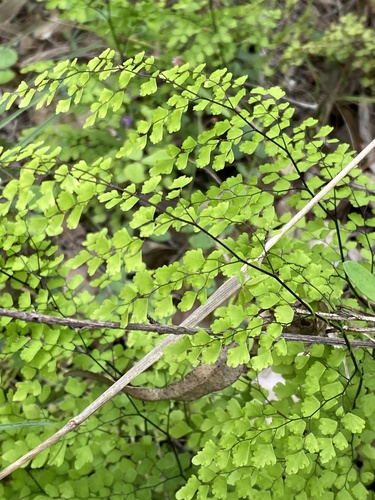
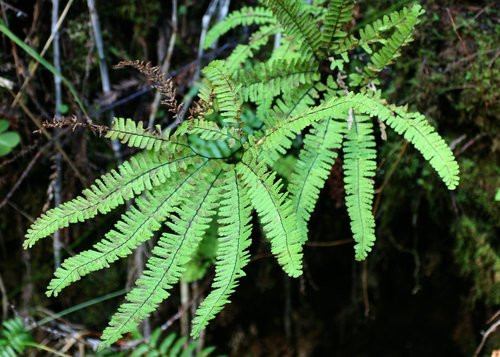
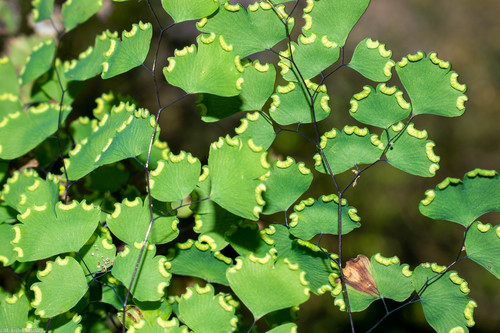
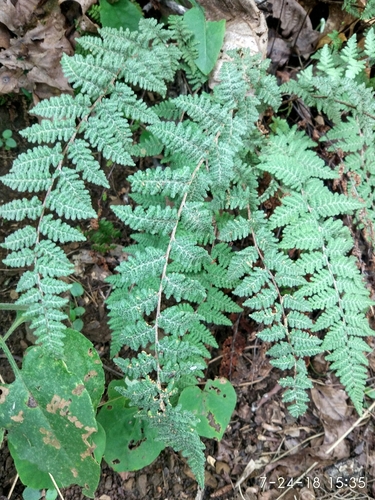
Myriopteris tomentosa, commonly called woolly lipfern, is a small evergreen fern that grows in tufts or clusters, with hairs covering most of its leaf surfaces. Its compact branching rhizome is typically 2–3 mm (0.08–0.1 in) or 4–8 mm (0.2–0.3 in) in diameter. The rhizome bears persistent scales 3–4 mm (0.1–0.2 in) long; these scales are linear to slightly lanceolate, straight or slightly twisted, loosely pressed against the rhizome surface, and have a broad dark central stripe sharply distinct from their narrow light brown, orange-tan, or pale reddish-brown margins. Fronds grow in clusters from the rhizome, and unlike in many ferns, they do not emerge as coiled fiddleheads, a trait called noncircinate vernation. Mature fronds are 8–45 cm (3.1–17.7 in) long and 1.5–8 cm (0.59–3.15 in) wide, and fertile and sterile fronds have a similar appearance. The stipe, the stalk of the frond below the leaf blade, is 5–20 cm (2.0–7.9 in) long, typically making up about one-third of the total frond length. It is dark brown or chestnut brown, covered in woolly, orange-tan jointed hairs and hairlike scales, and its upper surface is rounded. Leaf blades are oblong-lanceolate, usually tetrapinnate (divided into pinnae, pinnules, pinnulets, and pinnulet divisions) at the base. Each blade contains around 20 pairs of pinnae: these are opposite and widely spaced at the base of the blade, and grow closer together closer to the blade tip. Blades are gray-green in color. The rachis, the central leaf axis, is rounded on the upper side, dark brown, and bears soft uniform-shaped hairs along with scattered linear scales. Pinnae are not jointed at their base, and dark pigment from the rachis extends into the base of each pinna. Basal pinnae are roughly the same size as the pinnae immediately above them, and pinnae are more or less symmetric around the costa, the pinna axis. The upper side of the costa is green for most of its length. On the underside of the costa, there are multiple rows of linear scales no more than 0.1–0.4 mm wide. These scales are loosely overlapping, do not hide the leaf surface, and have a truncate base without cilia on their edges. This feature distinguishes the species from the similar Myriopteris rufa, which has broad costal scales that do conceal the leaf surface. The smallest leaf segments are ovate and bead-like, as in many Myriopteris species, and grow up to 1–2 millimeters (0.039–0.079 in) in length. The upper leaf surface has fine, soft, unbranched hairs, while the lower leaf surface is covered by a dense mat of woolly hairs. Each pinna has 6 to 11 pairs of pinnules. During drought, this fern shrivels into a brown curled mass that appears dead, but it revives when moisture returns. On fertile fronds, sori are protected by false indusia formed by the leaf edge curling back over the lower leaf surface. Sori form at the folded edge of the false indusium, or a short distance inward from this edge. The false indusia differ slightly in appearance and texture from other leaf tissue, and are 0.05 to 0.25 mm wide. Beneath the false indusia, the sori are more or less continuous around the margin of the bead-like leaf segments. Each sporangium in a sorus holds 32 brown spores. The triploid sporophyte has a chromosome number of 90. Reproduction is apogamous: triploid spores are produced by mitosis rather than meiosis, they grow into gametophytes, which then sprout a genetically identical sporophyte without fertilization. The species is very similar to M. rufa, but M. rufa has broader, more prominent costal scales, while M. tomentosa’s costal scales resemble hairs. Small specimens may be confused with M. gracilis, but M. gracilis only has true hairs, and lacks the narrow scales found in M. tomentosa. Myriopteris tomentosa is distributed across Mexico, ranging from Veracruz north along the eastern side of the country and west to Sonora. Further north, it occurs in the southwestern United States, widespread across Texas and Oklahoma to northwestern Arkansas and the southern edge of Missouri, and also extends through the Appalachian Mountains from Alabama through Virginia and West Virginia. Previous reports of this species from Pennsylvania were incorrect. Woolly lipfern typically grows on rocky slopes, in rock crevices, and on ledges, growing on a variety of rock types including limestone and granite, and occurs at altitudes between 200 and 400 meters (700 to 1,000 ft). Globally, Myriopteris tomentosa is secure (ranked G5), but it is threatened in a small number of U.S. states at the edge of its range. It is only known from historical records in Kansas. NatureServe ranks it as critically imperiled (S1) in Missouri and West Virginia, and vulnerable (S3) in North Carolina and Virginia. Myriopteris tomentosa can be cultivated in moist to dry, circumneutral, well-drained sandy garden soil. It is comparatively easy to grow, unlike some other members of its genus. It requires high light or full sun.