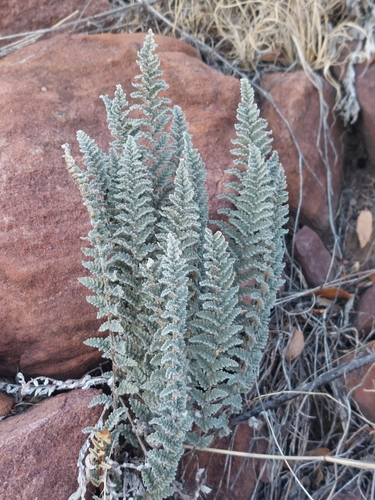
About Myriopteris rufa Fée
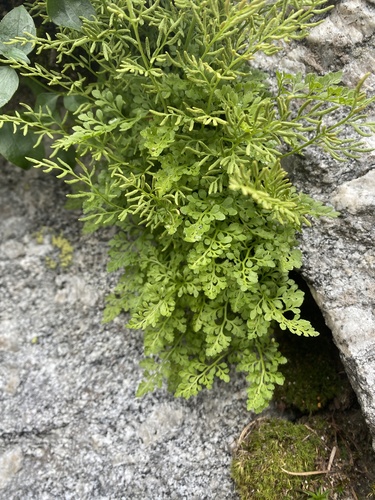
Myriopteris rufa Fée has a compact, horizontal, branching rhizome about 3 millimeters (0.1 in) or 4 to 8 millimeters (0.2 to 0.3 in) in diameter, with leaf blades closely spaced along its length. The rhizome bears persistent scales 3 to 4 millimeters (0.1 to 0.2 in) long, which are linear to slightly lanceolate, straight or slightly contorted, and loosely pressed against the rhizome surface. Scales have a broad, dark reddish-brown or black central stripe sharply differentiated from their narrow, light brown toothless (entire) margins. Fronds grow in clusters from the rhizome, and unlike many ferns, they do not emerge as coiled fiddleheads, a trait called noncircinate vernation. Mature fronds are 6 to 38 centimeters (2.4 to 15.0 in) long and 1.5 to 5 centimeters (0.59 to 1.97 in) wide. The stipe, the leaf stalk below the blade, is 3 to 16 centimeters (1.2 to 6.3 in) long, typically making up one-quarter to one-third of the total frond length. It is round in cross-section, and colored dark brown, chestnut brown, reddish-brown, or purplish-black. It bears abundant linear tan or white scales 1.5 to 2 millimeters (0.059 to 0.079 in) long, sometimes with additional narrowly lanceolate scales and a few hairs. Leaf blades are narrowly lanceolate to oblong-lanceolate, meaning they are broadest near but not at the base, and not much broader than the rest of the leaf. Blades are bi- to tripinnate, or tri- to tetrapinnate at the base, cut into pinnae, pinnules, pinnulets, and divisions of pinnulets. Each blade holds around 12 to 18 pairs of pinnae, is pointed (acute) at the tip, and blunt (obtuse) to truncate at the base. The rachis, the central leaf axis, is rounded on its upper side, dark brown, and bears uniform soft hairs plus linear-lanceolate scales. Pinnae are not jointed at their base, and dark pigment from the rachis extends into the pinna base. Basal pinnae are roughly the same size as the pinnae immediately above them, and pinnae are more or less symmetric around the costa, the pinna axis. The upper sides of costae are green for most of their length. The underside of costae bears multiple rows of lanceolate to linear scales no more than 0.4 to 0.7 mm wide. These scales are loosely overlapping but do not conceal the leaf surface, have a truncate or subcordate base, and lack lobes that overlap with other scales. Their margins are jagged to toothed (erose-dentate), and occasionally have one or two hairlike cilia at the base, with no cilia along the edges. This scale trait distinguishes M. rufa from the very similar Myriopteris tomentosa, where costa scales are linear and appear hairlike unless examined closely. The smallest leaf segments are oblong and obtuse to round and bead-like, as in many Myriopteris species, and reach up to 1 to 3 millimeters (0.039 to 0.118 in) in length. The upper leaf surface may have abundant fine, white to rusty, unbranched curly hairs 0.5 to 1 millimeter (0.020 to 0.039 in) long, or hairs may be sparse to almost entirely absent. The lower leaf surface is covered in a dense, woolly mat of curly reddish-brown hairs. On fertile fronds, the leaf edge curls slightly to protect the sori on the underside, but leaf tissue is not or only slightly differentiated into false indusia. When distinct, false indusia differ in appearance and texture from other leaf tissue, and are 0.05 to 0.25 mm wide. Under the false indusia, sori are more or less continuous around the margin of the bead-like leaf segments. Each sporangium in a sorus holds 32 brown spores. The triploid sporophyte has a chromosome number of 90. Reproduction is apogamous: triploid spores form by mitosis rather than meiosis, and grow into gametophytes that sprout a genetically identical sporophyte without fertilization. Intermediate specimens between M. rufa and M. windhamii (Cheilanthes villosa) are recorded from Texas and New Mexico, and may be hybrids. However, both taxa are apogamous in North America, so recent sexual hybridization is unlikely. Along with M. tomentosa, material previously classified as C. castanea, which has a relatively hairless upper surface, has been confused with M. gracillima; M. gracillima is smaller and has narrower scales underneath with long cilia. Myriopteris rufa occurs in the southwestern United States, from historically Arkansas, Texas and Oklahoma west to Arizona and Utah, and extends south through northern and eastern Mexico to Vera Cruz. Disjunct populations are found in the Appalachian Mountains in Virginia and West Virginia, and in Costa Rica, where one specimen (Gómez 683, CR) was collected in Cartago Province, in the Cordillera de Talamanca. It grows on the ground, rocky slopes, or ledges, particularly on limestone, and less commonly on basalt, at altitudes between 300 and 3,000 meters (980 to 9,800 ft). Several Appalachian populations grow in shale barrens or on shale or dolomite cliffs. Disjunct populations in northeast Texas occupy isolated rocky habitats, several of which were described by collector Correll as "iron ore rocks". This species is globally secure (ranked G5), but is threatened in some states at the edge of its range. It is only known historically from Arkansas. NatureServe ranks it as critically imperiled (S1) in Arkansas, imperiled (S2) in Virginia and West Virginia, and vulnerable (S3) in Colorado. This fern is easily cultivated. It should be grown under high light in well-drained garden soil supplemented with sand, where the soil remains dry to moist-dry.