About Myriopteris intertexta (Maxon) Grusz & Windham
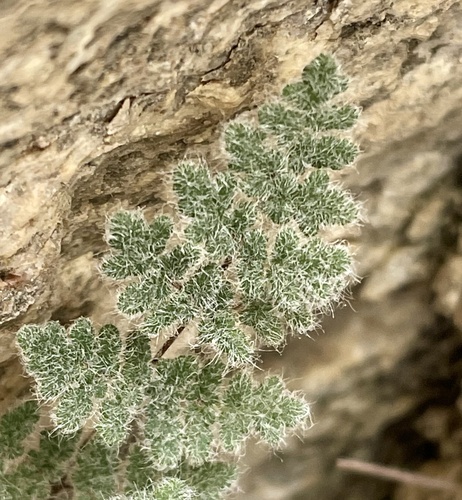
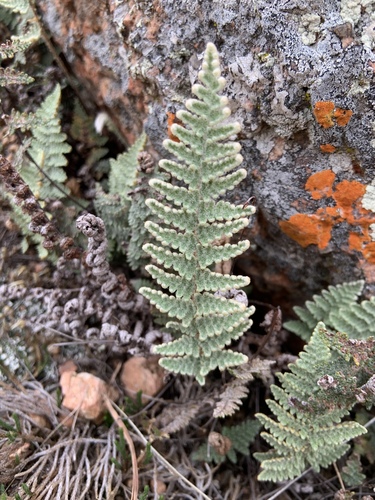
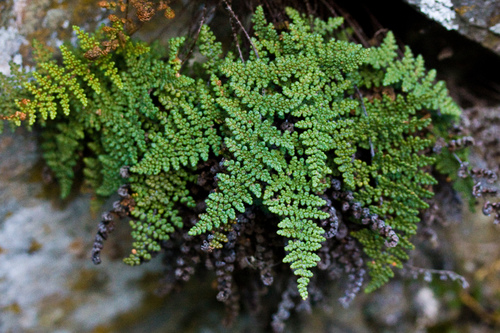
This fern, Myriopteris intertexta, grows clusters of dark green leaves that reach up to approximately 25 centimeters long. Each leaf is split into bumpy segments, which are further divided into pairs of rounded, bead-shaped ultimate segments. The edges of these ultimate segments curl under, creating a concave surface on their underside. Each ultimate segment is less than 3 millimeters wide, has sparse hairs on its upper surface, and bears scales on its underside. Its sori are mostly concealed beneath the scales and the curled leaflet margin, which acts as a false indusium. The long-lanceolate scales found on the underside of the leaflets are roughly 1 millimeter wide at their base. This width is intermediate between the scales of its two parent species: Myriopteris gracillima has very narrow, hair-like scales, while Myriopteris covillei has scales 2 to 3 millimeters wide. The leaves grow from a short, creeping rhizome, so plants often develop an elongated base that can creep along features like rock crevices. Myriopteris intertexta occurs naturally in Oregon, California, and eastern Nevada. There is also an apparently disjunct population located on Mount Olympus in the Wasatch Range of north-central Utah. The overall distribution of M. intertexta is intermediate between that of its two parent species: M. gracillima has a range that extends further north, while M. covillei has a range that extends further south and east into southern California, Arizona, the Baja California peninsula, and central Mexico.