About Myriopteris gracillima (D.C.Eaton) J.Sm.
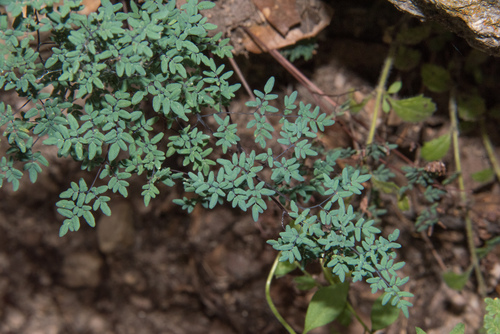
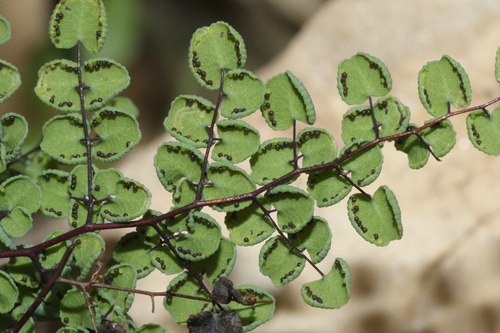
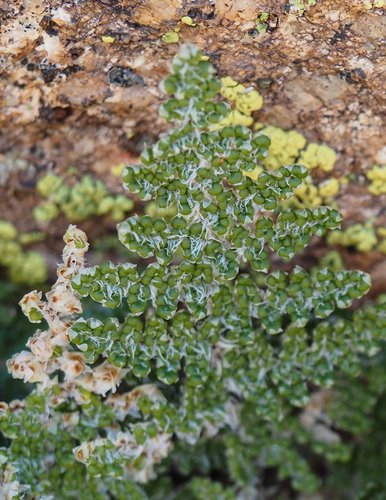
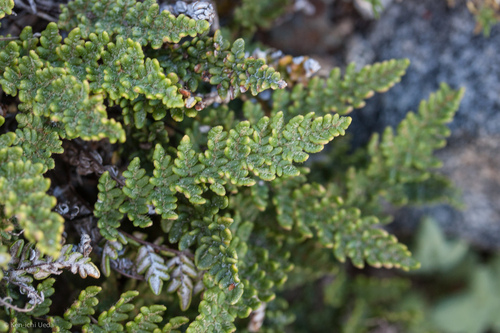
The scientific name of this fern is Myriopteris gracillima (D.C.Eaton) J.Sm. Leaf bases are closely spaced along the rhizome, which is 4 to 8 millimeters (0.2 to 0.3 in) in diameter. The rhizome is ascending and branches, and it bears brown to light brown scales. Scales are sometimes uniformly colored, or sometimes have a darker, poorly defined central stripe that may be red-brown. They are linear-lanceolate in shape, straight or tightly twisted, with entire (toothless) edges, and are only loosely appressed (pressed against the surface of the rhizome). The scales are not shed as the rhizome ages. Fronds arise from the rhizome in clusters, and do not unfold as fiddleheads like typical ferns (this is called noncircinate vernation). When mature, fronds are 5 to 25 centimeters (2.0 to 9.8 in) in length, occasionally reaching up to 30 centimeters (12 in), and 1 to 2 centimeters (0.4 to 0.8 in) wide, occasionally reaching up to 3 centimeters (1 in). The stipe (the leaf stalk below the blade) is 2.5 to 14 centimeters (0.98 to 5.5 in) long and about 1 millimeter (0.04 in) wide, rounded on the upper surface, and colored dark brown or medium brown to purplish-black. It bears a few linear-lanceolate scales that are ciliate at the base, pale, and uniformly colored. Leaf blades are linear-oblong or elliptic-lanceolate in shape, around 3 to 5 times longer than they are wide. They are typically 3 to 10 centimeters (1 to 4 in) long and 0.6 to 2.5 centimeters (0.24 to 0.98 in) wide, with an obtuse to truncate base and an acute to acuminate tip. The blade is usually bipinnate (cut into pinnae and pinnules) to tripinnate (cut into pinnae, pinnules, and pinnulets) at the base. The rachis (leaf axis) is rounded on the upper side and bears a few linear scales. At the base of each pinna, the dark color of the costa continues into the pinna base, and there is no distinct joint between the stalk and leaf. Basal pinnae are similar in size to the pair of pinnae just above them. The upper surfaces of the costae (pinna axes) are green for most of their length. The upper surfaces of the leaf blades are free of hairs and scales, while the lower surfaces are covered in many pale-brown, curly hairs, along with a few narrow scales. On fertile fronds, the leaf margin is strongly folded under to cover the sori, and an extremely narrow band of tissue along the margin forms a false indusium. Myriopteris gracillima is a small fern with dark green leaves up to around 25 cm (10 in) long that arise from a short creeping ground stem (rhizome), so plants often have an elongated base, for example creeping along a rock crevice. Each frond is intricately divided into segments made up of pairs of smaller segments that are oval and oblong beadlike, with edges rolled under, giving the fern a somewhat succulent appearance. It is also quite hairy and scaly, mostly on the underside of the leaf and leaf mid-rib. Sori are located within the rolled-under margins (false indusium) of each tiny leaf segment. This fern usually grows in sun in crevices in rock formations, or sometimes in thin soil in and around rocks. A more technical description adapted from Burke Herbarium describes Myriopteris gracillima as a lithophytic perennial, with leaves emerging from short creeping stems that are 4–8 mm (0.2–0.3 in) in diameter with narrow scales that are uniformly brown or have a weakly defined dark central stripe; the scales are straight to somewhat contorted, loosely appressed, and persistent. Leaves are 5–25 cm (2–10 in) long and 1–2.5 cm (0.4–1 in) wide, borne on a dark brown petiole. The leaf blade is linear-oblong and 2–3-pinnate at the base. The rachis is rounded on the upper surface, with scattered linear scales. Pinnae are not jointed at the base, and the dark stalk color continues into the pinna base. Pinnae are usually equilateral, appearing slightly pubescent or glabrous on the upper surface, with pinna midribs green on the upper surface for most of their length. Scales on the underside of the rachis are arranged in several rows, linear and truncate at the base, inconspicuous, 0.1–0.4 mm (0.004–0.02 in) wide at most, loosely overlapping, do not hide the ultimate segments, and are long-ciliate with cilia typically confined to the base. The ultimate pinna segments are oblong or rarely ovate and beadlike, 1.5–3 mm (0.06–0.1 in) at most. The lower leaf surface is densely covered with branched hairs and small ciliate scales. The upper leaf surface has scattered branched hairs, which tend to be shed as the leaf ages. Myriopteris gracillima is native to mountains in western North America, ranging from British Columbia to California and southern Nevada. It is absent from lower elevation dry inland areas such as the shrub-steppe of central Washington and Oregon and the central valley of California, but is present in the Rocky Mountains in British Columbia, Idaho, western Montana, northeastern Utah, and Nevada. It is also found at low elevation in the Columbia River gorge only in the region where it transects the Cascade Mountain range, presumably due to higher precipitation there. It grows primarily in sunny exposures in rock crevices with little or no soil. Like many cheilanthoid ferns, M. gracillima tolerates desiccation well. During an extended dry period, leaves curl and expose their hairy abaxial (lower) surface, presumably to reduce water loss. The leaves uncurl and return to green when moisture returns. Myriopteris gracillima can be cultivated, and should be grown under high light in well-drained garden soil with sand. The soil should be moist-dry and subacid.