About Myriopteris gracilis Fée
This fern, scientifically named Myriopteris gracilis Fée, has short, branching rhizomes with closely spaced leaf bases. The rhizomes grow upright or ascending rather than horizontally, and measure either 2 to 3 millimeters (0.08 to 0.1 inches) or 4 to 8 millimeters (0.2 to 0.3 inches) in diameter. The rhizome bears persistent linear-lanceolate scales that are slightly jagged (erose) at the margins, slightly twisted, and loosely pressed against the rhizome surface. Scales are brown, ranging from light to red-brown, orange-brown, or pale brown, and most have a blackish or dark central stripe.
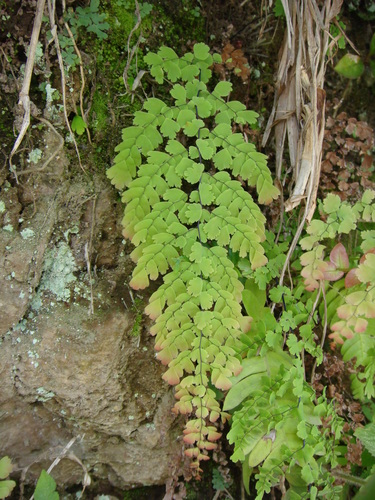
Fronds grow in clusters from the rhizome, reaching 4 to 20 centimeters (2 to 8 inches) long and 1.5 to 3 centimeters (0.59 to 1.2 inches) wide, and emerge as coiled fiddleheads in a pattern of circinate vernation. The stipe, the leaf stalk below the blade, makes up one-third to one-half of the total frond length. It measures 2 to 8 centimeters (0.8 to 3 inches) long and about 1 millimeter (0.04 inches) wide, is rounded on its upper surface, and ranges in color from dark brown to black, or reddish-brown to blackish. It bears straight, multicellular hairs less than 2 millimeters (0.08 inches) long, which are pale to tan with orange constrictions.
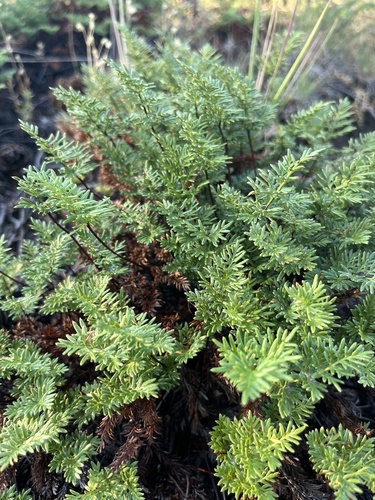
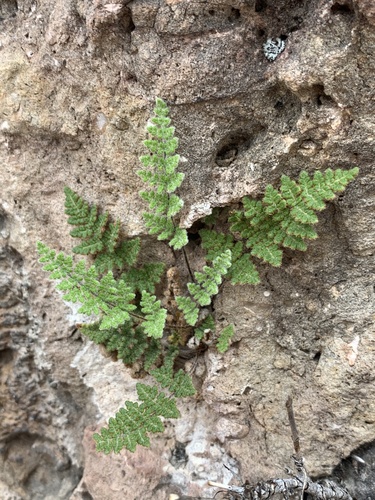
Leaf blades are linear-oblong to lanceolate or linear-lanceolate in overall shape, typically 2.5 to 7 centimeters (0.98 to 2.8 inches) long, occasionally reaching 10 centimeters (3.9 inches), and 1 to 3 centimeters (0.4 to 1 inch) wide. Blades are obtuse to truncate at the base and acute at the tip, and are typically bipinnate-pinnatifid (divided into pinnae with lobed pinnules) to tripinnate (divided into pinnae, pinnules, and pinnulets) at the base. The rachis, or central leaf axis, extends from the stipe and shares similar morphology: it is rounded on the upper surface, densely covered in uniform hairs, and lacks scales.
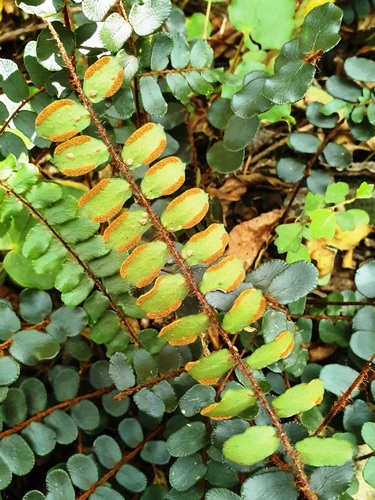
There are typically 3 to 10 pairs of pinnae, which are shaped from narrowly to broadly deltate. The dark color of the costa continues into the base of each pinna, with no distinct joint between the pinna stalk and the leaf. The lowest basal pinnae are slightly smaller than the pair of pinnae just above them. The upper surfaces of the costae, or pinna axes, are brown for most of their length. Pinnulets are round or slightly oblong with a beadlike appearance; larger pinnulets measure about 1 to 3 millimeters (0.04 to 0.1 inches) across. Blade tissue is pale green. The upper leaf surface has at most a sparse covering of hairs and may be almost hairless (glabrescent), while hairs form a dense covering on the lower leaf surface. Leaf hairs are long, segmented, white to brown or reddish-brown, and curved but not intertwined.
On fertile fronds, the leaf edge folds under to form a false indusium 0.05 to 0.25 millimeters wide. The tissue of these false indusia is only weakly different from the rest of the leaf blade tissue. Beneath the false indusia, sori are more or less continuous around the margins of the beadlike leaf segments, and tend to be hidden more by dense hairs than by the folded leaf margin. Each sporangium contains 32 spores. Individual sporophytes are apogamous triploids, with a chromosome number of 2n = 90.
Myriopteris gracilis is native to much of western North America, ranging from British Columbia and Alberta south to northern Mexico, and throughout much of the central United States. Its distribution is centered on the Rocky Mountains. It occurs less frequently east of the Rockies in the Great Plains, but is found in many locations in the Driftless Area and the Ozarks. A small number of populations occur as far east as Kentucky, Virginia, and North Carolina. In Mexico, it is recorded from the northernmost states of Chihuahua and Coahuila, and more recently from Sonora. It grows in crevices on cliffs and ledges, or in soil on rocky slopes. It prefers calcareous rocks such as limestone or dolomite, but sometimes grows on sandstone, and rarely grows on granite.
In cultivation, M. gracilis can be grown in well-drained garden soil amended with sand. The soil should be basic, and is best kept dry. It prefers full sunlight.