About Myriopteris fendleri (Hook.) E.Fourn.
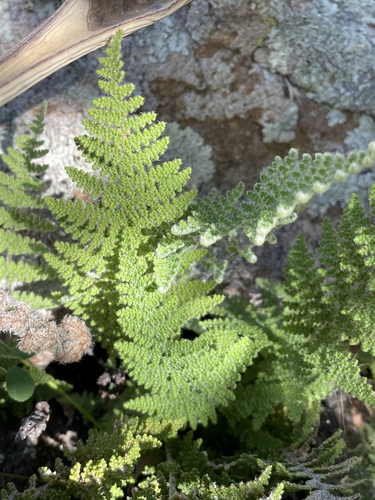
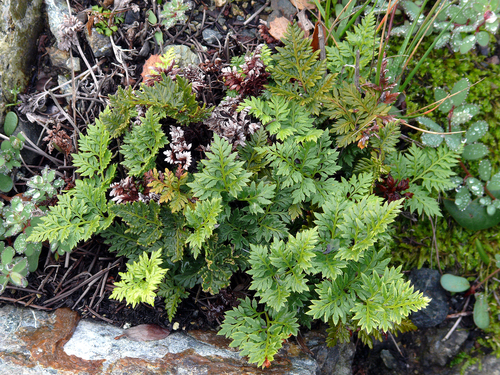
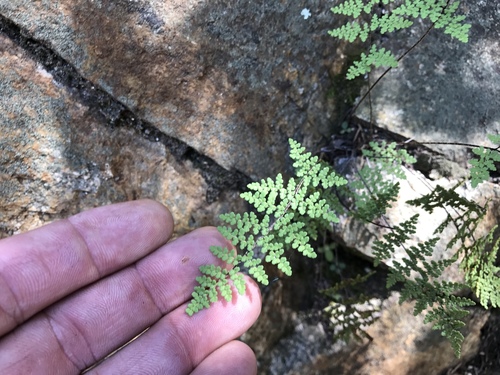
Myriopteris fendleri (Hook.) E.Fourn. grows from a short- to long-creeping rhizome that is 1 to 3 millimeters (0.04 to 0.1 in) in diameter. The rhizome is covered in shiny, uniformly brown lanceolate scales around 2 millimeters (0.08 in) long, which lack marginal teeth or projections. Occasionally, these scales are paler brown with a dark brown central stripe. They are straight or slightly twisted, loosely appressed (pressed against the rhizome surface), and often fall off older parts of the rhizome. Fronds are more or less scattered, and do not unfurl as fiddleheads, exhibiting noncircinate vernation. Full leaves, including the stalk, measure 7 to 30 centimeters (3 to 10 in) in total length. The stipe, the leaf stalk below the blade, makes up roughly half of the total leaf length, ranging from 3 to 17 centimeters (1.2 to 6.7 in) long. It is dark brown to dark shiny reddish-brown or purplish-black, and rounded rather than grooved on its upper surface. Scattered scales, but no hairs, are found on both the stipe and rachis (leaf axis). The loosely overlapping scales are linear, whitish, and 1 to 2 millimeters (0.04 to 0.08 in) long. Slightly wider, lanceolate scales with long teeth at the base may also grow on the stipe. Leaf blades range from narrowly oblong to lanceolate, and may even be ovate-deltate in shape, typically measuring 4 to 14 centimeters (1.6 to 5.5 in) long and 1 to 5 centimeters (0.39 to 2.0 in) wide. They are obtuse at the base and acuminate at the tip. Blades are typically tripinnate (divided into pinnae, pinnules, and pinnulets) at the base, and pinnulets may be further split into segments. The rachis (leaf axis) is rounded and somewhat scaly like the stipe, with no hairs present. The dark color of the leaf axes extends into the pinna bases, with no joint present. Each leaf usually has 10 to 14 pairs of pinnae, and the lowest pair is similar in size and shape to the pair above it. The costae (pinna axes) are dark at the base but mostly green on the upper surface. On the underside, they are covered in overlapping scales that often hide leaf segments from below. These scales are lanceolate to deltate-lanceolate, with truncate to subcordate (slightly notched) bases, and no overlapping basal lobes. Larger scales are 0.4 to 1.2 millimeters (0.016 to 0.047 in) wide. Scale margins are entire (untoothed) to denticulate (small-toothed) and do not bear cilia. The ultimate leaf segments are bead-like, measuring 1.5 to 3 millimeters (0.06 to 0.1 in) in diameter. They may have a few scales on the underside of their base, but are otherwise free of scales and hairs. On fertile fronds, sori are protected by false indusia formed by the leaf edge curling back over the underside. The false indusia are undifferentiated or only slightly differentiated from other leaf tissue, and are 0.05 to 0.25 mm wide. Under the false indusia, sori are more or less continuous around the edge of the leaf. Each sporangium in a sorus holds 64 brown spores. Individual sporophytes are sexual diploids with a diploid chromosome number of 2n = 60. Myriopteris fendleri is native to the southwestern United States and northwestern Mexico. In the United States, it occurs throughout Arizona east to western Texas and as far north as northern Colorado, with scattered populations in northern Texas and Oklahoma. In Mexico, it is found in Baja California Norte and Sonora, and has also been reported from Chihuahua. It most commonly grows on rocky slopes and ledges in crevices, or in soil at the base of boulders. It grows on a variety of rock substrates, both acidic and mildly basic. In Mexico, it occurs in pine–oak forest or pine–fir forest. M. fendleri can be grown relatively easily in rocky, subacid soil or well-drained garden soil. It tolerates moist to dry conditions and prefers full sunlight.