About Myriopteris aurea (Poir.) Grusz & Windham
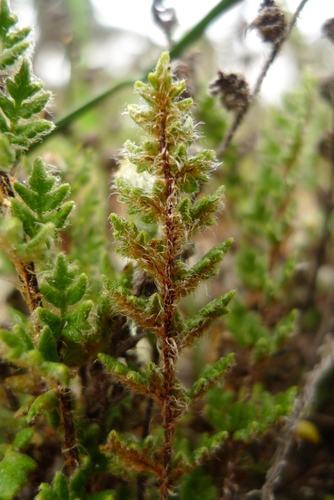
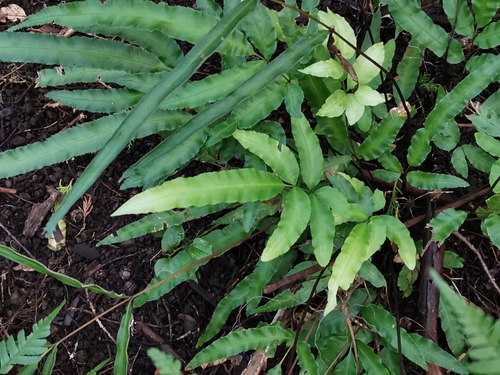
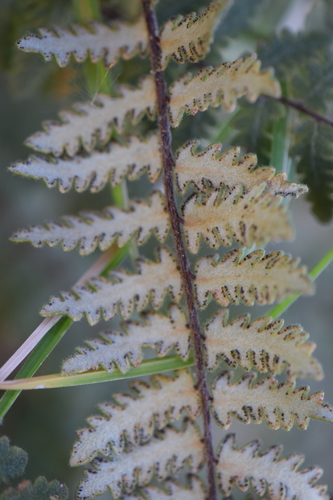
The horizontal rhizome of Myriopteris aurea has leaf bases that are closely spaced along it, and its diameter has been variously reported as 3 mm (0.1 in) or 4 to 8 mm (0.2 to 0.3 in). The rhizome carries linear to lanceolate scales, which have entire (untoothed) or subentire (very slightly toothed) margins. These scales are bi-colored: they have a shiny central stripe in shades of red-brown, shiny chestnut-brown to black, paired with narrow light-brown margins. The scales measure 3 mm (0.1 in) long, are slightly twisted, and lie strongly pressed against the rhizome. Fronds grow in clusters, and unlike many ferns, they do not unfurl as fiddleheads, a trait called noncircinate vernation. Mature fronds range from 10 to 60 cm (3.9 to 24 in) long, and may reach up to 75 cm (30 in), with a width of 0.5 to 3.5 cm (0.20 to 1.4 in). The stipe, the leaf stalk below the blade, makes up one-sixth to one-third of the total leaf length, and measures 3 to 15 cm (1.2 to 5.9 in) long. The upper surface of the stipe is rounded rather than grooved, and has a shiny color ranging from dark chestnut brown to black or purplish-black. It is covered in straight, white to tan hairs that are 2 mm (0.08 in) long, and lie more or less pressed against the stipe. Leaf blades are linear to lanceolate or elliptical, and are pinnate-pinnatifid, meaning they are cut into deeply lobed pinnae. This makes them much less dissected than most other Myriopteris species. Leaf blades measure 1 to 4 cm (0.4 to 2 in) wide. The rachis, the central leaf axis, is densely covered in soft pubescent hairs, and does not have scales. Between 15 and 44 pairs of pinnae are present, and attach directly to the rachis or via a short stalk. Each pinna is approximately equilateral in shape, and holds 3 to 8 pairs of lobes. The lobes may be cut anywhere from one-quarter to three-quarters of the distance to the costa, the pinna axis. Lobe number and cutting depth vary widely between individual plants. Pinnae connect to the rachis via a distinct stalk; the dark color of the rachis extends into this stalk, but ends abruptly at a swollen node covered in hairs. The lowest pair of pinnae is slightly smaller than the pair positioned just above it. At the tip of the frond, pinnae gradually taper to an acute or obtuse apex. Leaf texture ranges from parchment-like to almost leathery. The upper surface of the pinnae is covered with scattered to abundant stiff, one-celled hairs that lie flattened against the surface. These hairs are about 2 mm (0.08 in) long, and pale golden-tan in color. The lower surface of the pinnae is also covered in hairs, matted so thickly that the underlying leaf tissue is hidden. These hairs range from white, particularly in young individuals, to rusty red in color. Fronds do not curl up when dried out. On fertile fronds, sori form at the ends of veins near the leaf margin, creating a more or less continuous zone adjacent to the margin. The margin curls back slightly, but does not form a distinct false indusium to protect the sori. The recurved margin measures 0.05 to 0.25 mm wide, and is somewhat thinner and more delicate than the rest of the leaf tissue, though it is not fully hyaline. Each sporangium holds 32 dark brown to black spores. The vast majority of examined M. aurea individuals are apogamous triploids, with a chromosome number of 90 present in both the sporophyte and gametophyte generations. A few populations that produce 64 spores per sporangium have been reported, and these are presumed to be sexual diploids. Among closely related Myriopteris species, M. aurea is most similar to M. yatskievychiana, a species known only from Sonora that is smaller and has dense white hairs rather than rusty hairs on the underside of its leaves. The pinnate-pinnatifid leaf blades shared by these two species distinguish them from all other members of the genus, which have more highly dissected leaves. M. aurea bears a superficial resemblance to some species of Astrolepis, such as A. sinuata, which also have short, deeply lobed pinnae. However, Astrolepis species bear the stellate scales that give the genus its name, rather than the simple hairs found on M. aurea. In the southern part of M. aurea's range, it may be confused with Cheilanthes fraseri. C. fraseri differs in having leaves that are widely spaced along the rhizome, more or less triangular pinnae rather than equilateral pinnae, and rhizome scales that are light brown at the apex rather than dark brown. Myriopteris aurea grows throughout Mexico, with the exception of Tabasco and the Yucatan Peninsula, and it is the most widespread and abundant fern in the country. Its range extends a short distance north into the United States, where it occurs in Arizona, New Mexico, and Trans-Pecos Texas. To the east, it is found in the Greater Antilles and Venezuela. To the south, it extends through Central America into South America, growing along the Andes Mountains where it has been described as "one of the characteristic ferns of the Altiplano". It reaches as far south as Chile and Argentina, and extends east into Brazil, Paraguay and Uruguay. This species grows on dry rocky slopes, cliffs, soil banks, and shrubby hillsides. It can grow on a variety of different rock types, though it is comparatively uncommon on limestone. It occurs at altitudes ranging from 600 to 3,800 meters (2,000 to 12,000 ft). This species is ranked globally secure (G5) by NatureServe, which has not assigned conservation rankings to the three U.S. states where it grows at the northern edge of its range. It has been observed growing apparently established in various urban areas of Mexico City and other rocky valleys across the Americas. Its semi-epiphytic habit makes it highly adaptable to closed, sufficiently humid environments, and also allows it to withstand high temperatures and abrupt environmental changes. For these reasons, it can be considered effectively self-sustaining. However, the natural habitats that have been replaced by human activity have resulted in a reduction of its original growth range. Myriopteris aurea can be cultivated in moist-dry to dry garden soil amended with sand. The soil must be well-drained, and the species requires high levels of light. Writing in 1892, horticulturist George Schneider noted it was "an old inhabitant of our gardens". In 1898, Edward Palmer collected a specimen from a market in Saltillo, where he reported a decoction of the plant was prepared and drunk to treat "pain in the stomach" and "coughs".