About Myriophyllum verticillatum L.
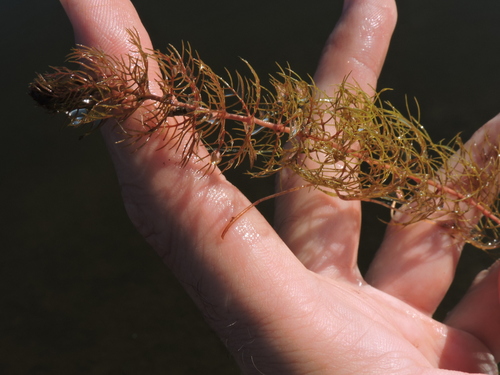
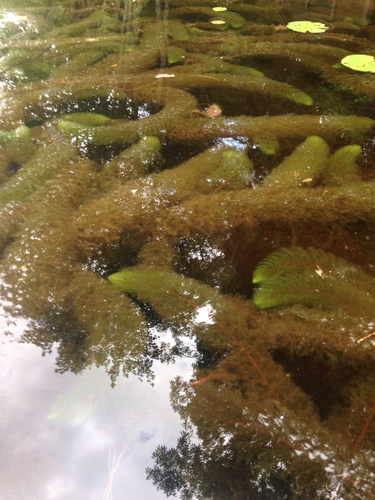
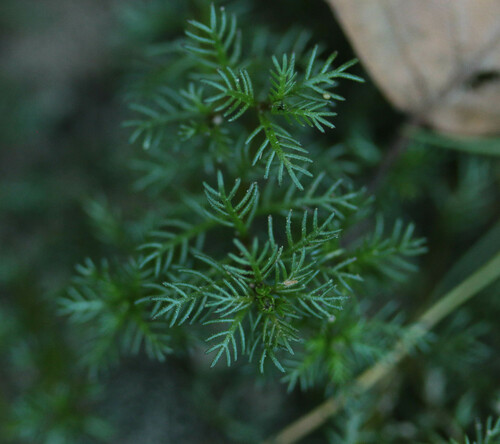
Myriophyllum verticillatum L., commonly called whorled water milfoil, can most easily be identified by its two distinct leaf types. The first type is submerged leaves, which have a feathery appearance and hold 5 to 14 pairs of leaflets per leaf. Along the stem, leaf whorls contain 4 to 5 leaves, spaced roughly 1 cm apart. The second type is emergent leaves, which grow on the plant's emergent spike and are pinnately lobed. From June through September, this species produces flowers and fruits at or above the water surface on erect spikes positioned among the emergent leaves; emergent leaves are typically at least twice as long as the associated flowers and fruits. A second distinguishing feature of whorled water milfoil is its production of turions, special winter buds that form at the end of the growing season. It is one of only a few milfoil species that produce turions, and this trait allows it to be distinguished from other turion-lacking milfoil relatives including Eurasian water milfoil, parrot feather, hybrid water milfoil, and low water milfoil. The turions of this species are long, yellowish-green, club-shaped buds covered in small stiff leaves, and form attached to the plant's submerged stem. After winter dormancy in spring, the small, thick, dark green turions expand and grow from the stem. As the plant develops roots and continues growing, larger green summer leaves form at the plant's tip. Turion leaves may remain visible at the base of the plant into some years' July. In fall, turions along with other plant fragments often break away from the main rooted plant and float to new areas, and these detached fragments commonly wash up along shorelines in late fall. Whorled water milfoil stems, which may be branched or unbranched, grow 20 to 100 inches long and form dense mats. This species most commonly grows in semi-shallow water bodies including ponds, lakes, marshes, and ditches, as well as slow-flowing streams in lowland regions. It grows best on light sandy bottoms and medium loamy soils, and thrives in still, alkaline water. It is often found growing alongside or near other aquatic plants, including the pondweeds Potamogeton strictifolius and Potamogeton ogdenii, water star-grass (Heteranthera dubia), and water-marigold (Megalodonta beckii). Whorled water milfoil is native to most of North America, the United Kingdom, Asia, and North Africa, and is classified as invasive in Ireland. The species reproduces both sexually and via turions. It produces turions each year between September and November; these overwintering structures sink to the water bottom and remain dormant until February, per 2006 research by Caffrey. In spring, turion fragments grow numerous small thin roots that anchor into soil to start new growth. Whorled water milfoil is monoecious, meaning individual flowers are either male or female, but both flower types occur on the same plant, and it is pollinated by wind. When present in small quantities, such as in fish and frog ponds, whorled water milfoil acts as a good water oxygenator. It also provides protection and supports respiration for fish spawn. No definitive management techniques for controlling this species are confirmed, and natural competition with other invasive aquatic plants has been the main control method used to date. A small number of management practices are currently used in some locations, but none have been approved for long-term use.