About Myriophyllum aquaticum (Vell.) Verdc.
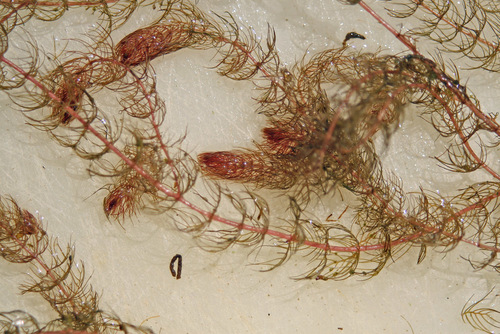
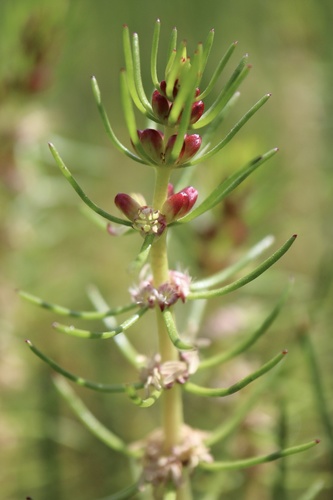
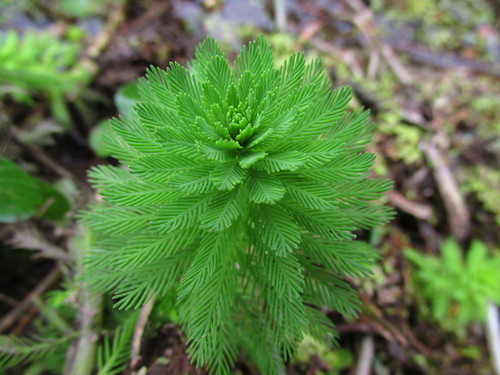
Myriophyllum aquaticum (Vell.) Verdc., commonly called parrot feather, is a perennial plant named for its feather-like leaves, which grow in whorls of four to six around the stem. Its most distinctive features are emergent stems and leaves that can grow up to one foot above the water surface, with a growth habit resembling small fir trees. Woody emergent stems can reach over 5 feet (1.5 meters) tall, and extend out to banks and shorelines. The plant produces small pinkish-white flowers that measure approximately 1/16 of an inch long. As water warms in spring, the species begins to grow vigorously. Most plants flower in spring, though some also flower in autumn. Almost all individuals of this species are female; no male plants have ever been found outside of South America. No seeds are produced by North American plants of this species, so parrot feather reproduces asexually: new plants grow from fragments of already rooted established plants. Parrot feather has whorls of feathery leaves, which range in color from blue-green to waxy grey-green, and are deeply cut into many narrow lobes. Recently, Kasselmann described a new variety, M. aquaticum var. santacatarinense, which differs from the typical variety in its stiffer, more robust growth habit, and its fewer, broader pinnae. Parrot feather is native to the Amazon River in South America, but can now be found on every continent except Antarctica. It is thought to have been introduced to North America around the late 1800s, and was first discovered in the United States in the 1890s in Washington, D.C. During the 20th century, it colonized areas in South Africa, Japan, England, New Zealand, and Australia. It typically grows in nutrient-rich freshwater streams, ponds, lakes, rivers, and canals. Because it prefers a warmer climate, it is found mainly in the southern parts of the United States. Today, parrot feather is used in indoor and outdoor aquariums, and is a popular plant for aquatic gardens. It spreads easily, and has become an invasive species and noxious weed in many areas. It can be introduced to new areas when sections of its rhizome are dug up and moved. In Florida, United States, flea beetle larvae use parrot feather as a host.