About Myriophyllum alterniflorum DC.
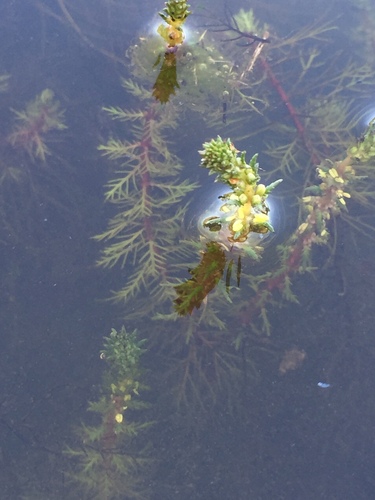
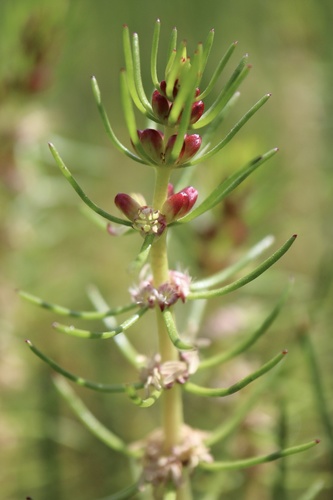
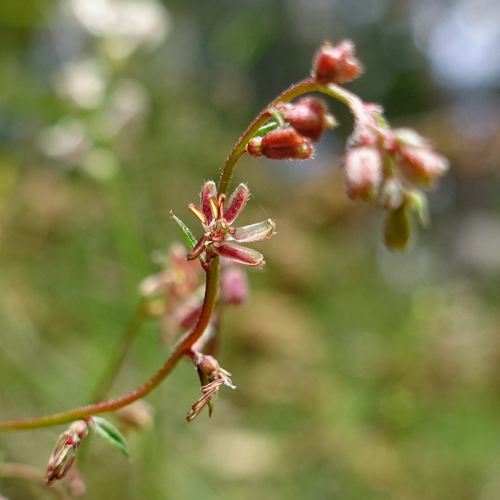
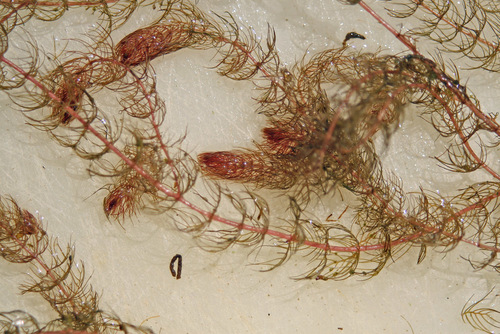
Myriophyllum alterniflorum DC. is an aquatic plant that grows to approximately 4 feet (1.2 m) tall, with stems ranging from 1 to 4 feet (0.3 to 1.2 m) long. Stems are often submerged in either murky or clear water. This species produces both submerged and above-water leaves, and leaf location influences the leaf's physical characteristics. Leaf blades measure 3–22 mm (0.12–0.87 in) long, with emergent leaves smaller than submerged leaves. All leaves grow in a whorled arrangement, with 3 or more leaves per stem node. Leaves are most often arranged at eight nodes along each stem, are typically red and green, and only rarely brown. Flowers grow above the water, with attached fruit. Each fruit measures 1.5 mm in length. When fully ripe, dry fruits split apart. This plant is perennial, so it blooms across three or more growing seasons, and its flowers are small. Flowers bloom in August, when they emerge from the water. M. alterniflorum inhabits shallow areas of slow-moving water bodies including rivers and lakes. It prefers fresh or brackish water, which is a mix of saltwater and freshwater. It grows in sandy and mucky substrates, and favors a pH range of 5.4–11, an alkaline environment where it thrives best. This species is native to Europe, occurring mostly in France. It is also found across North America, in Canada and the U.S. states of Massachusetts, Connecticut, Maine, New Hampshire, Rhode Island, and Vermont, and is present in all U.S. states except Hawaii and Wyoming. In New England, it is most common in Maine, especially in slow-moving river and lake habitats. It was introduced to Mountain Lake in San Francisco, California in 1888.