About Myrichthys maculosus (Cuvier, 1816)
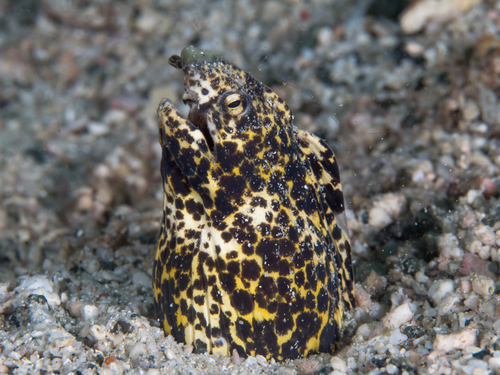
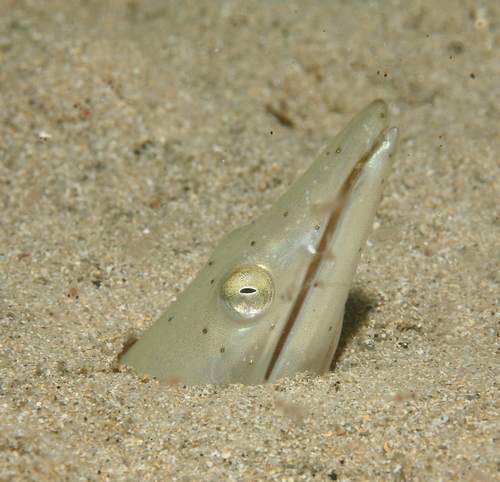
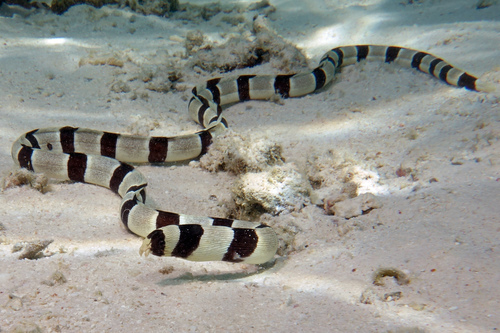
Myrichthys maculosus is an elongated, snake-like fish. It can reach a total length of 1 m (40 in), though most individuals grow to a more common 50 cm (20 in). It has a small head with a short snout, and long tubular nostrils that point downward. Each jaw has two rows of teeth, and there are an additional two rows of teeth on the palate. The dorsal fin originates just behind the head, while the anal fin starts halfway along the body; both fins extend close to the tip of the tail. This species has no pelvic or caudal fins, and its pectoral fins are small. The body of the fish is cream or yellow, marked with large brown or black circular or oval spots. Young individuals have a single longitudinal row of spots, while larger adults have three rows. Myrichthys maculosus occurs in the tropical and warm temperate Indo-Pacific region. Its distribution ranges from East Africa and the Red Sea to French Polynesia and the Galápagos Islands, and extends from Japan to eastern Australia. It is not found in Hawaii, where it is replaced by the closely related magnificent snake eel (Myrichthys magnificus). This species inhabits lagoons, reef flats, seagrass beds, and sandy plains, and can be found at depths down to around 260 m (850 ft). It is primarily nocturnal, but may occasionally be seen swimming over sandy or vegetated areas during the day. Most of the daytime is spent buried in sand, which it digs into tail first. It relies on its well-developed sense of smell to find prey, which includes crustaceans, banded snake eels, and other small fish buried in the sediment. At night, it sometimes forms large aggregations in areas with artificial lighting. Little information is available about the reproduction of this species; it has separate sexes, and its larvae are leaf-shaped and called leptocephali.