About Myrichthys colubrinus (Boddaert, 1781)
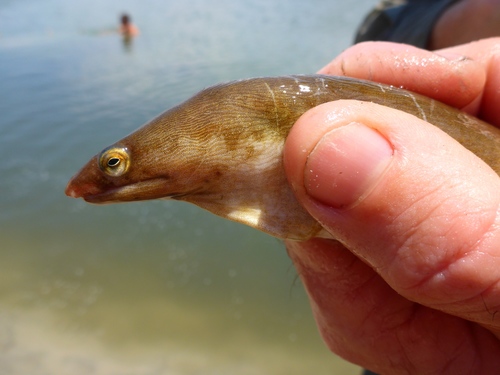
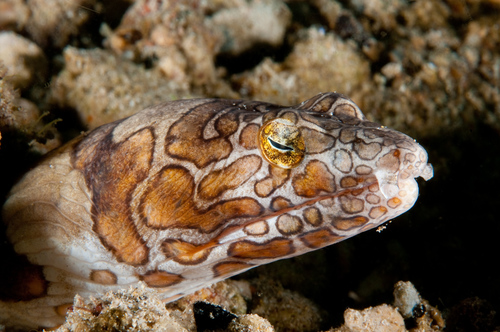
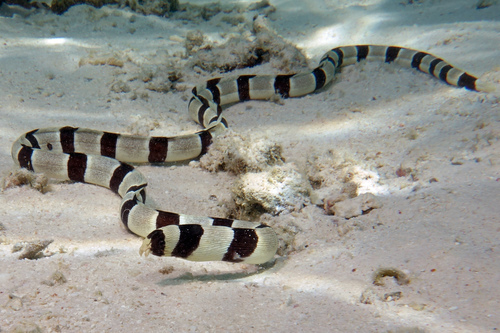
Myrichthys colubrinus, commonly known as the banded snake eel, is most notable as a Batesian mimic of the highly venomous sea krait. As a non-venomous species, it avoids predation by copying the visual appearance and movement of the venomous sea krait, and it can be very difficult to distinguish the two animals when viewed from a distance when they occupy the same area. This eel has broad black and white bands running from its anterior to posterior end. The white portions of its body have a slight grey tinge, which provides a subtle countershading effect, and white bands lighten as they approach the adjacent black bands. There is considerable natural variation in band size across the species, which is suspected to stem from regional banded snake eels matching local phenotype variations of the sea kraits they mimic. Adult individuals have between 25 and 35 bands total. This species belongs to a family of eels commonly called snake eels or worm eels, named for their characteristic long, narrow, cylindrical, smooth bodies with no other defining external features. Banded snake eels have a circular cross-section, a sharply pointed head, and a sharply pointed tail. Reported vertebral counts for the species range from 190 to 202, with most sources noting 198 to 202 vertebrae. A defining trait of the genus Myrichthys is the placement of posterior nostrils, which sit either within the mouth or along the upper lip, while anterior nostrils are noticeably protruding and tubular in shape. Myrichthys eels also have molariform teeth; the banded snake eel specifically has granular teeth arranged in two rows along the jaw. On average, adult banded snake eels measure 51 to 68 centimeters in total length from snout tip to tail tip, and the largest recorded specimen measured 97 centimeters. Small pectoral fins are visible behind the gills, and the only other visible fin is the dorsal fin, which blends into the body and runs the full length of the back to the tail. This fin, alongside the eel's body shape, supports its movement. Myrichthys colubrinus moves through slow, methodical undulations, bending its entire body along the spine into an S-shape to propel itself through water and across the rocky and coral reefs it inhabits. As early as 1922, scientists observed this species in muddy areas of Ambon, in the East Indies. The family Ophichthidae, which this species belongs to, is one of the most widely distributed families of eels, spread across the Indo-Pacific region across a wide range of depths. Members of this family are most commonly found in coastal waters ranging from Australia to Japan and Hawaii, with some species occurring off the coast of Mexico. Many species burrow into the sandy seabed of tropical and subtropical waters, and family members can be found from intertidal zones down to depths of 800 meters, with the highest populations in shallow tropical coastal waters. It can be difficult to confirm exact species distributions within this family, because most individuals stay buried in sand with only their heads exposed. The banded snake eel itself is a very widespread species. It has been recorded in the Indian Ocean, Red Sea, along the southern coast of Africa, across many Pacific island chains including the Line Islands, Society Islands, and Tuamotu archipelago, and in the western Pacific off the coasts of New South Wales, Australia, and Japan, with recent records off the coast of Hawaii. The larval development and reproduction of the genus Myrichthys is poorly understood. Like all members of the Ophichthidae family, banded snake eels and their larvae are primarily nocturnal. All ophichthid eels produce pelagic leptocephalus larvae, and the family is thought to have a long larval stage. It is very difficult to identify larvae and eggs to the species level without genetic testing, and little to no targeted research exists on the specific breeding habits of this species.