About Myrceugenia planipes (Hook. & Arn.) O.Berg
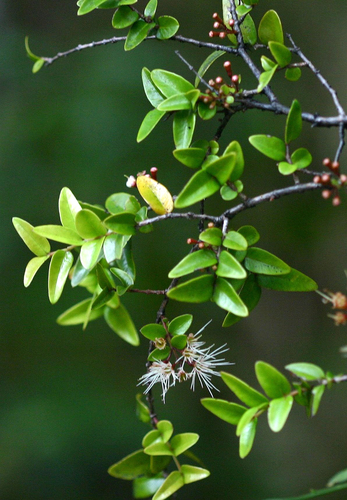
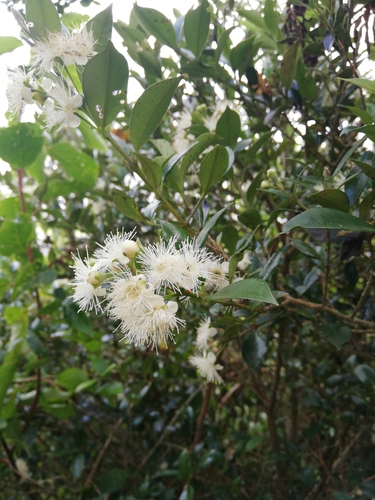
Myrceugenia planipes is an evergreen species that grows as a small tree or shrub, reaching up to 8 meters (26 feet) in height. It has smooth grey bark, and its young shoots are covered in dense hairs. Its leaves are opposite, elliptical, with entire margins, an acuminate apex, and a wedge-shaped to acuminate base. Leaves measure 2.2 to 8 cm long and 1.3 cm wide; the upper leaf surface is glossy green and hairless, while the lower surface is pale green and hairy on young leaves. Petioles are fluted, 2 to 6 mm long, and the midrib is prominent on the underside of the leaf. The flowers of Myrceugenia planipes are hermaphrodite; they grow singly in leaf axils, or clustered in axillary inflorescences of 2 to 3 flowers. There are 4 sepals fused at the base, and 4 free, deciduous white petals. The flowers produce a very large number of stamens, between 120 and 220 per flower, that are 7 to 12 mm long; the style is approximately 5 to 8 mm long. The fruit is a black, sub-globose berry, around 0.8 to 1 cm in diameter, containing 3 to 4 seeds that are 4 to 5 mm long. This species is used in popular medicine as a remedy for skin diseases.