About Myoxocephalus octodecemspinosus (Mitchill, 1814)
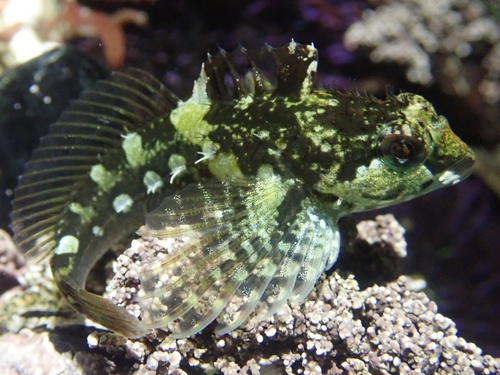
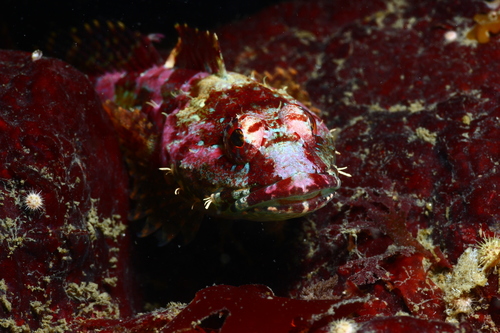
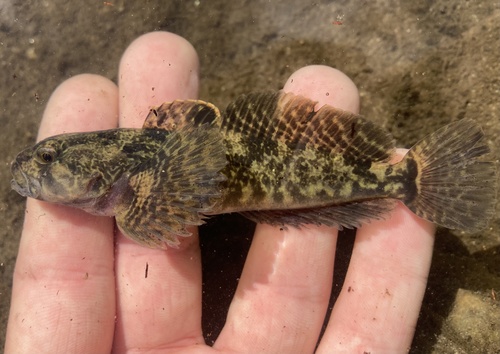
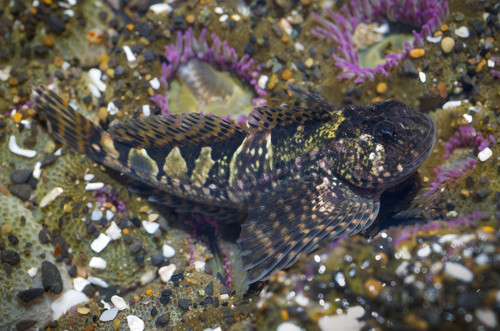
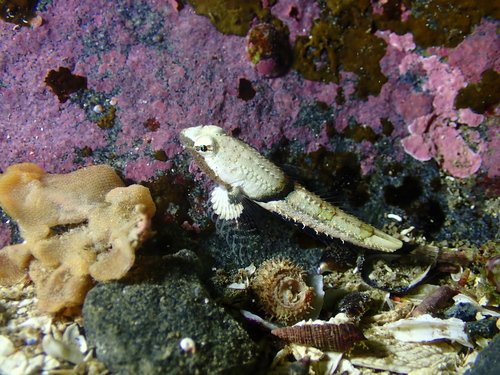
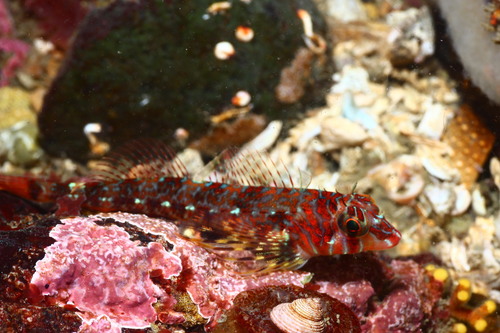
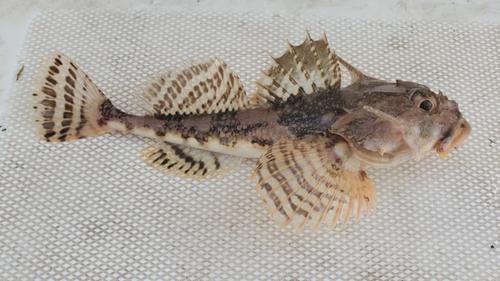
As a member of the Cottidae family, the longhorn sculpin (Myoxocephalus octodecemspinosus) shares the family’s typical body plan. It has an elongated body with very large, fanned pectoral fins that let it rest flat against the benthic seafloor. It also has disproportionately large heads, enlarged fins with prominent spines, a rounded caudal fin suited for its low speed requirements, two separate dorsal fins, and pelvic fins placed in an anterior position. Longhorn sculpin coloration is extremely variable and matches its surrounding environment, as the species relies on cryptic camouflage to avoid detection by matching nearby corals or rocks closely. Despite its scientific name translating roughly to "18-spined", the longhorn sculpin actually has 20 spines on its head. It also has 15 or 16 dorsal rays and 14 anal spines. This species is extremely similar in appearance to the shorthorn sculpin (Myoxocephalus scorpius). The key distinguishing feature giving the longhorn sculpin its common name is its long preopercular spine—the uppermost spine on the cheek—which is approximately four times the length of the spine directly beneath it. This spine is long enough that its tip extends past the fish's gill covers. Among its two dorsal fins, the front-most fin is taller, instead of both fins being roughly the same size. The longhorn sculpin's anal fin originates under the 2nd or 3rd ray of its second dorsal fin, while the shorthorn sculpin's anal fin originates under the 4th or 5th ray of its second dorsal fin. The longhorn sculpin's lateral line is marked by smooth cartilaginous plates, unlike the prickly scales that mark the shorthorn sculpin's lateral line. Overall, the longhorn sculpin has a more slender body and a flatter head than the shorthorn sculpin. The longhorn sculpin is a demersal (bottom-dwelling) species that lives in the temperate waters of the northwest Atlantic Ocean. Its range extends as far north as waters off eastern Newfoundland and the northern Gulf of Saint Lawrence, Canada, at 52°N, and as far south as waters near Virginia, USA, at 36°N. It has been recorded between 77°W inshore and 50°W offshore. It inhabits shallow coastal waters and sometimes uses intertidal zones, but moves to deeper waters during the winter. It is found at depths from 50m to 100m, in water temperatures ranging from 0.5 °C to 19 °C. Adult longhorn sculpins are benthic mesopredator foragers, sitting near the middle of the food web—they eat a wide variety of prey, and are also hunted by many other predators. Adults commonly feed on crustaceans and smaller fishes near the seafloor. They are also opportunistic scavengers, and will feed on discarded mollusc remains when available. This behavior leads them to gather under scalloping boats, where shucked mollusc remains fall to the seafloor. Newly hatched longhorn sculpin larvae feed on various species within zooplankton. Small larvae consume both adult and nauplius forms of copepods, especially Harpactidoid copepods, and they also eat Ostracoda (seed shrimps) and Coscinodiscus diatoms. As larvae grow larger, they stop eating copepod nauplii, though they still feed primarily on adult copepods. At this larger size, they begin eating nauplii of Balanus barnacles and invertebrate eggs. Like many aquatic animals, longhorn sculpins host a wide variety of parasites, including both endoparasites and ectoparasites, which include both unicellular and multicellular types. Leeches attach to longhorn sculpins to feed on their blood. Endoparasites are more common, and include multiple species of Apicomplexa, Protozoa, Nematodes, and Cestodes that infect the fish's digestive tract, gills, blood, and flesh. As a relatively small to medium-sized fish, longhorn sculpins are vulnerable to predation. Their main predators are larger carnivorous fish and seabirds such as Double-crested Cormorants (Nannopterum auritum) and Bald Eagles (Haliaeetus leucocephalus).