About Myotis nattereri (Kuhl, 1817)
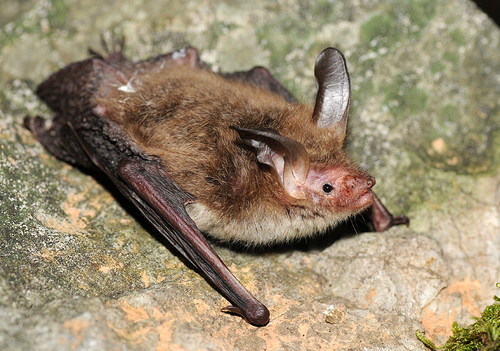
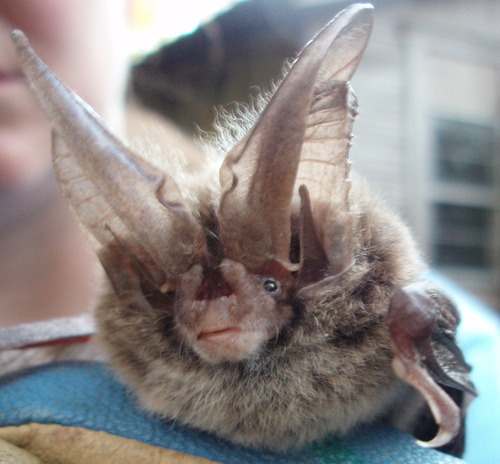
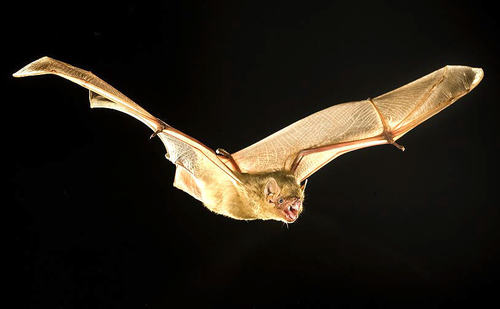
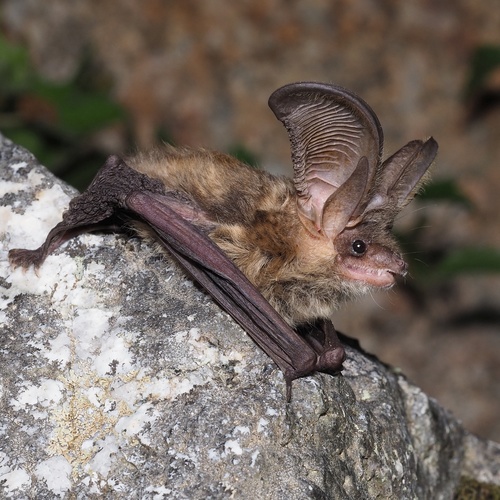
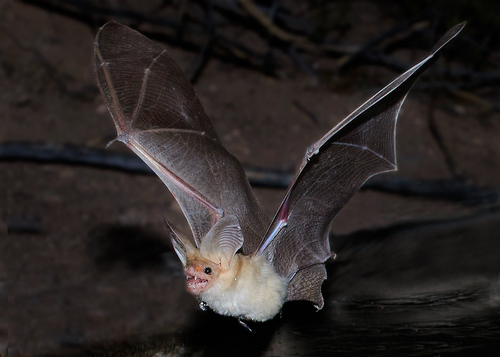
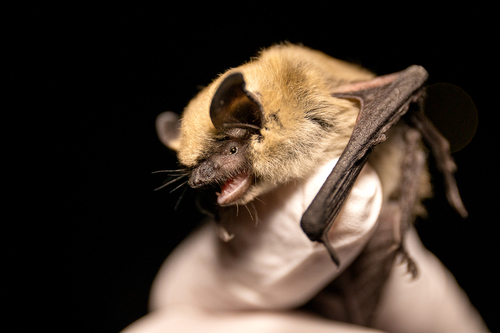
Natterer's bat (Myotis nattereri) is a medium-sized bat. Its head and body length ranges from 44 to 51 mm (1.75 to 2 inches), and its forearm, measured from elbow to wrist, averages 44 mm (1.75 inches). It weighs between 5 and 9.5 grams (0.18 to 0.34 oz). It has short, dense fur: the dorsal (upper) surface of its head and body is greyish-brown, while the ventral (under) surface is whitish-grey. Its ears and wing membranes are smoky grey. It can be told apart from other similar bat species by two key features: the free edge of the interfemoral membrane between its hind limbs is wrinkled and fringed with stiff, curved hairs, and its calcar, a cartilage spur that supports the membrane, is S-shaped. The Natterer's bat species complex has a western Palaearctic distribution, and is native to most of Europe, parts of the Middle East, and parts of northern Africa. To the north, its range reaches southern Sweden, Finland, and western Russia; to the west it reaches Ireland, the United Kingdom, Spain, and Portugal. Eastward, its range extends to Ukraine, western and southwestern Asia Minor, the Levant, the Caucasus region, the Kopet Dag Mountains in Turkmenistan, Iran, and northern Kazakhstan. Its southern limit is Morocco and Algeria, extending as far south as the Atlas Mountains. There are very few records of this species complex from North Africa, so the population there is likely small. Historically, its range included Norway, where it is now considered possibly extirpated. Even though the species complex has a wide overall range, genetic and morphological studies confirm that only "true" Myotis nattereri occur across most temperate zones of Europe and the Balkans. Populations of Natterer's bats native to other regions have already been reclassified into separate species, but despite improved understanding of diversity within the Natterer's bat species complex, some populations in the Middle East have not yet been formally classified. This bat occurs from sea level up to around 2,000 metres (6,600 ft) in elevation. It inhabits forests, parkland, and open countryside with scattered woodland. It roosts in tree hollows, buildings, and nestboxes. In winter, it hibernates in caves, mineshafts, tunnels, and cellars, hiding in cracks and crevices that are usually located near the cave entrance. It is mostly a resident species, and its summer roosts and winter hibernation sites are typically within 120 kilometres (75 mi) of one another.