About Myotis lucifugus (Le Conte, 1831)
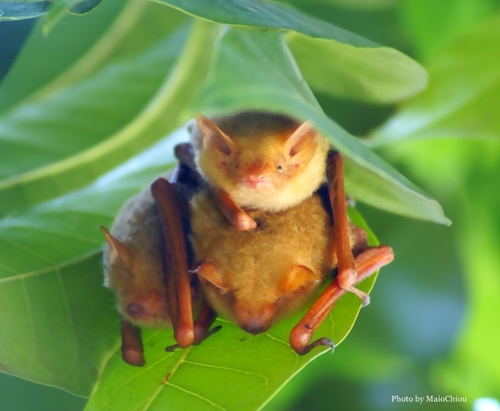
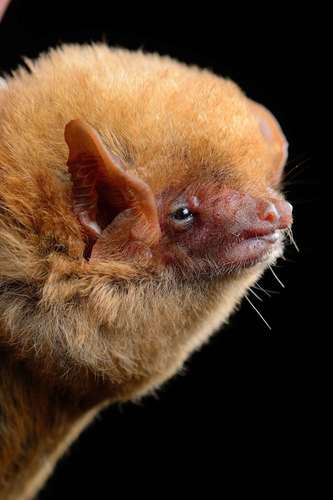
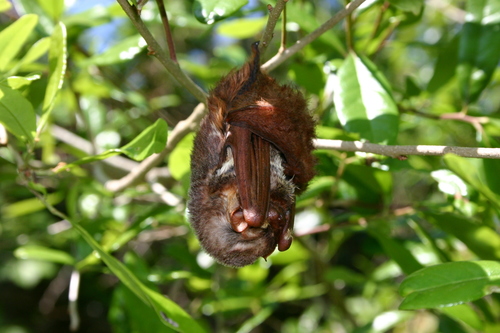
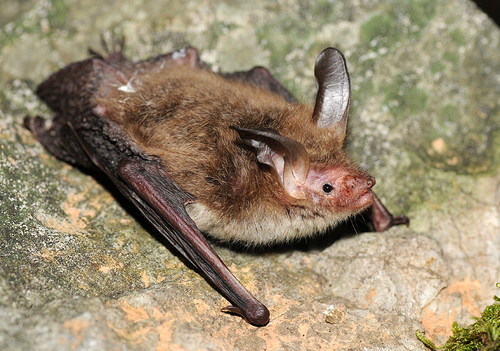
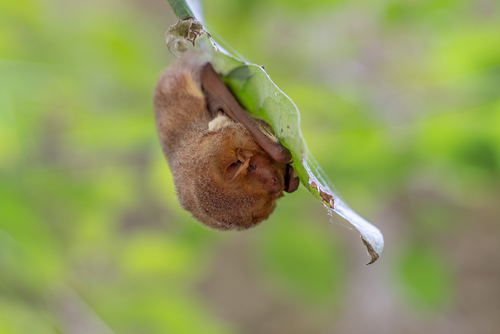
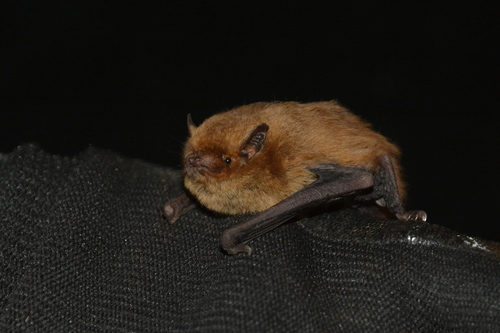
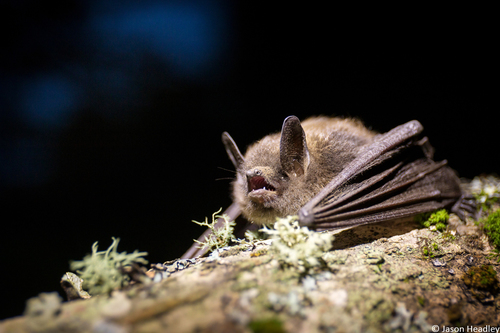
External characteristics of little brown bats (Myotis lucifugus) are as follows. It is a small bat species, with adult individuals weighing 5.5–12.5 g (0.19–0.44 oz) and having a total body length of 8.0–9.5 cm (3.1–3.7 in). Individuals reach their lowest weight in spring, when they emerge from hibernation. Forearm length measures 36–40 mm (1.4–1.6 in), and wingspan ranges from 22.2–26.9 cm (8.7–10.6 in). The species is sexually dimorphic, with females averaging larger than males. Pelage (fur) can display a range of colors, from pale tan or reddish to dark brown. Belly fur is lighter in color than back fur, and the fur has a glossy appearance that is less pronounced on the belly. Multiple pigmentation disorders have been documented in this species, including albinism (total lack of pigment), leucism (partial lack of pigment), and melanism (over-pigmentation). For range and habitat, the little brown bat lives across most of North America. To the north, its range extends west to Alaska and across most of Canada to Labrador. To the south, its range reaches Southern California, and across the northern portions of Arizona and New Mexico. Historically, the largest known aggregations of this species occurred in karstic regions of the Eastern United States. For roosting habitat, the little brown bat roosts in sheltered locations during the day. These roosts can be human-made structures or natural structures such as tree hollows, wood piles, rocky outcrops, or occasionally caves. Tree species used for roosting include quaking aspen, balsam poplar, oak, and maple. The species prefers warm, dark roosts. For maternity colonies, females prefer roosts with temperatures between 23.3–34.4 °C (73.9–93.9 °F). For hibernation habitat, the little brown bat hibernates in caves or abandoned mines. Females migrate up to hundreds of kilometers from their summer ranges to reach these hibernacula. The species prefers hibernacula with relative humidity greater than 90%, ambient temperatures above freezing, and a constant temperature throughout the entire winter. For foraging habitat, the little brown bat forages along the edges of vegetated habitat, and also along the edges of bodies of water or streams. One study conducted in the Canadian province of Alberta found that foraging activity was significantly higher in old-growth forest than would be expected based on the relative availability of this habitat type. In terms of reproduction and life cycle, the little brown bat has a promiscuous mating system, meaning individuals of both sexes mate with multiple partners. It is a seasonal breeder, with mating occurring in the fall before annual hibernation. As a seasonal breeder, males do not produce sperm year-round; spermatogenesis takes place from May through August each year. During spring and summer, males and females roost separately. In the fall, individuals of both sexes gather in the same roost in a behavior called "swarming". Like several other bat species, male little brown bats exhibit homosexual behaviors, mating indiscriminately with torpid roosting bats regardless of the other bat’s sex. Even though copulation happens in fall, fertilization is delayed until spring via sperm storage. Gestation lasts 50–60 days after fertilization, and females give birth to a litter of one pup. At birth, pups weigh approximately 2.2 g (0.078 oz) and have a forearm length shorter than 17.2 mm (0.68 in). Despite their small absolute mass, newborn pups are very large relative to their mother, weighing up to 30% of the mother’s postpartum body weight. Pups are born with closed eyes and ears, but these open within a few hours of birth. They grow rapidly: by around three weeks old, young bats begin to fly, start weaning, and have a forearm length similar to that of adults, though they do not yet match adult weight. Young bats are fully weaned by 26 days old. Females may reach sexual maturity within their first year of life, while males reach sexual maturity in their second year. Relative to its body size, this is a very long-lived species. Wild individuals have been recorded living up to 34 years, while the average lifespan is around 6.5 years. Males and females both have high annual survival rates (probability of surviving an additional year), though these rates vary by sex and region. A colony documented in Ontario had a male survival rate of 81.6% and a female survival rate of 70.8%; a colony in southern Indiana had survival rates of 77.1% for males and 85.7% for females.