About Myotis leibii (Audubon & Bachman, 1842)
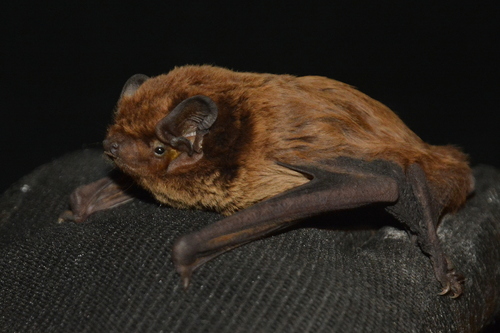
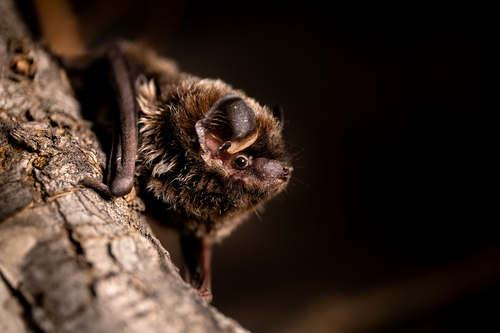
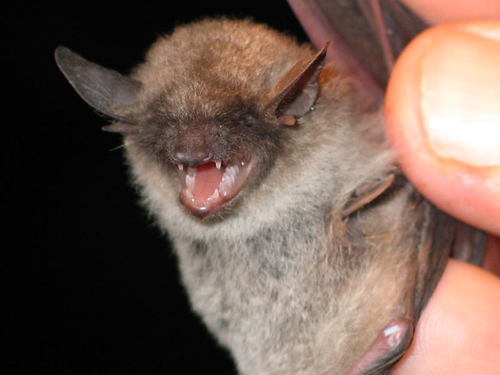
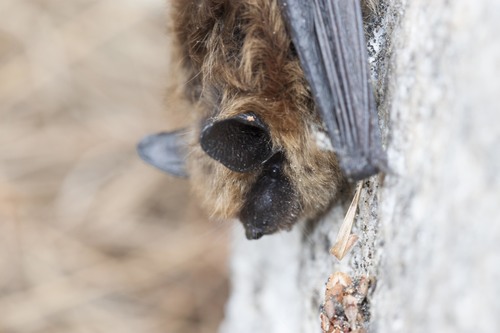
Myotis leibii, commonly called the eastern small-footed bat, measures 65 to 95 millimeters in total length, has a wingspan of 210 to 250 millimeters, and weighs between 4 and 8 grams, with a typical weight of 4.0 to 5.25 grams. This species gets its common name from its very small hind feet, which reach a maximum length of just 8 millimeters. A key identifying trait of this bat is a dark facial "mask" formed by its nearly black ears and muzzle. For most individuals, the ears, wings, and interfemoral membrane (the membrane stretching between the legs and tail) are dark, creating a sharp contrast with the lighter fur covering the rest of the body. The fur on the bat's back is dark at the roots and fades to light brown at the tips, giving the species a characteristic shiny, chestnut-brown appearance. Like all bats, the eastern small-footed bat has a patagium that connects its body to its forelimbs and tail to support flight. Its head is relatively short and flat, with a forehead that slopes gradually away from the rostrum, a feature that separates it from other species in the Myotis genus. It has erect ears that are broad at the base, and a short, flat nose. Like other Myotis species, it has a pointed tragus. It also has a distinctly keeled calcar, a cartilaginous rod on the hind legs that supports the interfemoral membrane. The combination of this keeled calcar and a small forearm (shorter than 34 millimeters) can be used to tell this species apart from all other Myotis found in eastern North America. Its tail measures 25 to 45 millimeters in length and extends past the interfemoral membrane. This species has a dental formula of 2.1.3.3 / 3.1.3.3. Eastern small-footed bats are most easily confused with little brown bats (Myotis lucifugus), especially when an individual's facial mask is less distinct; however, a forearm shorter than 34 millimeters and the presence of a keeled calcar are diagnostic traits that confirm identification.
The species' range extends from northern Arkansas and southern Missouri east to the Appalachian Mountains and Ohio River basin, south into northern Georgia, and north into New England, southern Ontario, and Quebec. Its distribution is scattered across this entire range, and the species is considered uncommon. Eastern small-footed bats are mostly associated with rock formations in deciduous or coniferous forests. Most observations of the species come from mountainous areas between 240 and 1125 meters in elevation, where exposed rock formations are more common, but the species has also been recorded at rocky sites at lower elevations. During spring, summer, and autumn, they roost primarily at exposed rock outcrops such as cliffs, bluffs, shale barrens, and talus slopes, but they also roost in man-made structures including buildings, joints between segments of cement guard rails, turnpike tunnels, road cuts, and riprap-covered dams. The largest known populations of Myotis leibii are found in New York, Pennsylvania, West Virginia, and western Virginia. The total number of recorded individuals across all known hibernacula is only 3,000, with roughly 60% of this total coming from just two sites in New York.
Like many other bat species, the eastern small-footed bat typically produces only one offspring per year, though a small number of twin births have been recorded. This k-selected reproductive strategy means its populations cannot withstand high mortality rates, making the species especially vulnerable to sudden population declines. Mating most often occurs in autumn, and females store male sperm through winter hibernation. Fertilization takes place in spring once females become active again, gestation lasts between 50 and 60 days, and pups are born in late May and early June. Mating has also been recorded during hibernation when individuals are awake. During the breeding season, large numbers of bats gather in a behavior called "swarming". All bats in this genus are polyandrous, meaning individuals mate with multiple partners over the mating period. This mating behavior increases the likelihood of successful copulation, and thus improves reproductive success.
Males initiate copulation by mounting the female and tilting her head back to nearly a perpendicular angle. The male secures his position by biting and pulling back the hairs at the base of the female's skull. He then uses his thumbs to further stabilize his position, and enters the female under her interfemoral membrane with his penis, which is stabilized by its baculum. Both individuals have been observed to be very quiet during copulation. Once copulation is complete, the male dismounts and flies away to find another mate. Newborn bats, called pups, weigh 20 to 35% of their mother's body weight and are completely dependent on their mother. The young's large body size is thought to require high energy expenditure from the mother, which is why females are limited to producing one offspring per year. Adult males and females may use the same rock outcrops, but as is typical for other bats in this genus, the sexes usually roost separately from one another. In Virginia, both sexes generally roost alone or occasionally in pairs, except that females gather into maternity groups around the time pups are born and typically maintain these "maternity colonies" until pups are weaned. The size of these maternity colonies has not been well studied, but they appear to form smaller groups than other bats in the Myotis genus.