About Myosotis rakiura L.B.Moore
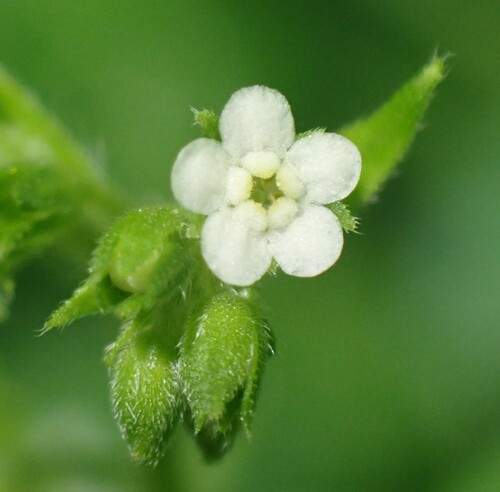
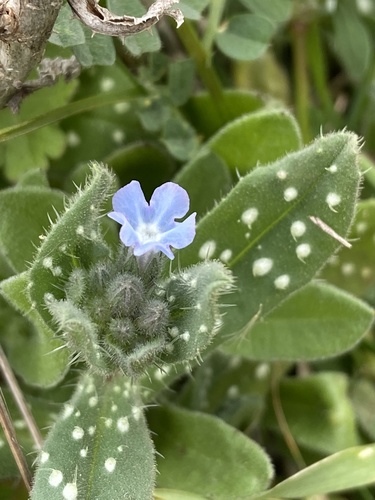
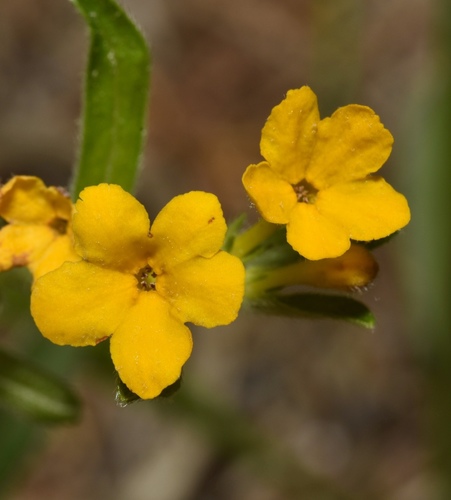
Myosotis rakiura plants grow as individual rosettes that often cluster together to form loose tufts or clumps. The rosette leaves have petioles between 5 and 40 mm long. Their leaf blades measure 19–62 mm long by 7–21 mm wide, with a length-to-width ratio of 2.0–5.3:1. The blades are oblanceolate, or sometimes narrowly ovate, are widest at or above the middle (rarely below the middle), and have an obtuse apex. The upper leaf surface is densely covered in mostly flexuous, patent to erect, forward-facing (antrorse) hairs that grow at an oblique angle to the mid vein. Hairs on the leaf edges are similar but mostly erect, while hairs on the leaf underside are also similar but mostly backward-facing (retrorse) and appressed to patent. Each rosette produces 1 to 10 erect, once- or twice-branched, bractless (ebracteate) inflorescences that can grow up to 300 mm long, and split into a forked V-shape near their tips. Cauline leaves are similar in shape to rosette leaves but smaller, with shorter petioles, and decrease in size towards the inflorescence tip. Each inflorescence holds up to 210 flowers, each borne on a pedicel that reaches up to 4 mm long when fruiting, with no bract. The calyx is 3–5 mm long when flowering and grows to 3–7 mm long when fruiting. It is lobed to between half and three-quarters of its total length, and is densely covered in mostly antrorse (with some retrorse hairs near the base), patent to erect, mostly flexuous hairs. The corolla is white, up to 9 mm in diameter, with a cylindrical tube, obovate, broadly obovate or very broadly obovate petals, and small yellow scales that alternate with the petals. The anthers are fully extended out above the scales. The four smooth, shiny, medium to dark brown nutlets are 1.5–2.0 mm long by 0.9–1.4 mm wide and ovoid in shape. The chromosome number of Myosotis rakiura is unknown, and its pollen characteristics are also unknown. It flowers from November to February and fruits from July to April, with the main flowering and fruiting period falling between December and January. Myosotis rakiura is a forget-me-not endemic to coastal southern New Zealand. It is found specifically in Otago and Southland on the South Island, Stewart Island/Rakiura, and Solander Island/Hautere, at elevations between 0 and 130 m above sea level. It grows on coastal cliffs and rocks, and within shrubland, turf, or grassland.