About Myosotis brevis de Lange & Barkla
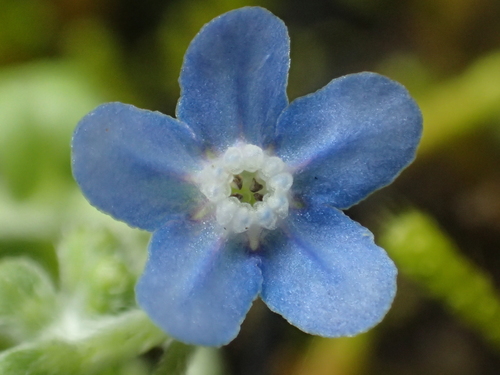
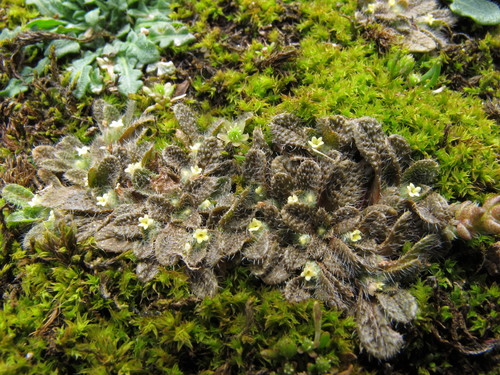
Myosotis brevis de Lange & Barkla plants grow as single rosettes. The rosette leaves have petioles 1 to 7 millimeters long. The rosette leaf blades measure 1–9 mm long by 1–4 mm wide, with a length-to-width ratio of 1.2–2.5:1. They are shaped from narrowly oblanceolate to broadly obovate, are widest at or above the middle, range in color from green to brown, and have an obtuse apex, which is occasionally acute. The upper leaf surface is densely covered in flexuous, appressed to erect, forward-facing (antrorse) hairs. The lower leaf surface has the same hair type, but far fewer hairs, ranging from hairless (glabrous) to sparsely haired. Each rosette produces multiple prostrate, bracteate inflorescences that can grow up to 5 cm long. The cauline leaves are similar in size and shape to the rosette leaves, and become sessile closer to the tip of the inflorescence. Each inflorescence holds up to 17 flowers, each of which grows on a very short pedicel and has an associated bract. The calyx is 1–2 mm long when flowering, growing to 2–4 mm long when fruiting, and is lobed to one-third or two-thirds of its total length. Calyx hairs are more densely distributed on the calyx ribs, and may sometimes be of two different lengths and types. The corolla may be white, cream, pale blue, or blue-striped, and is up to 2 mm in diameter. It has a cylindrical tube, and small yellow scales that alternate with the petals. The anthers are very short, usually less than 0.3 mm long, and are fully contained within the corolla tube. The four smooth, shiny nutlets are ovoid shaped, and are usually 0.9–1.2 mm long by 0.5–0.8 mm wide. M. brevis has the distinctive M. discolor pollen type, which sets it apart from all other bracteate-prostrate Myosotis species in New Zealand. This species flowers from September to April and fruits from October to April, with peak flowering and fruiting occurring between October and December. Myosotis brevis is a forget-me-not endemic to New Zealand. It is found in coastal areas of the North Island (Taranaki, Southern North Island) and mountainous areas of Canterbury and Otago in the South Island, at elevations ranging from 0 to 1900 m above sea level. In the North Island, M. brevis grows in herb fields, turfs and gravels on coastal cliffs, platforms and beaches. In Canterbury, it is found along the edges of seasonally inundated tarns. In Otago, it occurs in exposed, dry to seasonally moist alpine fellfield, pasture or turf.