About Myosotis antarctica Hook.fil.
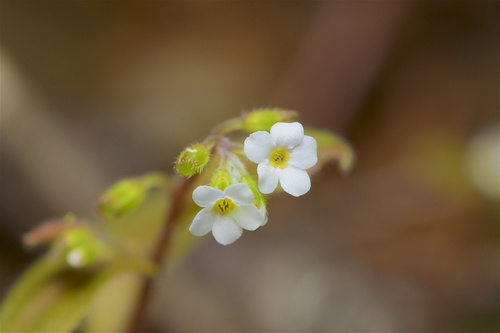
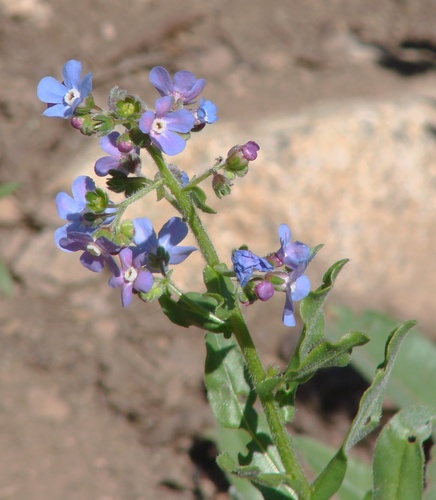
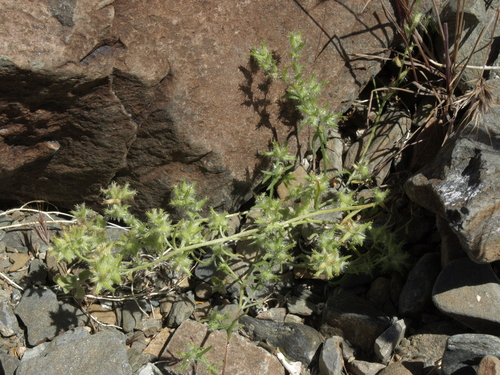
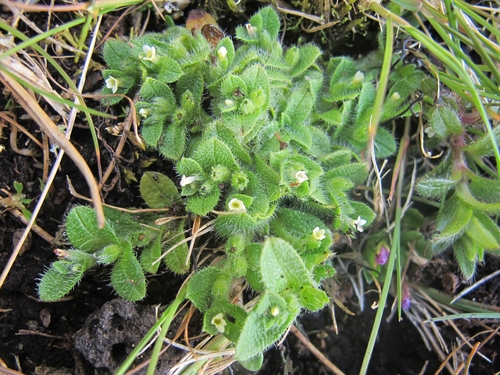
Myosotis antarctica Hook.fil. plants grow as single rosettes. The rosette leaves have petioles that measure 1–20 mm in length. Their leaf blades are 3–26 mm long and 1–11 mm wide, with a length to width ratio that is usually 1.0–4.0:1. The blades range in shape from narrowly oblanceolate to very broadly obovate, are widest at or above the middle, are green or brown, and have an obtuse apex. The upper leaf surface is densely covered in evenly distributed, forward-facing (antrorse) hairs that are curved or flexuous, and range from spreading to erect. The lower leaf surface has a similar hair type, but has fewer hairs, ranging from completely hairless (glabrous) to sparsely distributed hairs. Hairs on the leaf edges are appressed to spreading. Each rosette produces multiple prostrate, bracteate inflorescences that are usually up to 15 cm long, and rarely reach up to 31 cm long. The cauline leaves are similar in size and shape to the rosette leaves, and are usually sessile. Each inflorescence can hold up to 46 flowers; each flower grows on a very short pedicel, and is accompanied by a bract. The calyx is 1–4 mm long during flowering and 2–7 mm long during fruiting, is lobed to between one-third and three-quarters of its total length, and has hairs that sometimes occur in two different lengths and types. The corolla is white, cream, or blue, and reaches up to 4 mm in diameter. It has a cylindrical tube, with small yellow scales that alternate with the petals. The anthers are very short, usually less than 0.3 mm long, and are fully included inside the corolla tube. The four smooth, shiny nutlets are usually 1.2–1.9 mm long by 0.8–1.2 mm wide, and are ovoid in shape. The chromosome number of Myosotis antarctica is unknown, and its pollen is of the australis type. It flowers from August to April and fruits from September to April, with peak flowering and fruiting occurring from December to January. Myosotis antarctica is a forget-me-not native to New Zealand, Campbell Island, and southern Chile (Magallanes), where it grows at elevations from 0 to 2200 m above sea level. In mainland New Zealand, it occurs in the North Island (Auckland, Taranaki, Gisborne, Volcanic Plateau, Southern North Island), South Island (Western Nelson, Sounds-Nelson, Marlborough, Westland, Canterbury, Otago, Southland, Fiordland), and Stewart Island/Rakiura. It can be found in habitats ranging from coastal to subalpine, including turfs, dunes, fellfields, scree, cliff faces, and terraces.