About Myoporum sandwicense (A.DC.) A.Gray
Myoporum sandwicense, also commonly known as naio, can grow as a small tree, large tree, or dwarf shrub, with its growth form determined by elevation and growing conditions. Small tree specimens reach 9 meters (30 ft) in height, with a trunk diameter of 0.3 meters (0.98 ft). The largest naio grow to 18 meters (59 ft) tall, with trunk diameters up to 0.9 meters (3.0 ft). At the tree line, naio forms a 0.6-meter (2.0 ft) tall shrub. The bark of older Myoporum sandwicense specimens is typically dark, rough, and furrowed.
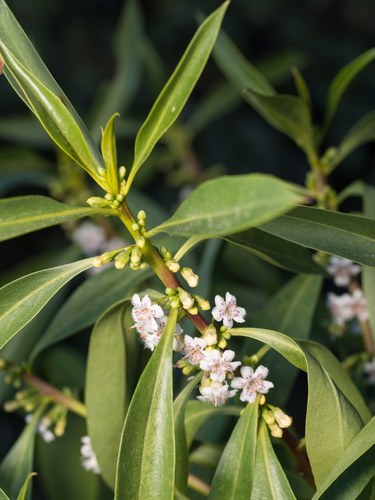
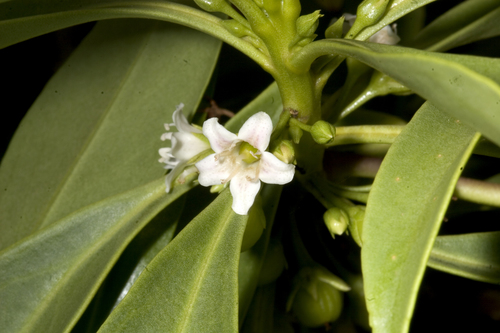
Its leaves are arranged alternately, usually crowded close to the ends of stems. Most leaves measure 60–135 millimeters (2–5 in) long and 11–25 millimeters (0.4–1 in) wide, shaped elliptic to lance, and have a distinct mid-vein on the lower leaf surface. Flowers grow year-round, in groups of 2 to 6 in leaf axils on stalks 4.5–18 millimeters (0.2–0.7 in) long. Flowers have a tubular bell shape and a fragrant scent, with 5 lance-shaped sepals and 5 petals that form the floral tube. The tube is most often white or pink, with darker blotches at the base of the petal lobes. The tube is 1.5–3.5 millimeters (0.06–0.1 in) long, and the petal lobes are roughly the same length as the tube. The fruit is a waxy white drupe 8 millimeters (0.31 in) in diameter, which is juicy and bitter-tasting. Fruits typically dry out and stay attached to the branch.
In the United States, the distribution of M. sandwicense is restricted to the state of Hawaiʻi. Within Hawaiʻi, it grows on all major islands at elevations ranging from sea level to 2,380 meters (7,810 ft). Naio grows in a wide range of habitats, including low shrublands, dry forests, mesic forests, and wet forests, but it is most common in subalpine shrublands.
The finely-textured wood of M. sandwicense is hard and has a specific gravity of 0.55. Native Hawaiians, who called this wood ʻaʻaka, used it to carve manu, the ornamental end pieces for the bow and stern of outrigger canoes, pale, the gunwales of waʻa (outrigger canoes), pou (house posts), haha ka ʻupena (fishing net spacers), and lamalama (long-burning torches used for night fishing). Due to its similarity in scent when burned, the oily wood was also used as a substitute for ʻiliahi (Santalum spp.). After most ʻIliahi (Santalum freycinetianum) were harvested, naio was briefly exported to China during the 19th century, where it was processed into incense and burned in Joss houses.